


The murkiness of memory that has obscured Taiwan’s White Terror period was captured by A Foggy Tale (大濛), which scooped four gongs at the 62nd Golden Horse Awards in November. The film depicts a girl’s journey to claim the remains of her older brother — executed by the Chinese Nationalist Party (KMT) government.
Literally nebulous, the fog motif was multivalent, denoting the historical haze and also the oppressive clouds looming over Taiwanese society during this period.
Extending the metaphor, director Chen Yu-hun (陳玉勳) compares the victims to evaporated clouds. Unlike clouds, though, which remain part of a dynamic cycle, traces of Taiwan’s lost generation did not resurface for decades.
“They really were just a fog,” Chen told the independent online media outlet The Reporter. “Once it dissipated, they left nothing behind. I always felt that someone should at least commemorate them, so I made this movie.”
Kaori Lin’s (賴香吟) focus in this delicate trio of tales is different. In a twist on Hannah Arendt’s phrase, “the banality of evil,” the protagonists of these long short stories reflect the mundane cruelty of the KMT system.
As James Lin notes in his introduction, this “is enacted not only through violence but also through constraints, uncertainties, and limits on daily lives.”
One is reminded of classic depictions of Soviet repression — Aleksandr Solzhenitsyn’s The Gulag Archipelago, Leonid Borodin’s The Story of a Strange Time, Vassily Grossman’s Life and Fate, though the latent violence in Lin’s narratives is often perceptible only to readers who know where to look.
Closer to home, stories in Transitions in Taiwan (reviewed in Taipei Times, Oct. 14, 2021) another collection focused on this era, adopt a similar show-don’t-tell approach.
Each instalment in Portraits in White follows an individual from childhood to old age, starting with Mr. Ch’ing Chih, whose life exemplifies the pervasive, silent dread. Despite his humble, native Taiwanese background, he ascends to the status of political warfare officer, during national service, spending hours drilling dogma based on Sun Yat-sen’s (孫逸仙) Three Principles of the People and the wisdom of “the Leader,” a lurking, apotheosized presence — uppercased throughout the text.
JOY AND PROFUNDITY
At one stage, Ch’ing Chih meets the Leader, leaving him petrified as he struggles to decode the latter’s heavily accented Mandarin. The anxiety is compounded after a handshake with “the Great Man” has Ch’ing-chih wondering whether the sweat on his palm is his own.
“Oh no, it had to be from his. What was he thinking? He mustn’t lose his life over wild thoughts.”
Self-policing of language and thought vie for control of Chi’ing Chih’s soul with instinctive artistic sensibilities — the Bible, the poetry and essays of Yeh Shan (葉珊), better known as Yang Mu (楊牧), lines of verse published in the dangwai (“outside the party” 黨外) magazine Formosa (美麗島).
These texts come via his ill-fated childhood friend Chang Kuang-ming, and while Ch’ing Chih grasps at their symbolism, entranced by Chang’s infectious joy, he intuits their profundity.
In the latter case, Ch'ing Chih "didn't dare continue reading" a simple ode to the beauty of Taiwan, and even the source of the words remains unspoken, inferred only by juxtaposition to the Kaohsiung Incident, which involved key figures behind the publication, or Lin’s introductory clarification.
“Unprompted by any outside force, his fear of potential repercussions is enough to stop him,” Lin writes.
The oblique references to incidents and people in the story of Ms. Casey, a lukewarm dissident in self-imposed exile, in Paris and Berlin (where Lin is based), create a similar sense of trepidation.
REDISCOVERING TAIWANESENESS
The identity of that most famous emigre activist Peng Ming-min (彭明敏) is confirmed only by news of a daring escape to Sweden by “Mr. Peng,” as if the utterance of his full name might conjure a reverse Candyman hex, disappearing the speaker.
Reflections on the Taiwanese diaspora’s role in identity formation and the fight for freedom fill these pages.
The irony is evident in Casey rediscovering her Taiwaneseness through the Hoklo songs of Chi Lu-hsia (紀露霞) that she had not heard since childhood. (James Lin mistakenly writes that this was Casey’s first time hearing a Taiwanese song, but the point holds.)
Likewise, the obsession of Wen-hui, the elderly lead of the second novella, with movie actress Chang Mei-yao (張美瑤) whose Indian summer as a soap star coincides with the protagonist’s dotage, is a search for lost time and “a new focus in life” for someone who was left behind.
Finally rejecting the epithet "obasan" that she has endured for years — a reminder of how her “fractured Mandarin” and incomprehension of political change prevented her adapting to the KMT era — she demands to be called Fumie, the Japanese name she shares with her film idol.
In the parallel arcs of the two women’s journeys — the comeback of a presumed has-been with the stagnation of a never-was — there is a whiff of the doppelganger.
PRODUCT OF ENVIRONMENT
Among the other motifs that resonate is Ch’ing Chih’s notion that his generation was shackled by circumstance, their fate molded not just by their elders but “more to the point their environment, “ which “as they grew older, they’d realize … was harder to fight.”
Later, Ch’ing Chih reflects that blaming God or environment is pointless. “Born into this unfortunate era, we must thrust out our chests to meet the trying test of the times,” he says. “Even if you want to back off, to evade, you simply can’t do it.”
With Chang, he shares “aspirations and a sense of insignificance, owing to the time and place of their birth.”
Approaching middle age, he concludes that, rather than learning from him, his children “were in fact taught by the times.” His uncle says the same of his own generation: Environment “determined everything.”
This fatalism is reflected in the book’s title. Most obviously, it alludes to the White Terror itself, perhaps to pale obfuscating mist, too. But there is something else here: the absence of color, characters drained of vigor, then left as empty silhouettes, hollowed-out, half-finished outlines. There is also the white of death and, yet with it, purity and the possibility of rebirth.
Envisaging how he will arouse his old pal Kuang-ming from the stupor that has consumed him, Ch’ing-chih runs through an internal monologue: “Some lives are brighter than the sun, more pristine than the white snow.”
It is surely no coincidence that the characters for Kuang-ming’s (光明) name in the original Chinese suggest a brighter future, just as Casey’s hazy perception of autumn sunrays through the window of the doctor’s waiting room hold the hope of emergence from a “white, murky” past.
“World affairs are always entangled but the world is always beautiful,” she reflects. “Not to see it would be such a pity.”
Recently the Chinese Nationalist Party (KMT) and its Mini-Me partner in the legislature, the Taiwan People’s Party (TPP), have been arguing that construction of chip fabs in the US by Taiwan Semiconductor Manufacturing Co (TSMC, 台積電) is little more than stripping Taiwan of its assets. For example, KMT Legislative Caucus First Deputy Secretary-General Lin Pei-hsiang (林沛祥) in January said that “This is not ‘reciprocal cooperation’ ... but a substantial hollowing out of our country.” Similarly, former TPP Chair Ko Wen-je (柯文哲) contended it constitutes “selling Taiwan out to the United States.” The two pro-China parties are proposing a bill that

Institutions signalling a fresh beginning and new spirit often adopt new slogans, symbols and marketing materials, and the Chinese Nationalist Party (KMT) is no exception. Cheng Li-wun (鄭麗文), soon after taking office as KMT chair, released a new slogan that plays on the party’s acronym: “Kind Mindfulness Team.” The party recently released a graphic prominently featuring the red, white and blue of the flag with a Chinese slogan “establishing peace, blessings and fortune marching forth” (締造和平,幸福前行). One part of the graphic also features two hands in blue and white grasping olive branches in a stylized shape of Taiwan. Bonus points for
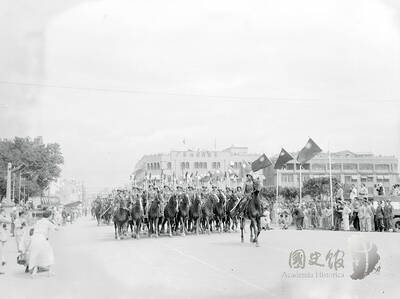
March 9 to March 15 “This land produced no horses,” Qing Dynasty envoy Yu Yung-ho (郁永河) observed when he visited Taiwan in 1697. He didn’t mean that there were no horses at all; it was just difficult to transport them across the sea and raise them in the hot and humid climate. “Although 10,000 soldiers were stationed here, the camps had fewer than 1,000 horses,” Yu added. Starting from the Dutch in the 1600s, each foreign regime brought horses to Taiwan. But they remained rare animals, typically only owned by the government or
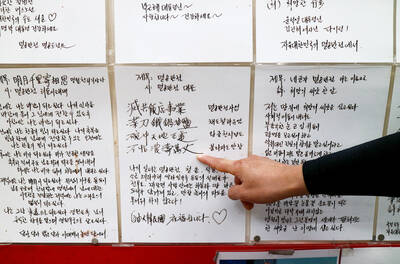
“M yeolgong jajangmyeon (anti-communism zhajiangmian, 滅共炸醬麵), let’s all shout together — myeolgong!” a chef at a Chinese restaurant in Dongtan, located about 35km south of Seoul, South Korea, calls out before serving a bowl of Korean-style zhajiangmian —black bean noodles. Diners repeat the phrase before tucking in. This political-themed restaurant, named Myeolgong Banjeom (滅共飯館, “anti-communism restaurant”), is operated by a single person and does not take reservations; therefore long queues form regularly outside, and most customers appear sympathetic to its political theme. Photos of conservative public figures hang on the walls, alongside political slogans and poems written in Chinese characters; South


 RSS
RSS