


It plays a little loose with facts but the righteous rage of Dog Day Afternoon is present enough in Gus Van Sant’s Dead Man’s Wire, a based-on-a-true-tale hostage thriller that’s as deeply 1970s as it is contemporary.
In February 1977, Tony Kiritsis walked into the Meridian Mortgage Company in downtown Indianapolis and took one of its executives, Dick Hall, hostage. Kiritsis held a sawed-off shotgun to the back of Hall’s head and draped a wire around his neck that connected to the gun. If he moved too much, he would die.
The subsequent standoff moved to Kiritsis’ apartment and eventually concluded in a live televised news conference. The whole ordeal received some renewed attention in a 2022 podcast dramatization starring Jon Hamm.
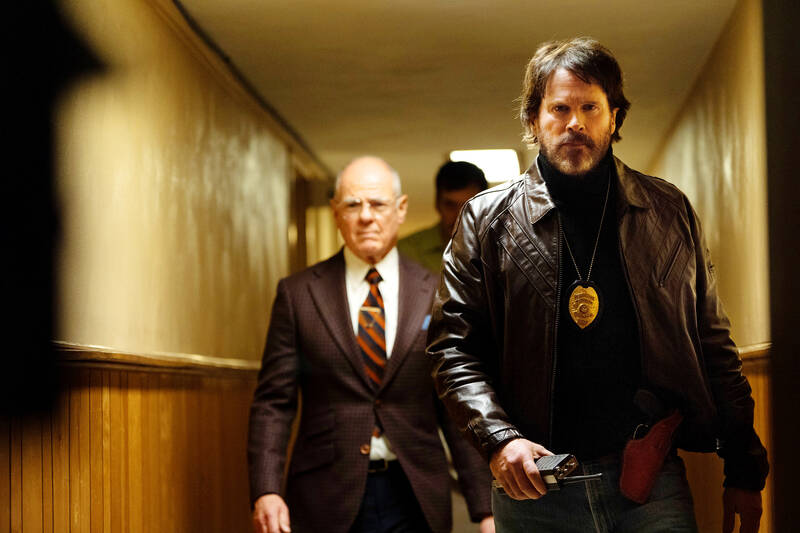
Photo: AP
But in Dead Man’s Wire, starring Bill Skarsgard as Kiritsis, these events are vividly brought to life by Van Sant. It’s been seven years since Van Sant directed, following 2018’s Don’t Worry, He Won’t Get Far on Foot, and one of the prevailing takeaways of his new film is that that’s too long of a break for a filmmaker of Van Sant’s caliber.
Working from a script by Austin Kolodney, the filmmaker of My Own Private Idaho and Good Will Hunting turns Dead Man’s Wire into not a period-piece time capsule but a bracingly relevant drama of outrage and inequality. Tony feels aggrieved by his mortgage company over a land deal the bank, he claims, blocked. We’re never given many specifics, but at the same time, there’s little doubt in Dead Man’s Wire that Tony’s cause is just. His means might be desperate and abhorrent, but the movie is very definitely on his side.
That’s owed significantly to Skarsgard, who gives one of his finest and least adorned performances. While best known for films like It, The Crow and Nosferatu, here Skarsgard has little more than some green polyester and a very ’70s mustache to alter his looks. The straightforward, jittery intensity of his performance propels Dead Man’s Wire.
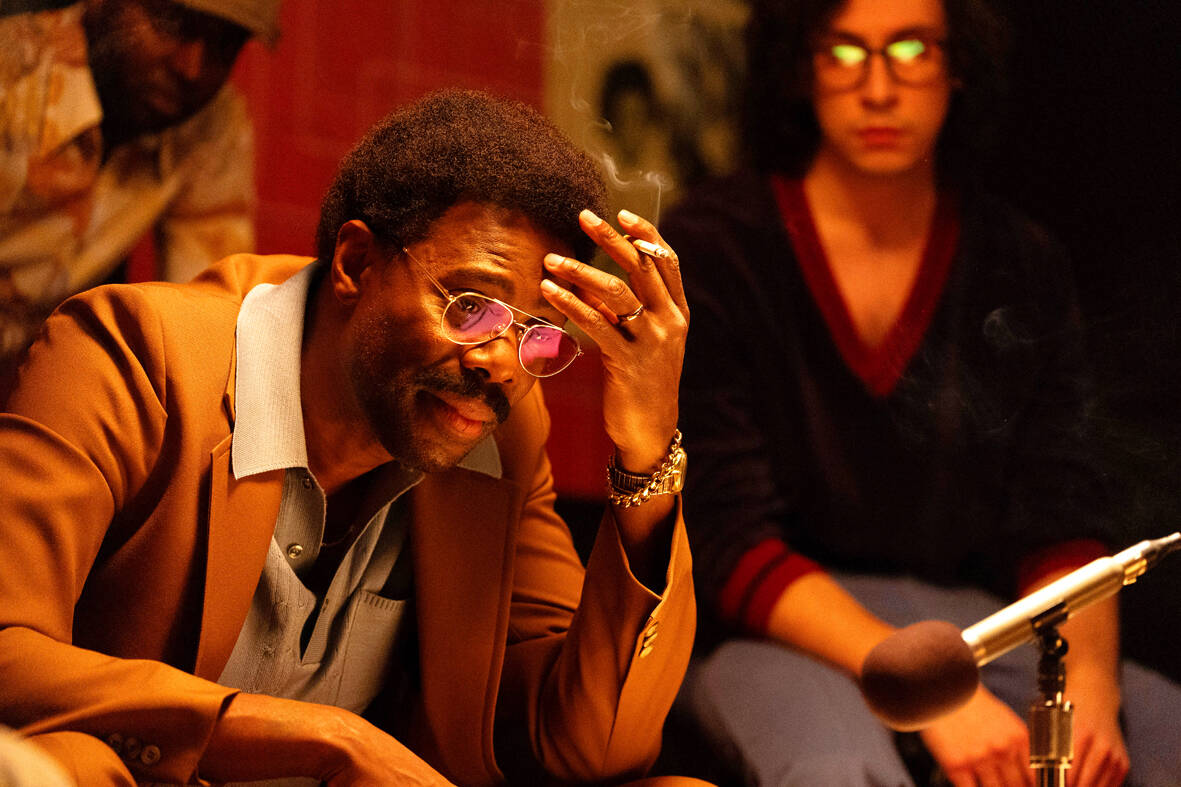
Photo: AP
Yet Van Sant’s film aspires to be a larger ensemble drama, which it only partially succeeds at. Tony’s plight is far from a solitary one, as numerous threads suggest in Kolodney’s fast-paced script. First and foremost is Colman Domingo as a local DJ named Fred Temple. (If ever there were an actor suited, with a smooth baritone, to play a ’70s radio DJ, it’s Domingo.) Tony, a fan, calls Fred to air his demands. But it’s not just a media outlet for him. Fred touts himself as “the voice of the people.”
Something similar could be said of Tony, who rapidly emerges as a kind of folk hero. As much as he tortures his hostage (a very good Dacre Montgomery), he’s kind to the police officers surrounding him. And as he and Dick spend more time together, Dick emerges as a kind of victim, himself. It’s his father’s bank, and when Tony gets M.L. Hall (Al Pacino) on the phone, he sounds painfully insensitive, sooner ready to sacrifice his son than acknowledge any wrongdoing.
Pacino’s presence in Dead Man’s Wire is a nod to Dog Day Afternoon, a movie that may be far better — but, then again, that’s true of most films in comparison to Sidney Lumet’s unsurpassed 1975 classic. Still, Van Sant’s film bears some of the same rage and disillusionment with the meatgrinder of capitalism as Dog Day.
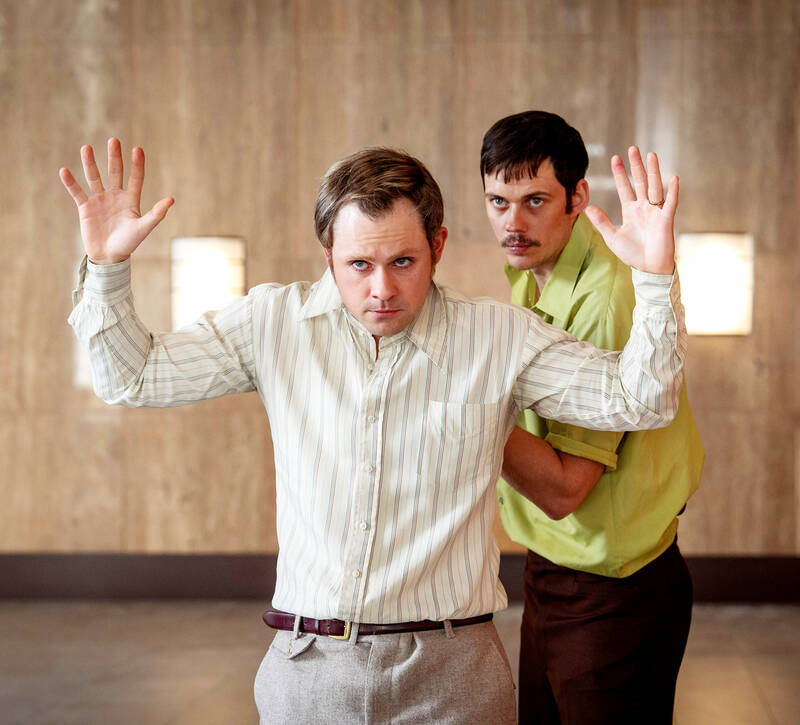
Photo: AP
There’s also a telling, if not entirely successful subplot of a local TV news reporter (Myha’la) struggling against stereotypes. Even when she gets the goods on the unspooling news story, the way her producer says to “chop it up” and put it on air makes it clear: Whatever Tony is rebelling against, it’s him, not his plight, that will be served up on a prime-time plate.
It doesn’t take recent similar cases of national fascination, such as Luigi Mangione, charged with killing a healthcare executive, to see contemporary echoes of Kiritsis’ tale. The real story is more complicated and less metaphor-ready, of course, than the movie, which detracts some from the film’s gritty sense of verisimilitude. Staying closer to the truth might have produced a more dynamic movie.
But Dead Man’s Wire still works. In the film, Tony’s demands are US$5 million and an apology. It’s clear the latter means more to him than the money. The tragedy in Dead Man’s Wire is just how elusive “I’m sorry” can be.

If one asks Taiwanese why house prices are so high or why the nation is so built up or why certain policies cannot be carried out, one common answer is that “Taiwan is too small.” This is actually true, though not in the way people think. The National Property Administration (NPA), responsible for tracking and managing the government’s real estate assets, maintains statistics on how much land the government owns. As of the end of last year, land for official use constituted 293,655 hectares, for public use 1,732,513 hectares, for non-public use 216,972 hectares and for state enterprises 34 hectares, yielding

The small platform at Duoliang Train Station in Taitung County’s Taimali Township (太麻里) served villagers from 1992 to 2006, but was eventually shut down due to lack of use. Just 10 years later, the abandoned train station had become widely known as the most beautiful station in Taiwan, and visitors were so frequent that the village had to start restricting traffic. Nowadays, Duoliang Village (多良) is known as a bit of a tourist trap, with a mandatory, albeit modest, admission fee of NT$10 giving access to a crowded lane of vendors with a mediocre view of the ocean and the trains

The March/April volume of Foreign Affairs, long a purveyor of pro-China pablum, offered up another irksome Beijing-speak on the issues and solutions for the problems vexing the People’s Republic of China (PRC) and the US: “America and China at the Edge of Ruin: A Last Chance to Step Back From the Brink” rang the provocative title, by David M. Lampton and Wang Jisi (王緝思). If one ever wants to describe what went wrong with US-PRC relations, the career of Wang Jisi is a good place to start. Wang has extensive experience in the US and the West. He was a visiting

One of the challenges with the sheer availability of food in today’s world is that lots of us end up spending many of our waking hours eating. Whether it’s full meals, snacks or desserts, scientists have found that it’s not uncommon for us to be mindlessly grazing at some point during all of our 16 or so waking hours. The problem? As soon as this food hits the bloodstream in the form of glucose, it initiates the release of the hormone insulin. This in turn activates a switch present in every one of our cells, which is responsible for driving cell


 RSS
RSS