


With Taiwan getting unprecedented levels of press over the past few years, it’s hard not to feel that there has been a fair amount of bandwagon-jumping amid the slew of books that has appeared.
At first glance, this novel by veteran BBC journalist Frank Gardner could certainly appear opportunistic — the stark one word title emblazoned uppercase across a cover designed to resemble the flag of the People’s Republic of China (PRC), fighter jets swirling around the points of the huge central star, a shadowy (presumably Taiwanese) mountain range in the background and the ominous silhouette of an aircraft carrier below communicate shallow sensationalism.
Yet, Gardner has paid his dues. As the BBC’s security correspondent since 2002, he has reported from all corners of the world. In 2004, he was paralysed from the waist down after being shot multiple times by terrorists while filming in Saudi Arabia. His cameraman was killed during the attack.
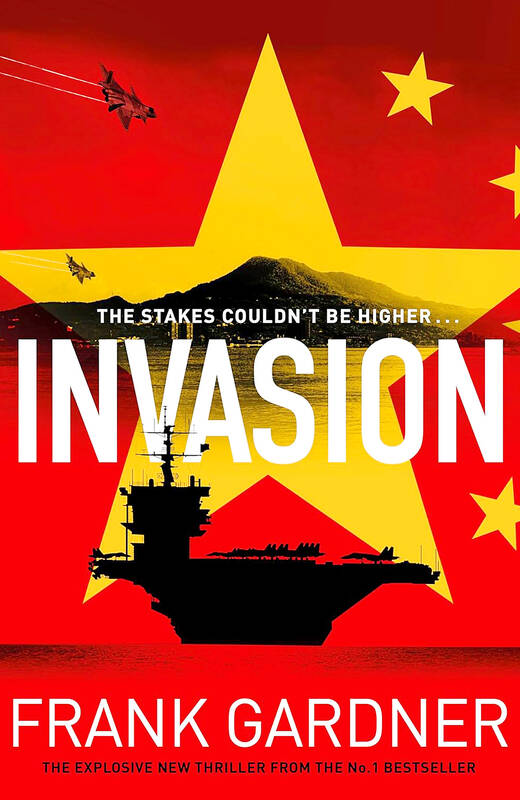
Invasion , by Frank Gardner.
A fluent Arabic speaker, his area of expertise is the Middle East, but he has spent enough time reporting on China, particularly on its military buildup and — most recently — Beijing’s race to upgrade its Dongfeng (DF) hypersonic missiles.
Those weapons feature prominently in this latest instalment from a series of thrillers featuring former ex-commando Luke Carlton as protagonist and, while this may be bestselling fiction, the ominous capabilities of the DF projectiles and the fact that Beijing (and Moscow) have pulled ahead of the US in the development of this technology are attested to in Gardner’s journalism.
This, alone, makes the passages of this novel that deal with China’s deployment of weapons and miliary equipment ahead of an invasion of Taiwan scarily plausible.
As one would expect, given his background, Gardner has the essentials locked down: the focus is the DF-26, which — at time of writing was the most advanced of China’s intercontinental ballistic missiles (ICBM), though it has since been superseded by the DF-27, which appears to break with its predecessors by offering twin land-attack and anti-ship roles, and the relatively unknown DF-61, which was unveiled at the China Victory Day Parade in September last year.
As Gardner notes, the DF-26 was considered a gamechanger when unveiled in 2016 due to its range of up to 4,000km, which would allow it to strike the US island territory of Guam.
SUPERHUMAN SOLDIERS
However, occasionally key details appear to be fudged: The DF-26s are depicted as being stationed at the Jilantai Missile Testing Site in Inner Mongolia, where they are launched across the Gobi Desert “like flying needles, white contrails streaking across the sky behind them …”
The target is a mock-up of Zuoying Naval Base (海軍左營基地) in Kaohsiung and, as People’s Liberation Army Colonel General Li Wei Chen reports to party headquarters in Beijing on the success of the test strike in obliterating the facsimile, “[h]is chest swelled with pride.”
In fact, while DF-26 launches have been observed at the Jilantai site through satellite imagery, most sources cite the Taklamakan Desert as the main test site for this series of missiles.
Quibbles aside, these details are rooted in reality, providing a credible foundation for the fiction that follows. Pushing the boundaries of believability is “the ultra-secretive program to develop ongoing generations of genetically enhanced service men and women.”
For this fictive initiative Gardner comes up with the codename Project 49, presumably in reference to the goal of restoring glory to China by that year — the centennial of the PRC’s founding. The year has been earmarked by Xi Jinping in (習近平) conjunction with another of his pet slogans, the “Chinese Dream.”
UNMANNED OUTPOST
An outstanding product of Project 49 is Private First Class Jian Zhang, a member of the elite Jiaolong Commandos (Sea Dragons, 蛟龍突擊隊), the frogmen who are tasked with leading the first incursion into Taiwanese territory with a nighttime attack on Kinmen County’s Lieyu Island.
This outpost, which was heavily bombarded during the Second Taiwan Strait Crisis of 1958, is portrayed as woefully undefended in terms of manpower, which given the reduction of forces there to bare bones levels over the decades, is not inaccurate. Defense analysts may well argue that this does not account for its considerable defensive infrastructure.
Shot up with respirocytes — artificial blood cells that, as far as we know, remain at a hypothetical level in current science — Zhang and his ilk gain superhuman powers, including the ability to hold their breathe under water for up to four hours and to recover, as Zhang does, from what would normally be grievous injuries in a matter of days,
Against the geopolitical backdrop of a Chinese warship firing missiles across the bows of a British destroyer off Taiwan’s coast and the response of the trilateral AUKUS submarine partnership to the Chinese threat, is the kidnapping in Hong Kong of English environmental scientist Dr Hannah Slade working as a “clean skin” collector for the UK’s MI6.
STATING THE OBVIOUS
Squished with a piece of gum to a gap between her teeth is a tiny hard drive supplied by a top British asset with access to the upper echelons of the CCP’s security apparatus. The prevention of the invasion and, with it, World War III may hinge on her rescue.
Eventually the trail leads to Macau, then Taipei, where Carlton and his partner have a fateful run in with mobsters from the Celestial Alliance (天道盟), eventually taking them to a remote temple retreat in Taiwan’s Central Mountain Range.
There are a fair few inconsistencies in Gardner’s text: shortly after the missile test overseen by Colonel General Chen, we are introduced to Taiwanese Master Sergeant Wu Chi-ming at Hsiaohsuehshan radar station. He is from then on referred to as Master Sergeant Chi-ming. Basic stuff like this could have been sorted by any editor with a basic understanding of Chinese nomenclature.
The constant spelling out of geopolitical issues that would surely be clear to everyone in the room also grates: the topic of “microchips” being introduced to Cabinet members as the reason why Taiwan is important, for example. This might be hard to avoid in a book that targets a general readership but could surely have been done more subtly.
By and large, Invasion does what it says on the tin, creating an engaging thriller from a scenario that is currently prominent in both political and public discourse.
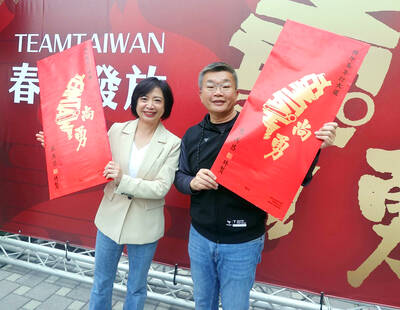
As Taiwan’s second most populous city, Taichung looms large in the electoral map. Taiwanese political commentators describe it — along with neighboring Changhua County — as Taiwan’s “swing states” (搖擺州), which is a curious direct borrowing from American election terminology. In the early post-Martial Law era, Taichung was referred to as a “desert of democracy” because while the Democratic Progressive Party (DPP) was winning elections in the north and south, Taichung remained staunchly loyal to the Chinese Nationalist Party (KMT). That changed over time, but in both Changhua and Taichung, the DPP still suffers from a “one-term curse,” with the
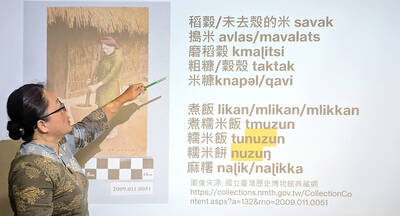
Jan. 26 to Feb. 1 Nearly 90 years after it was last recorded, the Basay language was taught in a classroom for the first time in September last year. Over the following three months, students learned its sounds along with the customs and folktales of the Ketagalan people, who once spoke it across northern Taiwan. Although each Ketagalan settlement had its own language, Basay functioned as a common trade language. By the late 19th century, it had largely fallen out of daily use as speakers shifted to Hoklo (commonly known as Taiwanese), surviving only in fragments remembered by the elderly. In

William Liu (劉家君) moved to Kaohsiung from Nantou to live with his boyfriend Reg Hong (洪嘉佑). “In Nantou, people do not support gay rights at all and never even talk about it. Living here made me optimistic and made me realize how much I can express myself,” Liu tells the Taipei Times. Hong and his friend Cony Hsieh (謝昀希) are both active in several LGBT groups and organizations in Kaohsiung. They were among the people behind the city’s 16th Pride event in November last year, which gathered over 35,000 people. Along with others, they clearly see Kaohsiung as the nexus of LGBT rights.

In the American west, “it is said, water flows upwards towards money,” wrote Marc Reisner in one of the most compelling books on public policy ever written, Cadillac Desert. As Americans failed to overcome the West’s water scarcity with hard work and private capital, the Federal government came to the rescue. As Reisner describes: “the American West quietly became the first and most durable example of the modern welfare state.” In Taiwan, the money toward which water flows upwards is the high tech industry, particularly the chip powerhouse Taiwan Semiconductor Manufacturing Co (TSMC, 台積電). Typically articles on TSMC’s water demand


 RSS
RSS