


Down in Taipei’s student hub surrounding National Taiwan University (NTU), cheap and filling eats are a dime a dozen. Tucked into the bustling alleyways, Younghwaru also seems rather unassuming.
Sharpie scribbles adorn the red-painted walls like any well-trodden student bar. Beers clink after long days in the library and students chow down on steaming bowls of noodles. K-Pop dance videos blare in the background.
But Younghwaru is hiding a whole lot of history.
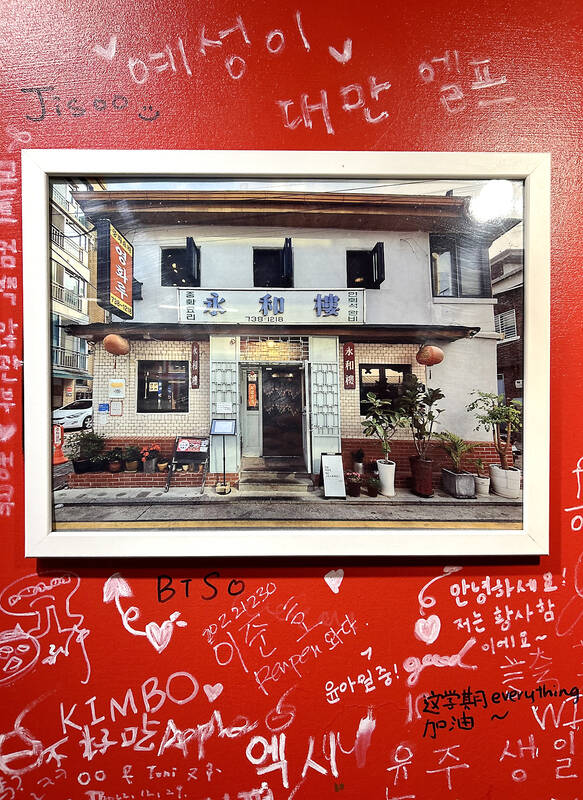
Photo: Hollie Younger
Serving Korean-style Chinese food, the original restaurant opened in Seoul in the 1970s, and the owner’s daughter brought a branch to Taipei just a few years ago.
The original Seoul storefront is featured in a framed picture in the restaurant in Daan District (大安). It retains that classic diner look that got it featured in many beloved K-dramas and movies over the years.
Now in Taipei, it serves the classic Chinese-Korean fusion flavors so beloved in Seoul, from jammy jjajangmyeon noodles to steaming bowls of jjampong soup.
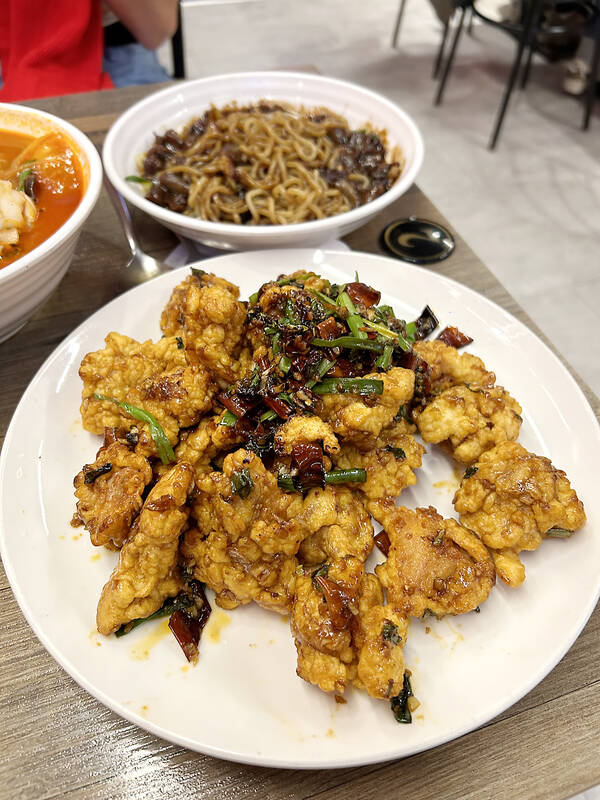
Photo: Hollie Younger
We’re served complementary kimchi and pickles before diving into their famous jjajangmyeon (NT$170).
A Korean take on the Chinese classic zhajiangmian (炸醬麵), gelatinous, chewy noodles are loaded with an unholy amount of inky black bean sauce, thick with chunky onions, shallots and minced pork, and topped with fresh cucumber.
This is much heavier and heartier than a classic zhajiangmian, and the rich, umami sauce coats each chewy QQ noodle. It’ll be hard to go back to my regular Taiwanese spot after this.
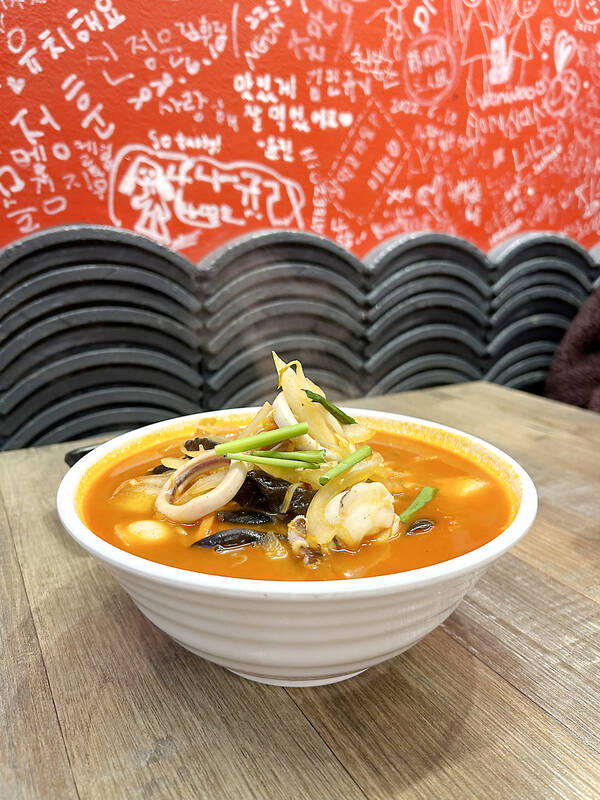
Photo: Hollie Younger
Another staple here is the seafood jjampong (NT$195), a spicy red stew of glass noodles and wood-ear mushrooms, laden with fresh shrimp, mussels, squid and those delightful little octopus that burst in your mouth.
For the price, this is a fantastic offering of seafood, still packing a strong chili kick from the gochugaru, Korean red pepper, though perhaps tamed down for local tastes.
We also sample the sweet and sour pork with deep-fried dumplings (NT$400) — it comes as a two-person combo deal for NT$609 with the jjajangmyeon and seafood jjampong.
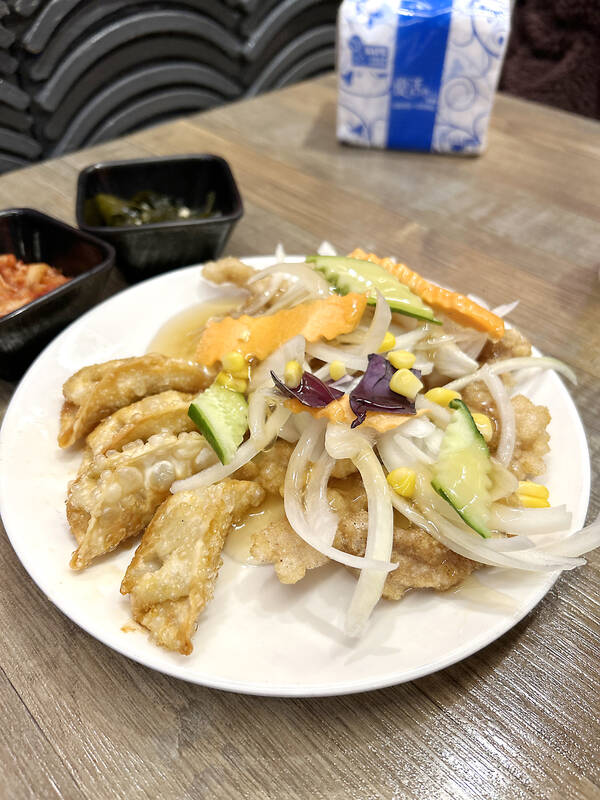
Photo: Hollie Younger
It’s nothing to write home about, but it’s a nice crispy and fried addition to the soups and noodles.
That said, we’ve already opted for a heaping pile of their Chinese-style Korean Fried Chicken (NT$460), or kkanpunggi.
Deep-fried boneless chicken bites are coated in a tangy, spicy garlic sauce and loaded with dried chilis, sticky caramelized onion and scallions. This is worth a trip alone. The batter is thick and chewy but still crispy on the outside, and the sauce is moreish enough to keep us picking away until well after we’re full.
We wash the whole feast down with large bottles of Cass beer (NT$170), sticking strictly Korean, but the fridge is also stacked with various Taiwanese beers and all manner of soju flavors.
Younghwaru keeps it simple and easy in menu and atmosphere, dishing out homely flavors, gut-busting portions and well-executed Korean-Chinese classics. The whole experience is really more akin to an evening in a gritty student enclave in downtown Seoul.
But sometimes an outrageously sized and outrageously well-priced plate of Korean fried chicken is just the thing on a chilly December evening.

Towering high above Taiwan’s capital city at 508 meters, Taipei 101 dominates the skyline. The earthquake-proof skyscraper of steel and glass has captured the imagination of professional rock climber Alex Honnold for more than a decade. Tomorrow morning, he will climb it in his signature free solo style — without ropes or protective equipment. And Netflix will broadcast it — live. The event’s announcement has drawn both excitement and trepidation, as well as some concerns over the ethical implications of attempting such a high-risk endeavor on live broadcast. Many have questioned Honnold’s desire to continues his free-solo climbs now that he’s a

As Taiwan’s second most populous city, Taichung looms large in the electoral map. Taiwanese political commentators describe it — along with neighboring Changhua County — as Taiwan’s “swing states” (搖擺州), which is a curious direct borrowing from American election terminology. In the early post-Martial Law era, Taichung was referred to as a “desert of democracy” because while the Democratic Progressive Party (DPP) was winning elections in the north and south, Taichung remained staunchly loyal to the Chinese Nationalist Party (KMT). That changed over time, but in both Changhua and Taichung, the DPP still suffers from a “one-term curse,” with the

Lines between cop and criminal get murky in Joe Carnahan’s The Rip, a crime thriller set across one foggy Miami night, starring Matt Damon and Ben Affleck. Damon and Affleck, of course, are so closely associated with Boston — most recently they produced the 2024 heist movie The Instigators there — that a detour to South Florida puts them, a little awkwardly, in an entirely different movie landscape. This is Miami Vice territory or Elmore Leonard Land, not Southie or The Town. In The Rip, they play Miami narcotics officers who come upon a cartel stash house that Lt. Dane Dumars (Damon)

Jan. 26 to Feb. 1 Nearly 90 years after it was last recorded, the Basay language was taught in a classroom for the first time in September last year. Over the following three months, students learned its sounds along with the customs and folktales of the Ketagalan people, who once spoke it across northern Taiwan. Although each Ketagalan settlement had its own language, Basay functioned as a common trade language. By the late 19th century, it had largely fallen out of daily use as speakers shifted to Hoklo (commonly known as Taiwanese), surviving only in fragments remembered by the elderly. In


 RSS
RSS