


In the leafy back blocks of a military cemetery in northern Taiwan, Liu Te-wen (劉德文) strides through a room holding rows and rows of shelves. He stops and stoops to the lowest row, opening a small, ornate gold door. He pulls out an urn, bundles it into his lap, and hugs it.
“Grandpa Lin, follow me closely,” Liu says. “I am bringing you back home to Fujian as you wished. Stay close.”
Inside the jade green urn are the ashes of Lin Ru-min, a former soldier who was 103 when he died in Taiwan, far from his home village in China’s Fujian province. Lin is among hundreds of people whose remains Liu, a 58-year-old Taiwanese man, has helped return to China over the past 23 years.
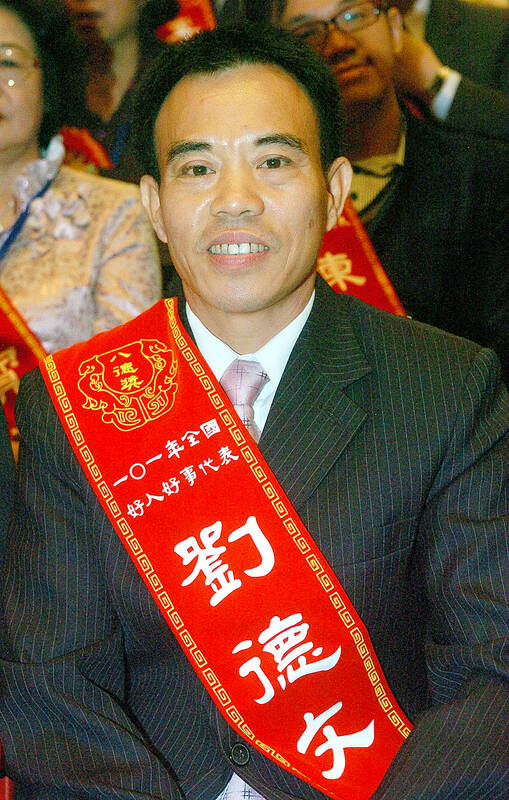
Photo: Wang Min-wei, Taipei Times
Liu’s work operates in a complicated space at the heart of modern Taiwan’s history, navigating the nuances of family grief and separation, the complicated ties between the two sides of the Taiwan Strait, and the risks of it all being co-opted in Beijing’s demands for reunification.
At the end of China’s civil war between the Chinese Nationalist Party (KMT) and the Communists in the late 1940s, Lin was a young fisher with a wife and five children in coastal Fujian, when he was snatched by the defeated KMT troops as they fled defeat, his niece’s daughter, Chen Rong, says.
He was forced into conscription, and taken to Taiwan, not allowed to return home for almost half a century.
The KMT, led by Chiang Kai-shek (蔣介石), brought an estimated one to two million affiliated people — known as waishengren (外省人) — when they fled, including soldiers, government workers, their families and forced conscripts like Lin.
“Tens of thousands were literally kidnapped to Taiwan this way,” says Dominic Meng-Hsuan Yang, a historian of modern Taiwan, China and civil war exiles, at the University of Missouri.
“In some of these unlucky coastal communities which happened to sit on the paths of the Nationalist divisions in retreat, a large number of male populations were taken away.’”
Chiang planned to regroup and replenish in Taiwan, and then retake China for the Republic of China. But the comeback never happened, and for almost 40 years he ruled Taiwan under a brutal martial law. Travel and other exchanges with what had become the Communist-ruled People’s Republic of China (PRC) were banned.
By the time the bans were lifted in the late 1980s, and after three decades of Maoism in the PRC, it was no longer realistic for most of the hundreds of thousands of remaining veterans to return, including Lin. Only about 2 percent ever did.
“The homes that the old KMT soldiers left behind in the late 1940s changed dramatically during the three to four decades they were gone,” says James Lin, an expert in Taiwan’s history and international studies at the University of Washington.
“Most soldiers had already settled down in Taiwan with children and grandchildren, and despite their longing for their natal home in China, realistically their homes were already in Taiwan.”
In hospital before he died, Lin told Chen that he still wanted his final resting place to be in Fujian. So Chen found Liu, an energetic but quietly spoken man from Kaohsiung, who spends his time helping families return the ashes of waishengren back to their ancestral homes.
Liu’s work started in his 30s, after he moved into a village which had been built for the KMT soldiers, and he later became the borough chief.
“There were over 2,000 single veterans just in my community who had no wives or families here in Taiwan,” Liu recalls.
“They missed their parents deeply. Every Chinese new year, they would face the direction of their home town and sit there for two or three hours without moving, quietly missing home … they asked: borough chief, could you please take me home, help me fulfill my lifelong wish, so I can be filial to my parents and at least redeem myself in the afterlife?”
Liu’s work has sent him across Taiwan, sometimes scouring through overgrown mountain regions to find long neglected graves. (Not everyone had relatives like Chen in Taiwan.)
“Some were merchants or sailors who came to Taiwan for business or trade and never made it back,” says Lin.
“Regardless of whether they were soldiers or civilians, I help the families as long as I can find their relatives.”
When he finds the right grave, he takes care of the paperwork, and then personally picks up the urn and carries it to China. Liu’s social media accounts show him carrying the urn, usually in a backpack worn on his front as a sign of respect.
“It’s not a commodity, it represents an elder with a soul and a life,” he says. Other posts show the urn in its own seat in vehicles and its own twin bed in hotel rooms, while Liu speaks updates of their journey.
Liu does not charge people for the service, and frowns upon those who do. He says he does not receive any financial assistance from the Taiwanese or Chinese governments, but is coy about how it is funded. Taiwan’s veterans affairs council declined multiple requests to answer questions.
Liu’s work has been written about in Taiwanese outlets and extensively in Chinese state media, where he is praised as a “ferryman of the souls.”
“Many in the broader public in the PRC sympathize with the old soldiers who were cut off from their home villages,” says Lin.
But the narrative also serves a propaganda purpose for Beijing, which often uses Liu’s work to emphasize the family ties between China and Taiwan as a way of promoting unification — a prospect that a large majority of people in Taiwan oppose.
More than 60 percent of people in Taiwan identify as solely Taiwanese but about one in three consider themselves to be also Chinese. Those who consider themselves Chinese, and support unification are usually found among older waishengren.
“It theoretically benefits Beijing to highlight the close familial ties that link together society across Taiwan and China, reinforcing a political phrase coined by Beijing that both sides of the strait are part of a same family,” says Lin.
Many of these men, like the young fisher Lin, had little say in the politics and war that so irrevocably changed their lives. And Lin says they felt that the “deeply traumatic” experience is often overlooked in modern Taiwan, because they are tied to what was at the time an authoritarian KMT state.
Liu says people in China and Taiwan are kin who “share the same origins and the same heritage,” but beyond that he just says he wants peace. He says he is not bothered about how his work is presented.
“What I care deeply about is building this kind of bridge for veterans to go home.”
After collecting Lin’s urn, Liu takes it outside and offers more blessings. He films a video for Lin’s family in Fujian, then wraps the urn in red and gold cloth and puts it inside a backpack, ready for the journey to Fujian.
Chen cries.
“We are going home,” she says. “I am asking Mr Liu to bring you home. Please bless us with health and safety.”

And so, in the wake of US President Donald Trump’s trip to the People’s Republic of China (PRC), all the experts on the Strait of Hormuz suddenly became experts on US-China-Taiwan relations. The Internet has certainly expanded human knowledge. Lots of these sudden experts made noise this week about Trump’s words after the meeting with PRC dictator Xi Jin-ping (習近平). Trump is going to sell out Taiwan! Longtime Taiwan commentator J. Michael Cole summed the situation up neatly in the Guardian: “We need to keep in mind that he has a tendency to say many things — sometimes contradicting himself within
There is considerable frustration and confusion among many, both in Taiwan and abroad — including in Washington — as to why the Chinese Nationalist Party (KMT) seems so dead set on using their legislative leverage to slash defense spending and disrupt the ability of the ruling Democratic Progressive Party (DPP) administration to function. Are they pawns of the Chinese Communist Party (CCP)? Are they traitors? In reality, there are multiple reasons. In the first column in this series on this subject, “Donovan’s Deep Dives: How and why the TPP and KMT help Beijing” (Sat May 16, page 12), we examined three

Last week US President Donald Trump was asked by a reporter whether he would speak on the phone to the President of Taiwan. “l’ll speak to him. I speak to everybody. We have that situation very well in hand,” Trump said. This marked the second time in a couple of weeks he had said he would talk to the President of Taiwan. In 2016 he famously took a call from then-president Tsai Ing-wen (蔡英文), when he was president-elect. Despite warnings that the apocalypse was nigh because of a phone call, the world quickly forgot about the conversation between two democratically-elected presidents.
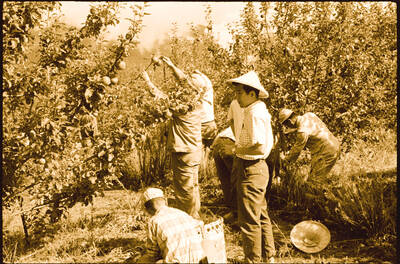
May 25 to May 31 Few believed that apples could be cultivated on a commercial scale in Taiwan’s high mountains. When horticulturalist Cheng Chao-hsiung (程兆熊) first proposed the idea in 1955, both American and Taiwanese colleagues dismissed it as implausible, arguing that temperate fruit could not be reliably grown on a subtropical island, especially on rugged terrain. However, it was this terrain in the Central Mountain Range where many Chinese Civil War veterans were resettled in the late 1950s. With limited job prospects and no family in Taiwan, they were placed on cooperative farms aimed toward self-sufficiency. Some say the conditions


 RSS
RSS