


Most people could tell you that Francis Crick, together with James Watson, discovered the double helix structure of DNA, and shaped our understanding of how genes work. Fewer know that Crick also played a key role in modern neuroscience and inspired our continuing efforts to understand the biological basis of consciousness.
Crick once said the two questions that interested him most were “the borderline between the living and the non-living, and the workings of the brain,” questions that were usually discussed in religious or mystical terms but that he believed could be answered by science. In his new biography of the Nobel prize-winning scientist, Matthew Cobb, emeritus professor of zoology at the University of Manchester, does an admirable job of capturing the rare thinker who not only set himself such ambitious goals but made remarkable progress in achieving them, radically remaking two scientific disciplines in the process.
‘AVERAGELY BRIGHT STUDENT’
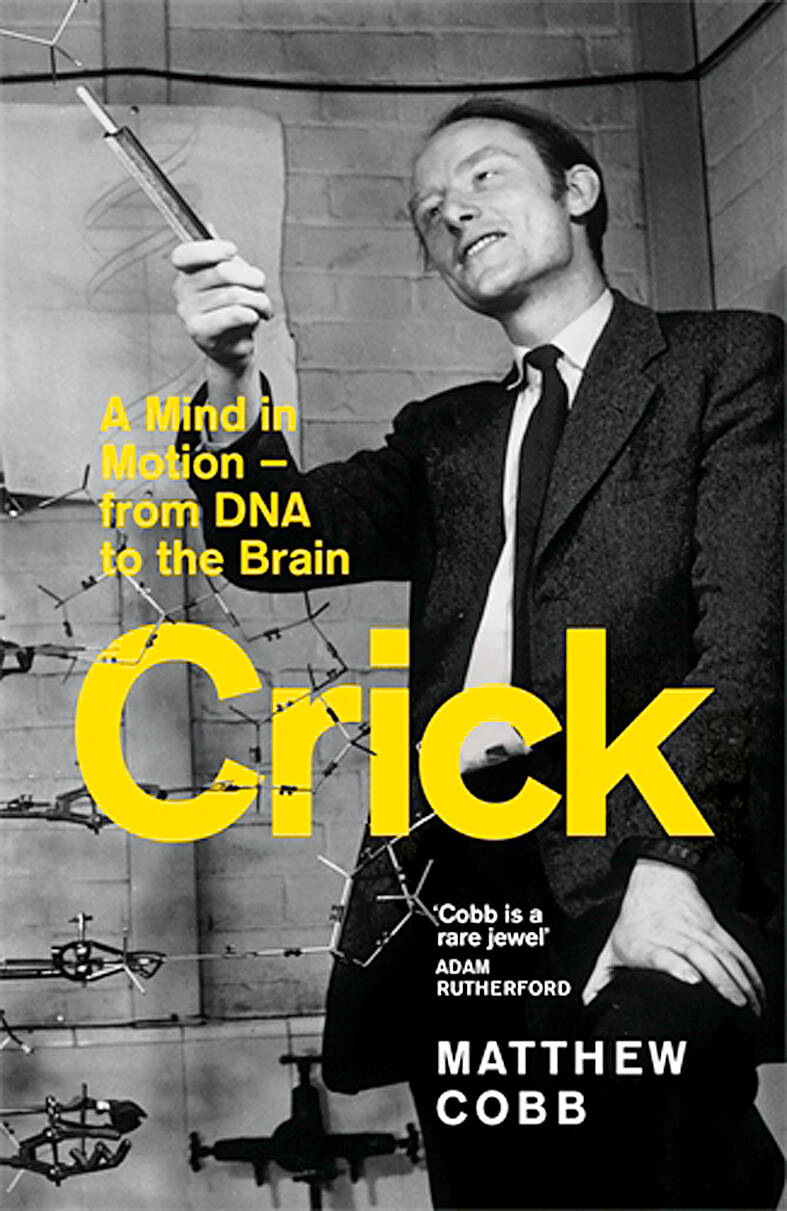
Surprisingly, perhaps, Crick was not a child prodigy. He began life as an “averagely bright student,” born in 1916 to a provincial middle-class family: his father ran a shoe company. After boarding at Mill Hill School in north London, he failed to get an Oxbridge scholarship (possibly because he was “hopeless” at Latin), and studied physics and mathematics at University College London, graduating with a 2.1. He began a PhD there, but it was disrupted by the second world war, when he was conscripted into developing mines that could evade German minesweepers.
It was only after the war that Crick, inspired by Erwin Schrodinger’s 1944 book What Is Life?, determined that he wanted to investigate the molecular basis of life, for which he needed a grounding in biology. He managed to get a studentship through the Medical Research Council to work at Strangeways Laboratory near Cambridge, studying the structure of cytoplasm (the liquid part of cells), and in 1949 transferred to Cambridge University’s Cavendish Lab, where scientists were using a technique called X-ray crystallography to investigate the structure of proteins. It was there that he found an ideal collaborator in the 23-year-old American scientist James Watson. Remarkably, by 1953 the pair had cracked the structure of DNA.
Far from being the stereotypical reclusive genius, laboring in isolation, Crick was loud-talking and charismatic, a philanderer, poetry lover and thrower of risque parties. Crick’s inspiration and breakthroughs came through intense encounters with others, and he was skilled at bringing researchers from different disciplines together to solve scientific puzzles.
In Cobb’s telling, Crick was bold and arrogant, with an uncanny ability to uncover connections and to identify new theoretical and experimental approaches, often challenging far more established experts. Lawrence Bragg, the head of the Cavendish lab, is said to have described him as “the sort of chap who was always doing someone else’s crossword.” This approach meant he often stepped on people’s toes and was occasionally wildly off mark.
SEXISM
Cobb wants to correct the widespread view that Crick and Watson arrived at their double helix model after stealing data from Rosalind Franklin, a British chemist whose X-ray diffraction images of DNA supported their theories. In The Double Helix, Watson’s popular account of his breakthrough, he wrote that he developed his ideas after seeing one of Franklin’s images, known as Photo 51. Cobb argues that this was an oversimplification: that Photo 51 gave Watson no new information, and Crick did not himself see it until weeks after the pair made their discovery. Crick and Watson should have asked Franklin for permission to use her data, Cobb writes, and it is true that she did not receive sufficient credit for her work. But the pair nonetheless acknowledged Franklin’s contributions in their academic papers on the double helix, and Crick and Franklin remained on friendly terms, with Crick acting as her “unofficial advisor.”
The whole affair nonetheless reeks of sexism, from the lack of courtesy shown to Franklin to her exclusion from networking groups such as the RNA Tie Club, and the letters exchanged between Crick and a male colleague discussing how Franklin was too cautious to be a first-rank scientist. I wished Cobb might have named it as such. (After all, what female scientist of their era could have recovered their public reputation after the kinds of blunders Crick sometimes made.)
Cobb sets himself an ambitious task in trying to do justice to both Crick’s prolific scientific career and his colorful personal life, and this biography is an impressive work of research and scholarship. It is intended to be accessible to the general reader, with the advice that those who are struggling with the science should “follow Crick’s advice to readers of his own books and skip the hard bits.”
This general reader struggled often with the technical detail and vocabulary. Some difficulty may be inescapable simply because the science is complex. Nonetheless, it is a relief whenever Crick is quoted, describing his research in his own words, because he had a knack for translating hard science into lay terms.
In a passage explaining how a rare mutation, if advantageous, can become widespread, Crick observes that “when times are tough, true novelty is needed … chance is the only source of true novelty.”
These broader, philosophical reflections, which place discoveries in their wider context, are fascinating and much needed — because when readers feel bogged down, they miss out on the wonder.
If one asks Taiwanese why house prices are so high or why the nation is so built up or why certain policies cannot be carried out, one common answer is that “Taiwan is too small.” This is actually true, though not in the way people think. The National Property Administration (NPA), responsible for tracking and managing the government’s real estate assets, maintains statistics on how much land the government owns. As of the end of last year, land for official use constituted 293,655 hectares, for public use 1,732,513 hectares, for non-public use 216,972 hectares and for state enterprises 34 hectares, yielding

The small platform at Duoliang Train Station in Taitung County’s Taimali Township (太麻里) served villagers from 1992 to 2006, but was eventually shut down due to lack of use. Just 10 years later, the abandoned train station had become widely known as the most beautiful station in Taiwan, and visitors were so frequent that the village had to start restricting traffic. Nowadays, Duoliang Village (多良) is known as a bit of a tourist trap, with a mandatory, albeit modest, admission fee of NT$10 giving access to a crowded lane of vendors with a mediocre view of the ocean and the trains
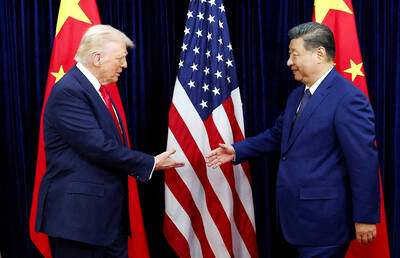
The March/April volume of Foreign Affairs, long a purveyor of pro-China pablum, offered up another irksome Beijing-speak on the issues and solutions for the problems vexing the People’s Republic of China (PRC) and the US: “America and China at the Edge of Ruin: A Last Chance to Step Back From the Brink” rang the provocative title, by David M. Lampton and Wang Jisi (王緝思). If one ever wants to describe what went wrong with US-PRC relations, the career of Wang Jisi is a good place to start. Wang has extensive experience in the US and the West. He was a visiting
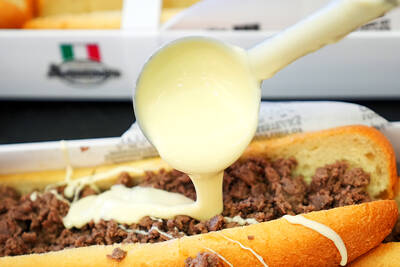
One of the challenges with the sheer availability of food in today’s world is that lots of us end up spending many of our waking hours eating. Whether it’s full meals, snacks or desserts, scientists have found that it’s not uncommon for us to be mindlessly grazing at some point during all of our 16 or so waking hours. The problem? As soon as this food hits the bloodstream in the form of glucose, it initiates the release of the hormone insulin. This in turn activates a switch present in every one of our cells, which is responsible for driving cell


 RSS
RSS