


When a ram tips its head back, curls its upper lip and takes a deep breath — known in the world of animal husbandry as a “flehmen response” — it’s often a sign of arousal. Sheep have a small sensory organ above the roof of the mouth, and the flehmen response helps to flood it with any sex pheromones wafting about.
Usually, rams flehmen when they encounter ewes during the mating period, said Michael Stucke, a farmer with 30 years of experience raising sheep in Westphalia, Germany. But on Stucke’s farm, the rams flehmen “all the time.”
“They do this all the time, because they find each other attractive,” said Stucke of his 35 male sheep. “They’re cuddling. They’re showing signs of affection. They’re jumping on each other. It’s undeniable that they’re attracted to each other.”
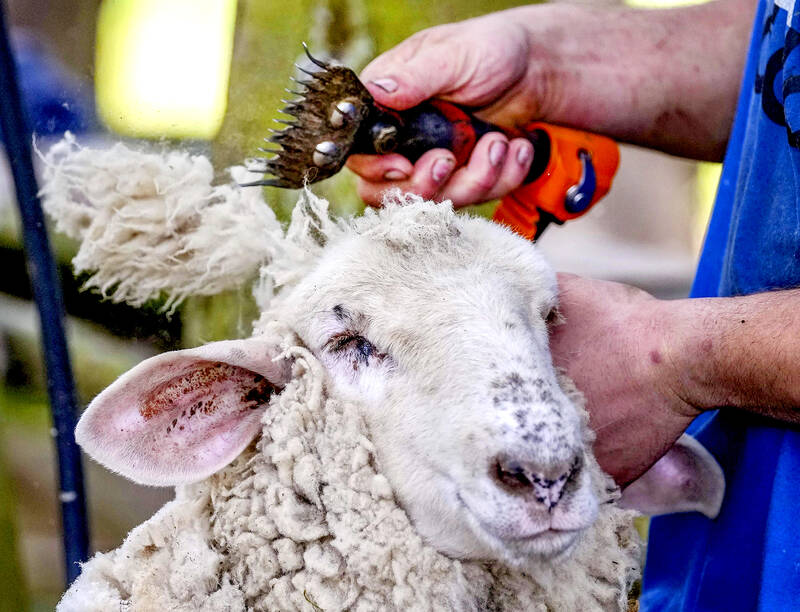
Photo: AP
Stucke is the proud shepherd of the world’s first and probably only flock of gay rams.Though researchers found that up to 8 percent of male sheep are “male-oriented,” homosexuality is viewed disfavorably by farmers, who expect rams to breed. Rams who refuse to breed are often slaughtered for meat, and it was during a discussion of this harsh reality with Stucke’s friend and business partner Nadia Leytes that the idea for Rainbow Wool was born: “What can we do to not send all of them to the slaughterhouse?”
“My heart beats for the weak and oppressed in general,” Stucke said. “I am gay myself and know the prejudices and obstacles that come with being a gay man, especially in the agricultural business.”
SAVING LIVES
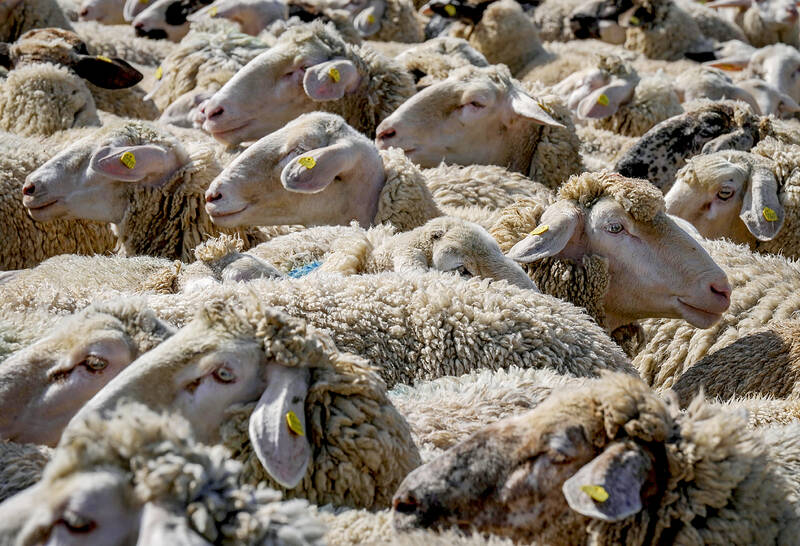
Photo: AP
Rainbow Wool’s solution has been to buy gay rams directly from breeders, outbidding the price they might receive from a slaughterhouse, and keep them for their wool. The flock now numbers 35, and the farm has a waiting list. Individual sheep can be named and sponsored — they include a Bentheimer landschaf named Wolli Wonka, a Shropshire named Prince Wolliam and Jean Woll Gaultier — and the wool is processed by a mill in Spain. All profits are donated to LGBTQ+ charities in Germany. “A couple of sheep [have been] saved but also a couple of people,” Leytes said, noting that their donations have supported relocating people living in countries where being gay is illegal.
Correctly identifying a sheep’s sexual orientation can be tricky. “Everybody can just say: ‘Hey I have a gay ram,’” Stucke said, “but what we’re doing is observing their behavior.”
“Some rams basically jump on everything, whether it’s female or male,” he added. “That would not qualify as being a gay ram. That would qualify as being a dominant. But if a ram consistently refuses to mate with a female sheep, this is the sign that you know he prefers other rams.”
Stucke’s flock burst on to the fashion scene last month when they provided the raw material for a knitwear collection designed by Chrome Hearts collaborator Michael Schmidt and sponsored by the gay dating app Grindr. Schmidt sent 36 looks down a New York City catwalk, all knit or crocheted from the wool of Stucke’s gay sheep. Each look represented a male archetype, starting with Adam sans Eve and including a pool boy, sailor, pizza delivery boy and plumber.
“I really wanted to lean into the gay,” Schmidt told the New York Times. “I view it as an art project. It’s selling an idea more than a collection of clothing, and the idea it’s selling is that homosexuality is not only part of the human condition, but of the animal world. That puts the lie to this concept that being gay is a choice. It’s part of nature.”
HUMAN NATURE
The naturalness of homosexuality as demonstrated by the gayness of sheep has been a subject of media fascination for decades, thanks in large part to Charles Roselli, a professor of biochemistry at Oregon Health and Science University. Roselli’s research into how sex hormones affect brain development is the source of the statistic about one in 12 rams being gay.
In 2007, his work fell victim to what the New York Times called “a textbook example of the distortion and vituperation that can result when science meets the global news cycle” when the Times, People for the Ethical Treatment of Animals (Peta) and gay rights activists accused Roselli — inaccurately — of seeking to “cure” homosexuality in rams and, ultimately, humans.
Rainbow Wool has not been targeted with the same degree of vitriol — a snarky Telegraph headline about a supposed “woke test” for New York’s fashion scene notwithstanding — but Stucke has been moving the gay flock from field to field to ensure their safety after receiving online threats.
Still, the project has faced criticism for whitewashing the realities of animal farming, which demand “brutal, violent heteronormativity,” scholars Gabriel N Rosenberg and Jan Dutkiewicz wrote in the New Republic. “If anything, the gay wool fashion show should make us think not about the good fortune of the few rescued rams but about how animal farming systematically, routinely and often violently exploits the reproduction of all the animals it encounters.”
Rosenberg and Dutkiewicz point to problems with ascribing human identities such as “gayness” to animals, including that researchers only classify sexuality based on “topping” behavior, with no way to register a ram’s preference for “bottoming.” “You can’t ask rams about their identities, and we have no evidence that sheep ascribe any special significance to sex in the way humans often do,” they said.
The limits of how far any kind of biological essentialism can get in helping to justify human rights through appeals to naturalism became immediately clear when Stucke was asked whether Rainbow Wool had any plans to provide sanctuary for lesbian sheep.
“I am personally convinced there are lesbian sheep, and I would like to create a new herd out of them, but it’s really hard to determine,” Stucke said. A key problem is that it’s impossible to know female sheep’s sexual preferences. “The act of being jumped on happens without consent in most cases, especially if the female herd is being kept for profit — for lambs or for meat,” he said.
Once a farmer starts taking an animal’s consent into account, is it possible to still be a farmer? What about the sheep who prefer not to be shorn? Or eaten?
Stucke is conscious of the limits of comparisons between farm animals and humans, but he nevertheless finds meaning and purpose in tending to his flock of gay sheep.
“I had some times when it was not easy for me to accept who I was and how I was wired, especially growing up in a very conservative family,” he said. “I needed to find myself, and I found myself, and this is now something that I treat with openness.
“If we can save an animal who is living in a different way, it sends a powerful message. It doesn’t have to be a direct comparison to say animals are just like people. It’s metaphorical.”
If one asks Taiwanese why house prices are so high or why the nation is so built up or why certain policies cannot be carried out, one common answer is that “Taiwan is too small.” This is actually true, though not in the way people think. The National Property Administration (NPA), responsible for tracking and managing the government’s real estate assets, maintains statistics on how much land the government owns. As of the end of last year, land for official use constituted 293,655 hectares, for public use 1,732,513 hectares, for non-public use 216,972 hectares and for state enterprises 34 hectares, yielding

The small platform at Duoliang Train Station in Taitung County’s Taimali Township (太麻里) served villagers from 1992 to 2006, but was eventually shut down due to lack of use. Just 10 years later, the abandoned train station had become widely known as the most beautiful station in Taiwan, and visitors were so frequent that the village had to start restricting traffic. Nowadays, Duoliang Village (多良) is known as a bit of a tourist trap, with a mandatory, albeit modest, admission fee of NT$10 giving access to a crowded lane of vendors with a mediocre view of the ocean and the trains
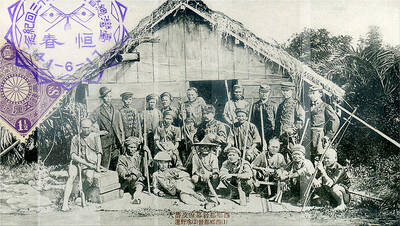
Traditionally, indigenous people in Taiwan’s mountains practice swidden cultivation, or “slash and burn” agriculture, a practice common in human history. According to a 2016 research article in the International Journal of Environmental Sustainability, among the Atayal people, this began with a search for suitable forested slopeland. The trees are burnt for fertilizer and the land cleared of stones. The stones and wood are then piled up to make fences, while both dead and standing trees are retained on the plot. The fences are used to grow climbing crops like squash and beans. The plot itself supports farming for three years.

For many people, Bilingual Nation 2030 begins and ends in the classroom. Since the policy was launched in 2018, the debate has centered on students, teachers and the pressure placed on schools. Yet the policy was never solely about English education. The government’s official plan also calls for bilingualization in Taiwan’s government services, laws and regulations, and living environment. The goal is to make Taiwan more inclusive and accessible to international enterprises and talent and better prepared for global economic and trade conditions. After eight years, that grand vision is due for a pulse check. RULES THAT CAN BE READ For Harper Chen (陳虹宇), an adviser


 RSS
RSS