


A baby and his family dog sit across from each other in a podcast studio.
“Welcome to the talking baby podcast,” says the infant, wearing headphones and sounding like a deep-voiced radio broadcaster. “On today’s episode, we’ll be talking to the weird-looking person who lives at my house.”
So begins a series of humorous interactions between two characters animated by artificial intelligence that’s attracted millions of views on social media. They’re a nod to the 1989 movie Look Who’s Talking but produced in a matter of hours and without a multimillion-dollar Hollywood budget.

Photo: AP
AI helped do all of that, but it didn’t craft the punch lines. It’s a relief to comedian Jon Lajoie, who made the videos, that AI chatbots just aren’t “inherently funny.”
“It can’t write comedy,” said Lajoie. “It can’t do any of that.” For now, at least, they won’t take his job.
Lajoie’s viral videos have gained him attention as an AI-adopting entertainer that’s he’s not entirely comfortable with as he grapples with what all this means for the future of his very human craft of making people laugh.
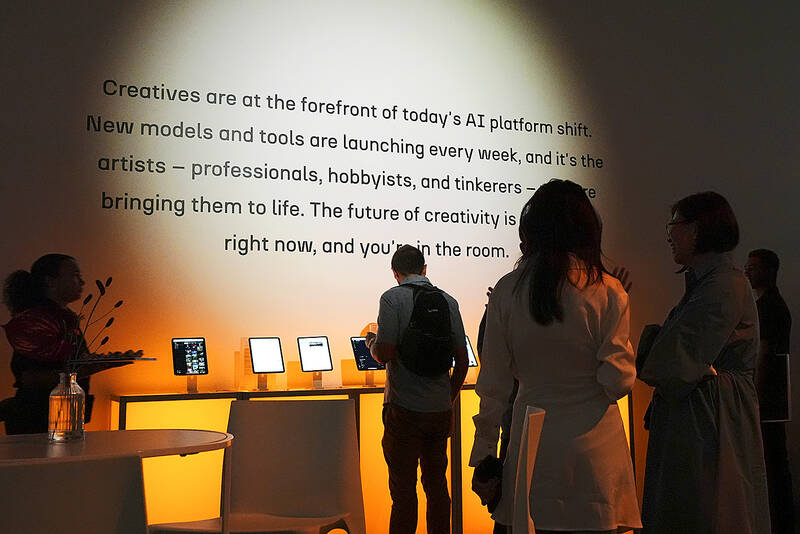
Photo: AP
King Willonius is not feeling so cautious. His first big hit was an AI-generated song called BBL Drizzy that made fun of rapper Drake during the height of his feud with Kendrick Lamar. He’s since moved into making AI video parodies like I’m McLovin It (Popeye’s Diss Song) and I Want My Barrel Back (Cracker Barrel song).
“It’s very similar to somebody who’s writing for The Onion or SNL,” Willonius said. “I try to find out, OK, what’s my comedic angle on this particular topic? And then I’ll generate a video from that.”
He starts with writing his own notes on an idea, then refines it with a chatbot, and puts that language — known as a prompt — into AI tools that can generate imagery, video, music and voices. The key, he says, is to keep iterating.
But he wouldn’t just ask it for a joke — Willonius says most chatbot-generated comedy lacks the “nuances or complexities that it takes for jokes to really land.”
A scholar of comedy, Michelle Robinson, said “a lot of the stuff that I’ve seen AI produce is corny as hell.”
“It does seem fluent in the basic grammar of jokes, but sometimes they’re slightly off,” said Robinson, a professor of American studies at the University of North Carolina at Chapel Hill. “They may be moderately funny, but I think they’re really missing an important element of what makes us laugh.”
What are they missing? She’s not totally sure, except that most good jokes are a little edgy or dangerous and chatbots can’t seem to calibrate “whatever provocation is in the joke to the moment that we’re living in.”
Caleb Warren, a professor who studies marketing and consumer psychology at the University of Arizona, said that leaves comedy writers with an opportunity to make use of tools that can’t completely outsource their skills.
“The ideas that are driving the humor are coming from the human comedian,” but the AI tools can help them execute and illustrate them, Warren said.
Willonius was a struggling comedian and screenwriter who began experimenting with AI during Hollywood’s actor and writer strikes in 2023.
“I leaned all the way into AI because I didn’t know what else to do with my free time,” he said. “I was doing everything I could to try to break into Hollywood. And once the writers’ strike happened, that kind of shut that down. I started to learn these AI tools and get really good at them and started to cultivate an audience.”
While Willonius saw an opening, the rise of generative AI has stoked division and posed challenges to other professional comedians.
Sarah Silverman joined book authors in suing leading chatbot makers, alleging they infringed the copyright of her The Bedwetter memoir. The daughter of the late Robin Williams called it “gross” and “maddening” when users of OpenAI’s AI video generator Sora conjured up realistic “deepfakes” of the beloved actor to churn out what she described as “horrible TikTok slop puppeteering.”
“You’re not making art, you’re making disgusting, over processed hot dogs out of the lives of human beings, out of the history of art and music, and then shoving them down someone else’s throat hoping they’ll give you a little thumbs-up and like it,” Zelda Williams wrote in October.
And the estate of legendary comic George Carlin last year settled a lawsuit against podcasters who purportedly cloned his voice to make a fake hourslong comedy special.
Comics have also relished mocking AI tools. A recent South Park episode called “Sora Not Sorry” had a bumbling police detective investigate a scourge of fake videos.
Lajoie, known for his work on the TV series The League and comic songs on YouTube, tried to see what would happen if he asked ChatGPT to help craft a bizarre movie script idea. He said it gave him something “super boring” about “grandma’s dentures and a talking raccoon.”
“That level of human creativity, it can’t mimic — yet — or at least maybe I’m not great at prompting,” he said. Instead, he found it useful to cheaply animate ideas he would otherwise never have pursued — such as the talking baby, birds wearing jeans, or a podcasting Jesus Christ interviewing an Easter Bunny who’s never heard of him.
The prominent venture capital firm Andreessen Horowitz invited Lajoie and Willonius to exhibit their video creations this fall at a new AI gallery space in Manhattan, part of a promotion of AI creativity tool startups that the firm invests in.
Willonius obliged. Lajoie ended up bowing out, after an interview with The Associated Press in which he voiced doubts about what he described as AI’s “Napster phase.” The music-sharing website shuttered in the early 2000s after the record industry and rock band Metallica sued over copyright violations.
The investment firm’s co-founder, Marc Andreessen, has been bullish about AI’s potential to bring new life into filmmaking and comedy. On a November podcast, he blamed Hollywood opposition to its adoption on “woke activists [who] have picked up AI as the new thing they’re going to agitate about.” He compared it to resistance to computer graphics in movies before they became commonplace.
Lajoie said he shared his early AI video experiments with a few friends who are “anti-AI; real, real, anti-AI” and they were surprised by how well the sketches retained Lajoie’s own comedic voice.
He insists he’s no AI expert, just “a creative person who can figure out how to make two characters talk to each other.” But even editing the sketches requires understanding comedic timing, and he has no interest in ceding that part to a machine.
“The thing with comedy is it’s so related to performance, delivery and point of view,” Lajoie said. “Do AIs have a point of view? They can grab a few points of view from different people.”
“And when it does have a point of view, I think that’s when we all should be afraid for all of the reasons that the Terminator has taught us,” he said.

If one asks Taiwanese why house prices are so high or why the nation is so built up or why certain policies cannot be carried out, one common answer is that “Taiwan is too small.” This is actually true, though not in the way people think. The National Property Administration (NPA), responsible for tracking and managing the government’s real estate assets, maintains statistics on how much land the government owns. As of the end of last year, land for official use constituted 293,655 hectares, for public use 1,732,513 hectares, for non-public use 216,972 hectares and for state enterprises 34 hectares, yielding

The small platform at Duoliang Train Station in Taitung County’s Taimali Township (太麻里) served villagers from 1992 to 2006, but was eventually shut down due to lack of use. Just 10 years later, the abandoned train station had become widely known as the most beautiful station in Taiwan, and visitors were so frequent that the village had to start restricting traffic. Nowadays, Duoliang Village (多良) is known as a bit of a tourist trap, with a mandatory, albeit modest, admission fee of NT$10 giving access to a crowded lane of vendors with a mediocre view of the ocean and the trains
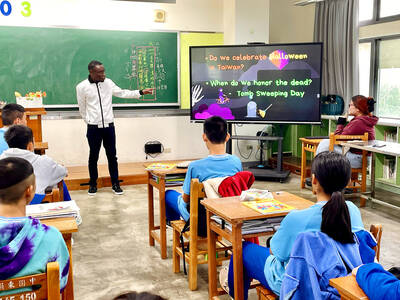
For many people, Bilingual Nation 2030 begins and ends in the classroom. Since the policy was launched in 2018, the debate has centered on students, teachers and the pressure placed on schools. Yet the policy was never solely about English education. The government’s official plan also calls for bilingualization in Taiwan’s government services, laws and regulations, and living environment. The goal is to make Taiwan more inclusive and accessible to international enterprises and talent and better prepared for global economic and trade conditions. After eight years, that grand vision is due for a pulse check. RULES THAT CAN BE READ For Harper Chen (陳虹宇), an adviser

Traditionally, indigenous people in Taiwan’s mountains practice swidden cultivation, or “slash and burn” agriculture, a practice common in human history. According to a 2016 research article in the International Journal of Environmental Sustainability, among the Atayal people, this began with a search for suitable forested slopeland. The trees are burnt for fertilizer and the land cleared of stones. The stones and wood are then piled up to make fences, while both dead and standing trees are retained on the plot. The fences are used to grow climbing crops like squash and beans. The plot itself supports farming for three years.


 RSS
RSS