


For 35 years, American zoologist Laurie Marker has been collecting and storing specimens in a cheetah sperm bank in Namibia, hoping conservationists never have to use them.
But she worries that the world’s fastest land animal might be on the brink of extinction one day and need artificial reproduction to save it.
Marker says the sperm bank at the Cheetah Conservation Fund she founded in the southern African nation is a “frozen zoo” of cheetahs she’s been building since 1990. It would be utilized in a worst-case scenario for the big cats, whose numbers have dropped alarmingly in the wild over the last 50 years.

Photo: AP
“You don’t do anything with it unless until it’s needed,” Marker, one of the foremost experts on cheetahs, said at her research center near the Namibian city of Otjiwarongo. “And we never want to get to that point.”
Conservationists mark World Cheetah Day on Thursday with less than 7,000 of them left in the wild, similar numbers to the critically endangered black rhino. There are only around 33 populations of cheetahs spread out in pockets mainly across Africa, with most of those populations having less than 100 animals, Marker said.
Like so many species, the sleek cats that can run at speeds of 112 kilometers per hour are in danger from habitat loss, human-wildlife conflict and the illegal animal trade. Their shrinking, isolated groups mean their gene pool is shrinking also as small populations continuously breed among themselves, with repercussions for their reproduction rates.
Globally, cheetah numbers in the wild have dropped by 80 percent in the last half-century and they’ve been pushed out of 90 percent of their historical range.
Scientists believe that cheetahs already narrowly escaped extinction at the end of the last ice age around 10,000 to 12,000 years ago, which first reduced their gene pool.
Marker said the lack of genetic diversity, along with the fact that cheetahs have 70 to 80 percent abnormal sperm, mean they might need help in the future.
“And so, a sperm bank makes perfect sense, right?” Marker said.
A COMMON TACTIC
Storing sperm is not unique to cheetahs in the wildlife world. It’s a tactic that conservationists have developed for other species, including elephants, rhinos, antelopes, other big cats, birds and others.
The value of animal reproductive research, Marker said, is seen in the desperate battle to save the northern white rhino from extinction.
There are just two northern white rhinos left, both females, making the species functionally extinct with no chance of reproducing naturally. Their only hope lies in artificial reproduction using northern white rhino sperm that was collected and frozen years ago.
Because both remaining northern white rhinos — a mother and daughter — can’t carry pregnancies, scientists have tried to implant northern white rhino embryos in southern white rhino surrogates. The surrogates haven’t managed to carry any of the pregnancies to term, but the conservation team has committed to keep trying to save northern white rhinos against all odds.
Other efforts around artificial reproduction have been successful, including a project that bred black-footed ferrets using artificial reproduction after they’d been reduced to a single wild population in Wyoming in the United States.
LAST RESORT
Marker doesn’t chase down cheetahs to collect their sperm but takes samples opportunistically. In Namibia, cheetahs are mostly in danger from farmers who view them as threats to their livestock, meaning Marker’s team are called out for cats that have been injured or captured and will collect samples while treating and releasing them.
Sperm samples can also be taken from dead cheetahs. “Every cheetah is actually a unique mix of a very small number of genes. We will try to bank every animal we possibly can,” Marker said.
The samples from approximately 400 cheetahs and counting are now stored at ultralow temperatures in liquid nitrogen at the Cheetah Conservation Fund laboratory. Marker’s research does not involve any artificial insemination as breeding wild animals in captivity is not allowed in Namibia.
Should cheetahs be threatened with extinction again, the first backup would be the roughly 1,800 cats living in zoos and other captive environments. But, Marker said, cheetahs don’t breed well in captivity and the sperm bank might be, like the northern white rhinos, the last resort.
Without it, “we’re not going to have much of a chance,” Marker said.

Just after 6am, I walked up to the ticket gate at Taipei Main Station and entered the Taiwan Railway platform without scanning any ticket; instead, I flashed the Sanrio Fun Rail pass on my phone to the gate worker and was admitted. I found my train and prepared to board. My destination? This very same station. I was embarking on a 13-hour journey on one of two round-the-island trains operated by ezTravel. They run each day, one counterclockwise around the island and one clockwise. They differ in a number of ways from an ordinary Taiwan Railway train and can make for
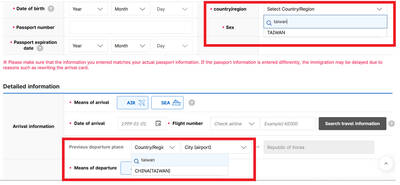
Jason Han says that the e-arrival card spat between South Korea and Taiwan shows that Seoul is signaling adherence to its “one-China” policy, while Taiwan’s response reflects a reciprocal approach. “Attempts to alter the diplomatic status quo often lead to tit-for-tat responses,” the analyst on international affairs tells the Taipei Times, adding that Taiwan may become more cautious in its dealings with South Korea going forward. Taipei has called on Seoul to correct its electronic entry system, which currently lists Taiwan as “China (Taiwan),” warning that reciprocal measures may follow if the wording is not changed before March 31. As of yesterday,

The Portuguese never established a presence on Taiwan, but they must have traded with the indigenous people because later traders reported that the locals referred to parts of deer using Portuguese words. What goods might the Portuguese have offered their indigenous trade partners? Among them must have been slaves, for the Portuguese dealt slaves across Asia. Though we often speak of “Portuguese” ships, imagining them as picturesque vessels manned by pointy-bearded Iberians, in Asia Portuguese shipping between local destinations was crewed by Asian seamen, with a handful of white or Eurasian officers. “Even the great carracks of 1,000-2,000 tons which plied

On Thursday, former Taipei mayor and founder of the Taiwan People’s Party (TPP) Ko Wen-je (柯文哲) was sentenced to 17 years in prison and had his civil rights suspended for six years over corruption, embezzlement and other charges. Seven others related to the case were also handed prison sentences, while two were found not guilty. It has been a bad week for the TPP. On Tuesday, prosecutors charged Chinese immigrant Xu Chunying (徐春鶯) with suspicion of taking part in Beijing-directed election interference. Xu has strong links to the TPP, which once offered her a party list legislator nomination. Tuesday also


 RSS
RSS