


All gloom was left outside as pensioners bustled into a room in Liverpool’s centuries-old town hall for a tea dance, a lively antidote to getting older in Britain.
“Come to tea dances and avoid the NHS!” joked Davina Woods, 71, referring to the country’s creaking health system and the awareness the retirees have that as they age, they will likely come into increasing contact with the service.
Woods, a former headteacher, said she loves the sessions for the chance to get dressed up and don high heels.
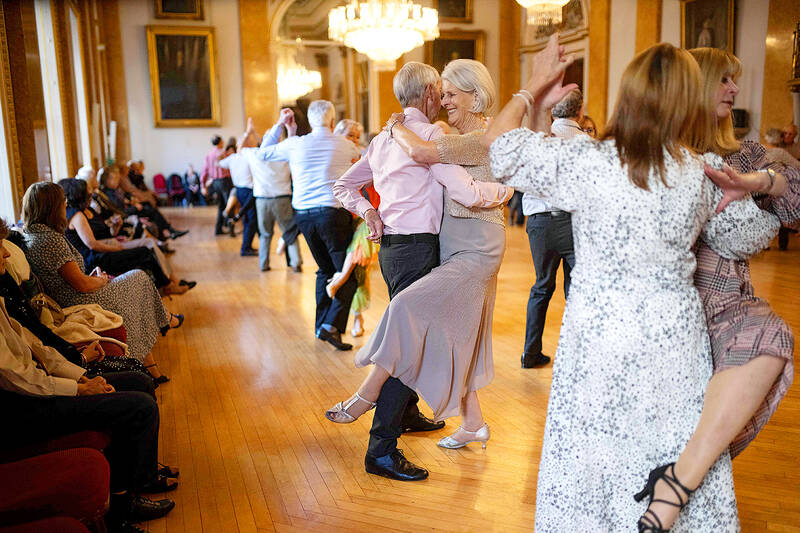
Photo: AFP
It really “lifts your spirits,” she said. For some, the dancing provides a welcome chance to put aside the political tensions facing the country as it grapples with a host of issues, including weak economic growth and discontent over immigration.
“We leave politics outside,” said engineer David Easton, 65.
“It brings people together. It brings us joy.”
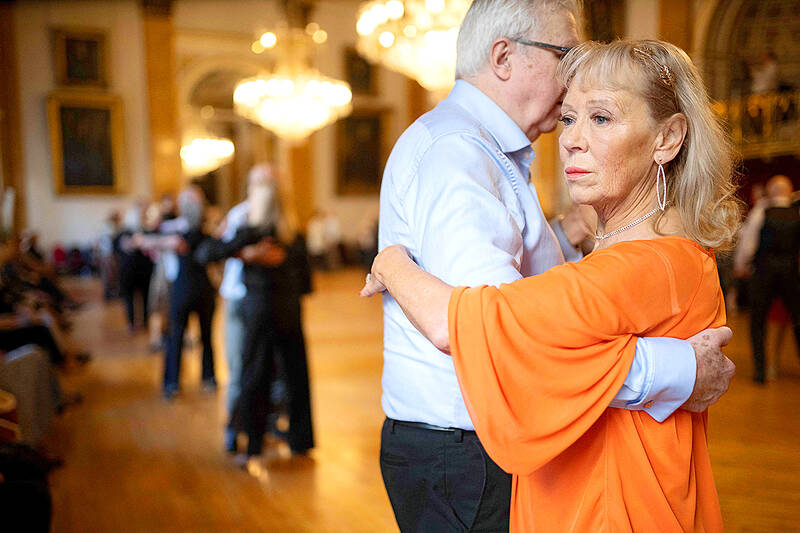
Photo: AFP
Tea dance, which evolved from the tradition of afternoon tea in the late 19th century, is enjoying a revival, especially since the COVID-19 pandemic.
This mirrors a trend seen with other traditional dances such as ballroom, with the BBC’s hugely popular hit TV show, “Strictly Come Dancing” often cited as a key factor.
One recent chilly Monday afternoon in the northwest city of Liverpool, 115 dancers paid the equivalent of US$16 to waltz, tango and cha-cha-cha under the chandeliers of the stunning 18th century town hall. Refreshments included tea and cakes.
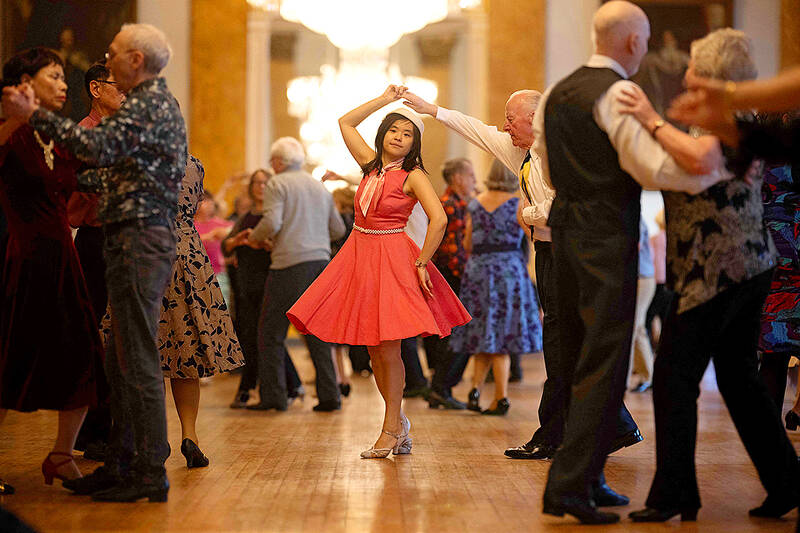
Photo: AFP
“It is very vibrant. It’s growing,” said organiser Jackie Williams, 53, who also started the company Ballroom Blitz in 2017. “More and more people join. Since Covid, people have realised how dancing can help, how much they need physical contact.”
GOOD FOR MENTAL HEALTH
New tea dance formats, which are more an occasion for people to gather for various types of dance, rather than a dance type itself, have emerged in recent years.
They include tea dances for same-sex couples and sessions tailored for people living with dementia.
For many, the social aspect is as important as the exercise.
“It’s a highlight of my life,” said Mo Massie, 75, a retired psychotherapist. “I love the social side of it. Otherwise people would be sitting at home alone watching TV.”
Retired nurse Greta Jones, 65, agreed. She started dancing 15 years ago when living alone. “I made a fabulous group of friends over the years. Tea dances are definitely a good way to fight loneliness.”
After three hours of twirling and tapping, the dancers melt away until the next time.
Mike Robinson, a 57-year-old former lecturer who lives in Manchester, said: “Dancing put a smile on my face.”
“It’s good for mental health.”

If one asks Taiwanese why house prices are so high or why the nation is so built up or why certain policies cannot be carried out, one common answer is that “Taiwan is too small.” This is actually true, though not in the way people think. The National Property Administration (NPA), responsible for tracking and managing the government’s real estate assets, maintains statistics on how much land the government owns. As of the end of last year, land for official use constituted 293,655 hectares, for public use 1,732,513 hectares, for non-public use 216,972 hectares and for state enterprises 34 hectares, yielding

The small platform at Duoliang Train Station in Taitung County’s Taimali Township (太麻里) served villagers from 1992 to 2006, but was eventually shut down due to lack of use. Just 10 years later, the abandoned train station had become widely known as the most beautiful station in Taiwan, and visitors were so frequent that the village had to start restricting traffic. Nowadays, Duoliang Village (多良) is known as a bit of a tourist trap, with a mandatory, albeit modest, admission fee of NT$10 giving access to a crowded lane of vendors with a mediocre view of the ocean and the trains

The March/April volume of Foreign Affairs, long a purveyor of pro-China pablum, offered up another irksome Beijing-speak on the issues and solutions for the problems vexing the People’s Republic of China (PRC) and the US: “America and China at the Edge of Ruin: A Last Chance to Step Back From the Brink” rang the provocative title, by David M. Lampton and Wang Jisi (王緝思). If one ever wants to describe what went wrong with US-PRC relations, the career of Wang Jisi is a good place to start. Wang has extensive experience in the US and the West. He was a visiting

One of the challenges with the sheer availability of food in today’s world is that lots of us end up spending many of our waking hours eating. Whether it’s full meals, snacks or desserts, scientists have found that it’s not uncommon for us to be mindlessly grazing at some point during all of our 16 or so waking hours. The problem? As soon as this food hits the bloodstream in the form of glucose, it initiates the release of the hormone insulin. This in turn activates a switch present in every one of our cells, which is responsible for driving cell


 RSS
RSS