


Previously only open to those who could afford the NT$3 million (US$95,623) membership, the beautifully landscaped 18-hole golf course next to Chengcing Lake (澄清湖) in Kaohsiung is now accessible to the general public. Come by and enjoy a quick nine holes, or stay on this lush, green perch above the city for the full eighteen. The only catch: you can’t actually play golf here anymore.
After a long history of poor legal compliance and late rental payments, the former Kaohsiung Golf & Country Club was effectively shut down by the city last year and converted into the Kaohsiung Green Park (高雄果嶺公園). This seemingly generic name for a park is actually quite apt in the original Chinese. The “Green” being referred to is not the color but the putting surface around a hole on a golf course, which is a distinct word in Chinese, one that was, ironically, borrowed phonetically from the English word “green.”
The park maintains most of the infrastructure and landscaping of the original course, but golf is no longer allowed. It’s a fantastic place to come for a walk, to sit and read in the shade or to have a picnic. Mercifully, karaoke machines are banned in the park, but some will be sad to learn that pets are not allowed, either.
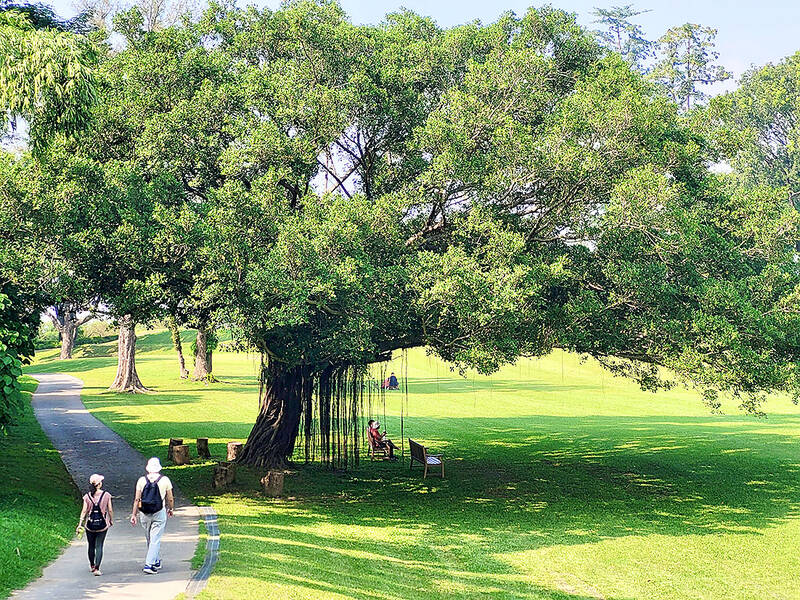
Photo: Tyler Cottenie
To get there, drive, ride or walk to the end of Ciouchang Road (球場路) in Niaosong District (鳥松). After walking through the front entrance, you have a nice elevated view of the course from the original first tee box.
If you’re not there to walk, sitting under the banyan trees with a view of Hole 10 and the mystical Jhongsing Tower (中興塔) is a lovely way to spend an hour or two. Sitting on one of the chairs on the clubhouse lawn with a view of the rolling fairway on Hole 18 and the less-than-mystical garbage incinerator in the distance is still a close second.
OUT FOR A WALK
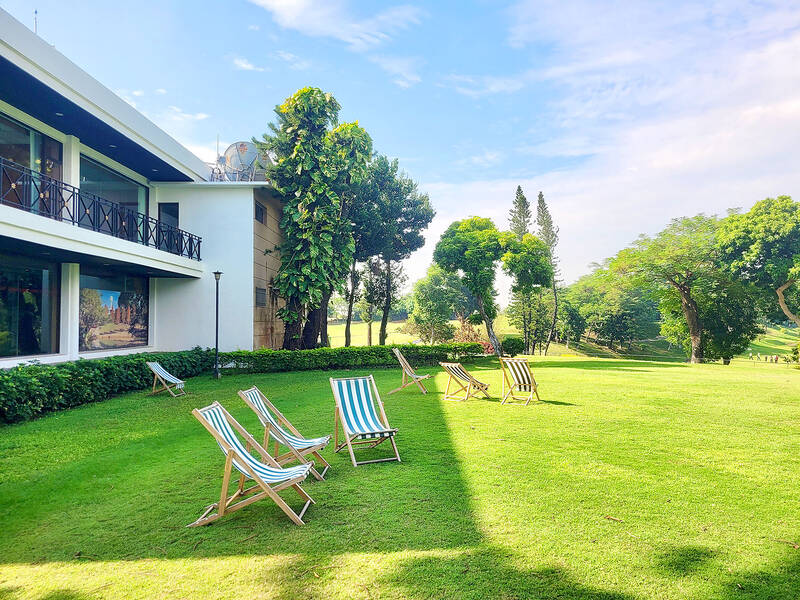
Photo: Tyler Cottenie
If you are looking for exercise, the best thing to do is to simply follow the holes in order. The layout of the course is such that the first nine holes are clustered together in the middle, ending back at the clubhouse, while the last nine holes go around the perimeter of the course, also ending back at the clubhouse. This works very well for a walk, as you can do just the front nine, or just the back nine, and still end up back where you started.
The walking itself makes for a comfortable and scenic escape from the city. A paved path for golf carts runs the entire length of each hole and makes it easy to follow the holes in order. The path also happens to run underneath tall trees for much of its length, making for a surprisingly shady and comfortable walk between the otherwise wide-open fairways.
On cooler or cloudier days, the fairways themselves are great to walk on. So far, they have been maintained to the same standard you would expect at an operational golf course. On both of my excursions here, the lawn mowers and turf blowers were hard at work.
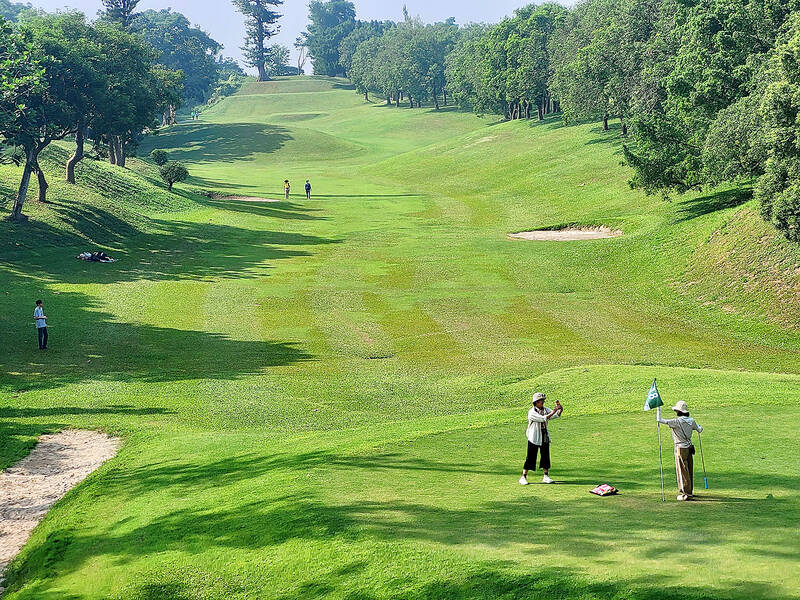
Photo: Tyler Cottenie
Some of the original greens are open to foot traffic and even have flags installed in the holes, while others have inexplicably been roped off. Greens are the most difficult type of grass to maintain at a golf course, but so far most of the old greens are still in great shape.
I did come across a peculiar sight on one of them: a half-dozen workers were on the ground digging up weeds by hand. This seems like a very labor-intensive way to maintain the greens, but then again, one of the reasons the golf course was closed down was due to the unlawful use of herbicides, so the manual approach actually does make sense.
LOTS TO SEE
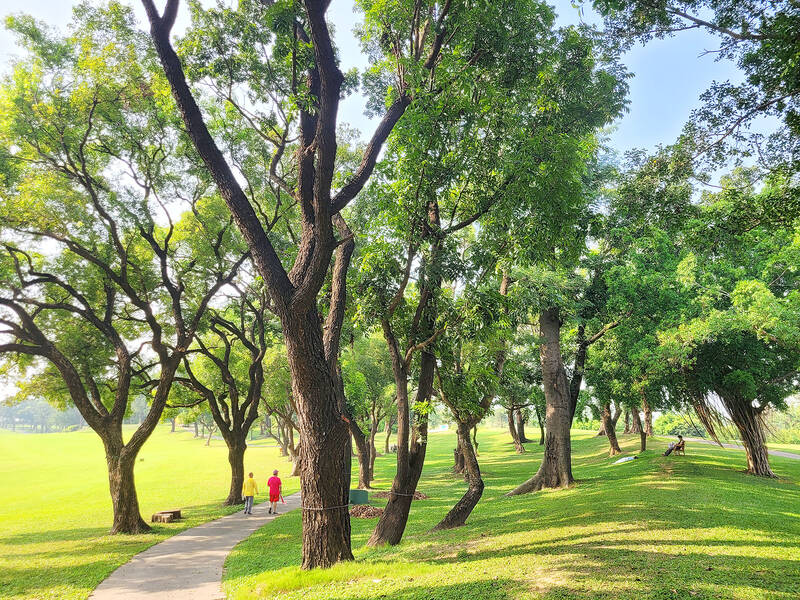
Photo: Tyler Cottenie
If you’re walking on the grass, keep your eyes out for birds. I spotted dozens of scaly-breasted munias feasting on grass seeds in the longer grass at the side of the fairway. Near the red-brick perimeter wall, I spotted a lone Malayan night heron walking away very slowly trying to avoid detection. You’re also likely to see much bigger birds above Kaohsiung Green Park: the Air Force’s C130s. Their flight path in and out of Pingtung County takes them right over the golf course.
In addition to the birds, one of the nicest features of the course is the great variety of attractive trees lining the fairways. These were carefully planted to provide a shady canopy above without compromising visibility down below. Since the creation of the park, numerous benches have been added to create convenient rest spots in these beautiful, shaded areas.
Most impressive is the labeling of these trees. Virtually every tall tree has been labeled with the name in Chinese, and a QR code bringing you to a city government webpage with information about the tree (Chinese only, so far, but the scientific name is given). There are shady banyans — a familiar sight near temples and in parks all over Taiwan — as well as more exotic trees like mahogany and kapok.
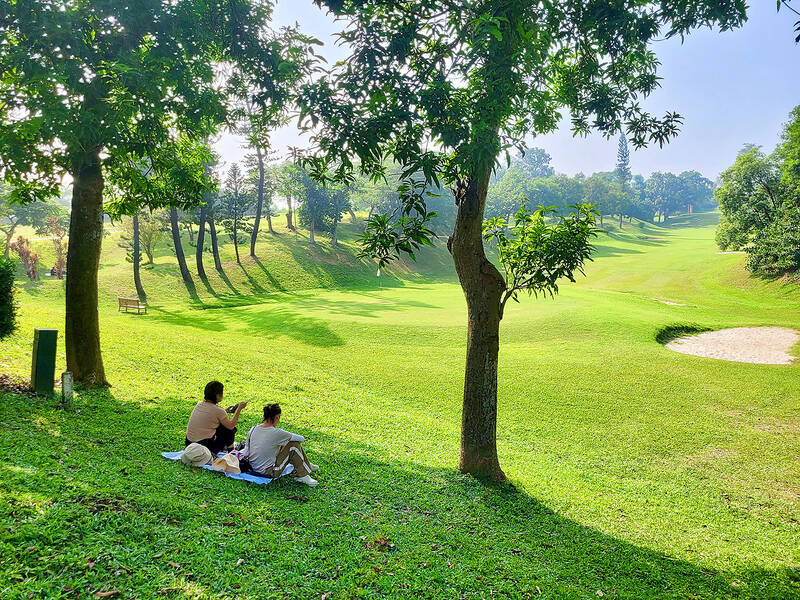
Photo: Tyler Cottenie
There are plenty of toilets around the course, so you can take your time while exploring the first nine holes. If you get thirsty, though, you will have to wait until you finish the front nine and get back to the clubhouse, where there is a tent selling cold drinks, and a water dispenser.
FINISHING OFF
If you’re continuing to the back nine, head past the ninth green to the old tee box for Hole 10. This hole is especially memorable for its backdrop: the Jhongsing Tower from the adjacent Chengcing Lake park. This multi-story octagonal pagoda is a lovely accent to the background scenery, visible from several holes but most prominent on Hole 10. By the time you reach the green, it towers above you less than 100 meters away.
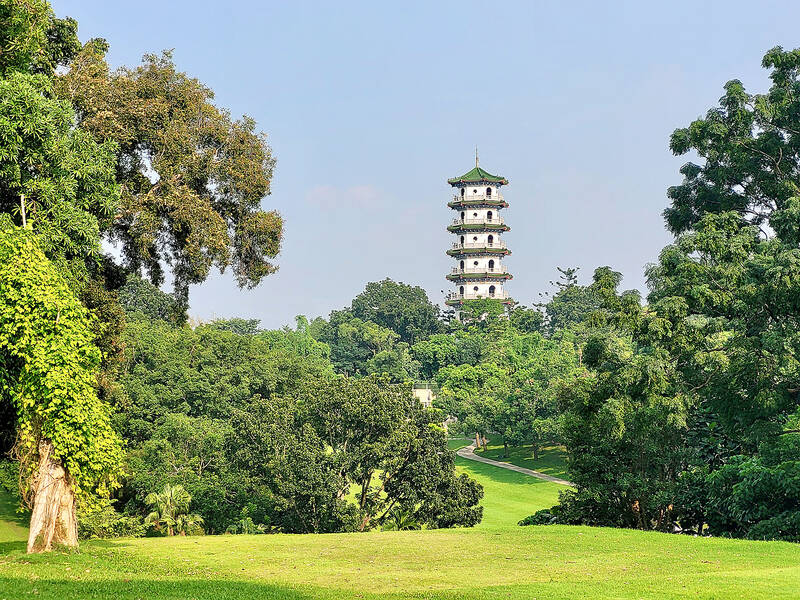
Photo: Tyler Cottenie
As you walk the perimeter of the course on the back nine holes, you will come across more vistas of the surrounding city. Modern apartment buildings create distant skylines. From Holes 13 to 15 you look down onto the newly developed Shuanghu Forest Park (雙湖森林公園) and Freeway No. 1 behind it. The golf course is the lynchpin in a new green corridor that will connect Chengcing Lake to the east with Shuanghu Forest Park and Jinshih Lake (金獅湖) to the west.
Use the new access path on Hole 14 to go down and explore Shuanghu Forest Park or carry on to Hole 15. Holes 16, 17 and 18 are parallel, so if you want to cut your visit shorter, choose one of them and head straight back to the clubhouse.
To leave the park, you could take Bus Y2 or O12 from right in front of the clubhouse, but these only go to nearby Chengcing Lake. They only operate on weekends, so a YouBike (the station is in front of the clubhouse) to anywhere else in the city may be your best transportation option.
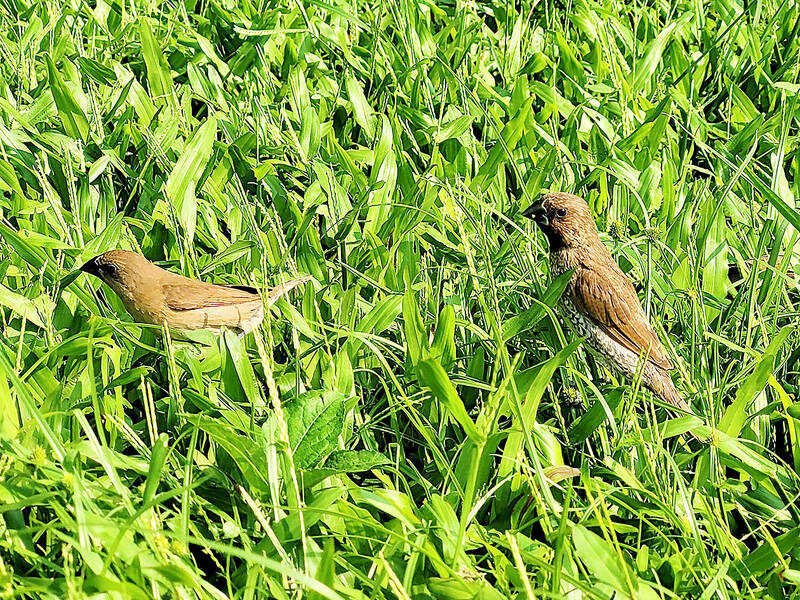
Photo: Tyler Cottenie
Cars and scooters can also park here for a charge of NT$30 per hour and NT$30 each time, respectively, or at the parking lot accessible from Bade South Road (八德南路) for the same cost. The free Shuanghu Forest Park parking lot is near the park’s southwest entrance, and there are walk-in entrances with no parking lots on the west side from within Shuanghu (mentioned above, at Hole 14), and on the east side from Songyi Road (松藝路).
It starts out as a heartwarming clip. A young girl, clearly delighted to be in Tokyo, beams as she makes a peace sign to the camera. Seconds later, she is shoved to the ground from behind by a woman wearing a surgical mask. The assailant doesn’t skip a beat, striding out of shot of the clip filmed by the girl’s mother. This was no accidental clash of shoulders in a crowded place, but one of the most visible examples of a spate of butsukari otoko — “bumping man” — shoving incidents in Japan that experts attribute to a combination of gender

The race for New Taipei City mayor is being keenly watched, and now with the nomination of former deputy mayor of Taipei Hammer Lee (李四川) as the Chinese Nationalist Party’s (KMT) candidate, the battle lines are drawn. All polling data on the tight race mentioned in this column is from the March 12 Formosa poll. On Christmas Day 2010, Taipei County merged into one mega-metropolis of four million people, making it the nation’s largest city. The same day, the winner of the mayoral race, Eric Chu (朱立倫) of the Chinese Nationalist Party (KMT), took office and insisted on the current

Last week the government announced that by year’s end Taiwan will have the highest density of anti-ship missiles in the world. Its inventory could exceed 1,400, or enough for the opening two hours of an invasion from the People’s Republic of China (PRC). Snark aside, it sounds impressive. But an important piece is missing. Lost in all the “dialogues” and “debates” and “discussions” whose sole purpose is simply to dawdle and delay is what the Chinese Nationalist Party (KMT) alternative special defense budget proposal means for the defense of Taiwan. It is a betrayal of both Taiwan and the US. IT’S
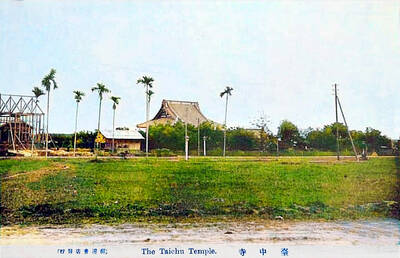
March 16 to March 22 Hidden for decades behind junk-filled metal shacks, trees and overgrowth, a small domed structure bearing a Buddhist swastika resurfaced last June in a Taichung alley. It was soon identified as a remnant of the 122-year-old Gokokuzan Taichuu-ji (Taichung Temple, 護國山台中寺), which was thought to have been demolished in the 1980s. In addition, a stone stele dedicated to monk Hoshu Ono, who served as abbot from 1914 to 1930, was discovered in the detritus. The temple was established in 1903 as the local center for the Soto school


 RSS
RSS