

Ryuichi Ichinokawa’s life could be right out of the movie Rental Family as the founder nearly two decades ago of the Heart Project business in Japan, which he bills as a surrogate attendance service complete with furnishing of extras and family members.
He has hired dozens of people to act like reporters with cameras and voice recorders, taking notes and milling with real journalists to fill up an otherwise rather vacant event. He has posed as the boyfriend of a woman who needs to discuss legal paperwork with her former spouse. And he has gone to a hospital as a stand-in husband for a woman getting fertility treatments.
“I am being of service to people. I hope they will be happy,” said Ichinokawa, a dapper elderly man who asked to not be photographed lest his identity become public.
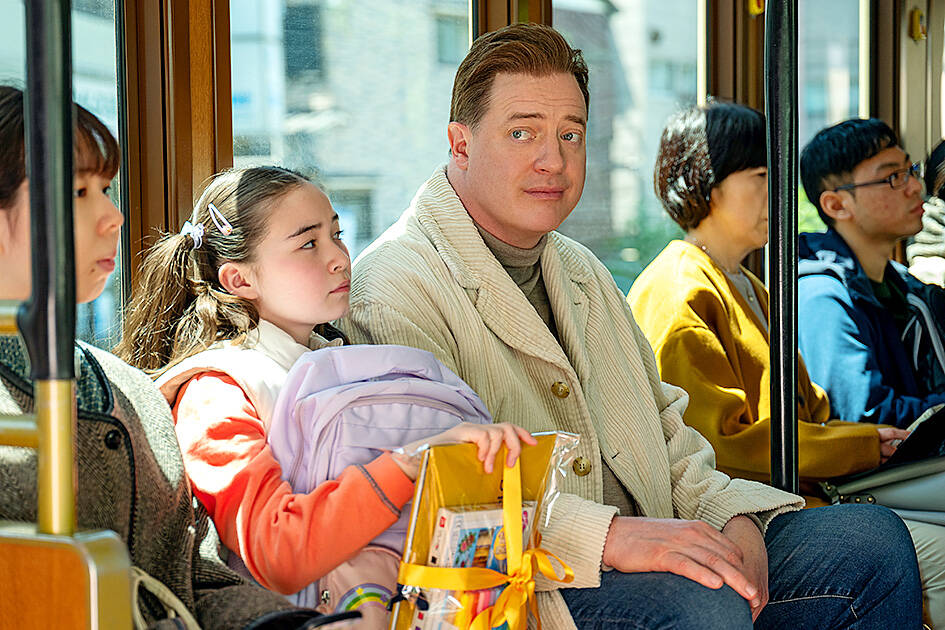
Photo: AP
Rental Family, a moving drama from Searchlight Pictures starring Brendan Fraser, is sure to spark interest in Japan’s real-life industry. The film centers on Phillip, an American actor who is recruited by a Tokyo “rental family” agency in need of a “token white guy.” His recurring jobs range from playing video games with a loner to portraying a little girl’s long absentee father. It isn’t long before Phillip starts to become emotionally invested in what were supposed to be superficial relationships. The film’s Japanese supporting cast also bring to life the intense highs and lows of assuming a role in a stranger’s life.
In reality, these niche businesses highlight how deeply people in Japan experience loneliness or worry about keeping up appearances. Outsiders may cringe at the idea of paying amateur actors to be fake family members or friends. But users say they find these services comforting and even healing.
STRESSFUL
The film’s director, Mitsuyo Miyazaki whose professional name is Hikari, was born in Japan yet knew little about the concept. Once she learned about it, she couldn’t stop thinking about what a unique story it could inspire. So Hikari started researching and found hundreds of companies in Japan that offer rental families or similar services. She spoke with several people in that world.
“I kind of started tackling those questions, and interviewed them on what are the necessities of the business that needs to happen in Japan. And then that’s how I kind of built stories,” Hikari said.
Even at a time when people seek company through Artificial Intelligence, she thinks hiring of actors to fill emotional voids will always be in demand.
“I don’t think they will disappear, honestly, it might just probably expand,” she said.
In Ichinokawa’s experience, most people who ask for the service have a certain social status to protect. He has organized visits to a bar for a hostess who wants to impress her employer with lots of clientele. Similar to the movie, Ichinokawa has gone to school events with a single mother and her child, acting as a friendly uncle.
Sometimes Ichinokawa takes extra steps to ensure the facade. If required, he will print fake business cards — which are routinely exchanged at Japanese gatherings.
Some parts are easy, like being a wedding guest who just sits and eats. But it’s often stressful work. You’re coached to avoid uttering the wrong name or background information. You might have to be prepared to talk about childhood memories you have no clue about. Ichinokawa used to scribble names on his hand. He also pores over notes in advance. If he’s really desperate, he excuses himself to the restroom.
Payment for getting rented out varies. For Heart Project, the relatively easy roles can make 9,800 yen (US$63) for a couple of hours. For the more elaborate parts, the client dishes out 20,000 yen (US$130) to 30,000 yen (US$190) per person.
Ichinokawa’s rule is that you only play a role once. To do it more than once is setting yourself up for failure. And he has never failed in his mission, he added proudly.
“I don’t feel I am acting. I really get angry if that’s what the situation requires,” he said.
LONELINESS EPIDEMIC
Japan has long grappled with loneliness, high suicide rates and a stigma surrounding mental illness. After a 2011 earthquake and tsunami, the country examined how the disasters were affecting mental health, said Miwa Yasui, a professor at the University of Chicago whose research includes the influence of culture on mental health.
Today, there are more mental health providers and an understanding of the need for counseling in Japan. During the pandemic, volunteers focused on teen depression started an online Japanese-language chat service.
Japanese people isolated physically are prone to feeling it internally, said Chikako Ozawa-de Silva, author of The Anatomy of Loneliness: Suicide, Social Connection and the Search for Relational Meaning in Contemporary Japan.
“When people feel they’re not loved, they are not accepted, they’re not seen, they’re not heard. The sense of ‘I don’t matter’ is a form of loneliness,” said Ozawa-de Silva, who is also a professor at Emory University.
This can lead to hikikomori, where people withdraw socially and become shut-ins for months or even years.
Japanese culture’s collectivist nature also contributes to hiding mental health challenges. Children are taught the principle of minna no tame ni or for the sake of everybody, Yasui said. As adults, there is pressure to maintain harmony and make sure the needs of others — work or family — are met.
“Within Asian cultures, there’s a concept of loss of face,” Yasui said. “If you lose that, that actually has significant implications.”
In Ozawa-de Silva’s opinion, renting actors for surface-level intimacy is putting a “Band-Aid” on a deeper problem.
“I’m not against that,” Ozawa-de Silva said. “If people can buy time by renting a family, while pursuing much better long-term solutions, I think the rental family could be a very, very beneficial thing.”
REAL CONNECTIONS
While someone with a Western mindset might find renting actors bizarre, many Japanese people find it reassuring. Much of the written feedback Ichinokawa gets expresses relief or appreciation: “Thank you for today. You really interacted with us like a real mother. My boyfriend kept saying, ‘What a great mom.’” From a male client: “Please relay my regards to the person who played the role of my wife and tell her she was a superb wife.”
The film, which will be released in February in Japan, uses the rental family concept to remind people that human nature’s need for connection is not something you can suppress.
“When you help somebody and if they feel like you’re being supportive, that makes you feel good,” Hikari said. “And a family member doesn’t have to be alway blood-related.”

Drones are widely recognized as a critical weapons technology of the future. Because of this, the pro-China Chinese Nationalist Party (KMT) and the Taiwan People’s Party (TPP) appear to be obstructing their development. One approach to handling this obstruction is to circumvent it by building robust drone capabilities across a wide swathe of the population. Taiwan is doing just that, but more is needed. The Penghu County Government on Monday said it was testing flying drones on routes from Magong City (馬公), the county seat, to Jibei Island (吉貝嶼). Because all of the inhabited islands lie within 40km of Magong,

For most train journeys, where you are going is the main consideration. On the Shanlan train (山嵐號) in eastern Taiwan, however, it’s not the “where” but the “how” that matters. On this pricey but meticulously crafted train journey running between Hualien and Taitung County’s Chihshang (池上), what you’re paying for isn’t to get from Point A to Point B, but rather a sensory, aesthetic and cultural experience. On the platform, the train stands out vividly next to the other Taiwan Railway carriages. Its exterior is painted in a yellow-green gradient intended to blend harmoniously with the ripening rice paddies of the East

For a time, it became popular to describe the tactics of the People’s Republic of China (PRC) in encroaching on sovereignty and militarizing islands in the South China Sea as “salami slicing.” Those slices have been getting chunkier. The People’s Liberation Army has been increasing its navy and air force activities in the region. The Chinese Coast Guard has likewise been ramping up their activities, and the civilian paramilitary People’s Armed Forces Maritime Militia has been backing up the navy and coast guard with alarming swarming maneuvers. The PRC claims most of the South China Sea through its U-shaped 10-dash

Another doleful set of demographic announcements this month from the National Development Council (NDC), with the number of young people shriveling as the proportion of old people grows. “Taiwan’s 18-year-olds, the typical age for entering college, will fall below 200,000 for the first time in the 2027 academic year to 195,309, down from 200,406 in 2026,” this paper reported citing NDC sources. Meanwhile, the administration of President William Lai (賴清德) announced a goal of training at least 500,000 AI professionals by 2040. Although this could include foreign recruits and retraining those already in the workforce, the math is stark: Ministry of


 RSS
RSS