


Artificial intelligence, the technology upending nearly every corner of society, is creeping into religion, serving up virtual Jesus and automated sermons — a change drawing mixed reviews from the faithful.
Religious chatbots and other faith-based digital tools are growing in number, offering counsel, comfort and spiritual guidance during an age of rapidly transforming socialization and engagement.
One app, which is called Text with Jesus, has thousands of paying subscribers. It lets people ostensibly ask questions of Mary, Joseph, Jesus and nearly all 12 apostles.
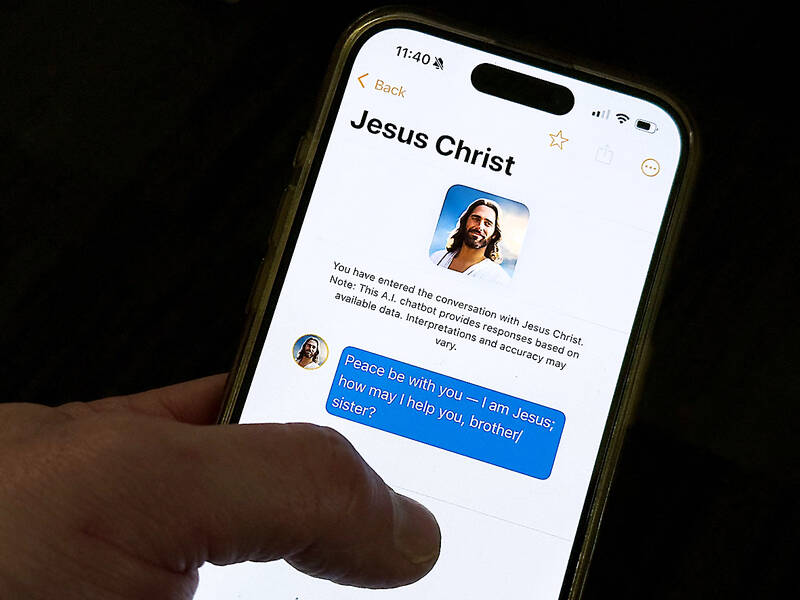
Photo: AFP
The idea is to educate, said Stephane Peter, CEO of Catloaf Software, which created the app. “This is a new way to address religious issues in an interactive way,” he said.
Although the app makes clear it uses AI, virtual Moses and Jesus don’t recognize that as such when asked the specific question. Peter said that ChatGPT’s latest version, GPT-5, on which Text With Jesus is based, follows instructions better than previous iterations. It is also better at staying in whatever character it is supposed to be and can deny more forcefully that it’s a bot.
He said many people consider the app blasphemous but it still has received a good rating in the App Store — 4.7 out of 5.

Photo: AFP
Online ministry Catholic Answers said it got a taste of how sensitive all this can be when it launched the animated AI character “Father Justin” last year.
“A lot of people were offended that it was using a priest character,” said Christopher Costello, the ministry’s director of information technology.
Days later, Catholic Answers stripped the avatar of its title to make it simply Justin.

Photo: AFP
“We don’t want to replace humans. We just want to help,” Costello said.
‘NO HEART, NO SPIRIT’
Other major religions have similar apps, such as Deen Buddy for Islam, Vedas AI for Hinduism, and AI Buddha. Most bill themselves as interfaces with scripture, not incarnations of actual holiness.
Nica, a 28-year-old Filipina who belongs to the Anglican Church, said she uses ChatGPT almost daily to study scripture — even though her pastor wants her to stop.
“I’d say it’s an added layer,” said Nica, who declined to give her last name.
“I am in a Christian community and my husband and I have spiritual mentors. It’s just that sometimes I have random thoughts about the Bible and I want answers immediately.”
Not many will acknowledge using AI assistants in matters of religion, even though some of these apps have been downloaded millions of times.
“People who want to believe in God maybe shouldn’t ask a chatbot. They should talk to people that believe, too,” said a woman named Emanuela as she left St Patrick’s Cathedral in New York.
Rabbi Gilah Langner said the halakhah — the collective body of religious laws derived from the Torah, the Jewish holy book — has many interpretations. Jews need other Jews, with their insights and perspective, to connect them to the tradition of their faith, she said.
“I don’t think you really get that from AI. It’s possible it would be very nuanced, but the emotional connection is missing,” Langner said.
AI can make people feel “isolated and not in an organic connection to a living tradition,” she added.
For their part, Christian communities do not reject AI outright.
Peter said he had spoken to clergy members and they agreed that AI could be a tool to educate people.
Last year Pope Francis named Demis Hassabis, a co-founder of AI research lab Google DeepMind, to serve in the Vatican’s scientific academy.
And as much of society experiments with artificial intelligence, so does the clergy.
In November 2023, pastor Jay Cooper of the Violet Crown City Church in Austin, Texas, had an AI assistant deliver an entire sermon. He warned parishioners in advance.
“Some people freaked out, said we are now an AI church,” said Cooper. But, he added, the service lured some people who did not usually attend church, especially video-game buffs.
Cooper said he has considered other ways of integrating AI into his church but has not repeated the AI sermon.
“I’m glad we did it,” he said, “but it missed the heart and spirit of what we usually do.”

The small platform at Duoliang Train Station in Taitung County’s Taimali Township (太麻里) served villagers from 1992 to 2006, but was eventually shut down due to lack of use. Just 10 years later, the abandoned train station had become widely known as the most beautiful station in Taiwan, and visitors were so frequent that the village had to start restricting traffic. Nowadays, Duoliang Village (多良) is known as a bit of a tourist trap, with a mandatory, albeit modest, admission fee of NT$10 giving access to a crowded lane of vendors with a mediocre view of the ocean and the trains
For many people, Bilingual Nation 2030 begins and ends in the classroom. Since the policy was launched in 2018, the debate has centered on students, teachers and the pressure placed on schools. Yet the policy was never solely about English education. The government’s official plan also calls for bilingualization in Taiwan’s government services, laws and regulations, and living environment. The goal is to make Taiwan more inclusive and accessible to international enterprises and talent and better prepared for global economic and trade conditions. After eight years, that grand vision is due for a pulse check. RULES THAT CAN BE READ For Harper Chen (陳虹宇), an adviser

Traditionally, indigenous people in Taiwan’s mountains practice swidden cultivation, or “slash and burn” agriculture, a practice common in human history. According to a 2016 research article in the International Journal of Environmental Sustainability, among the Atayal people, this began with a search for suitable forested slopeland. The trees are burnt for fertilizer and the land cleared of stones. The stones and wood are then piled up to make fences, while both dead and standing trees are retained on the plot. The fences are used to grow climbing crops like squash and beans. The plot itself supports farming for three years.

President William Lai (賴清德) on Nov. 25 last year announced in a Washington Post op-ed that “my government will introduce a historic US$40 billion supplementary defense budget, an investment that underscores our commitment to defending Taiwan’s democracy.” Lai promised “significant new arms acquisitions from the United States” and to “invest in cutting-edge technologies and expand Taiwan’s defense industrial base,” to “bolster deterrence by inserting greater costs and uncertainties into Beijing’s decision-making on the use of force.” Announcing it in the Washington Post was a strategic gamble, both geopolitically and domestically, with Taiwan’s international credibility at stake. But Lai’s message was exactly


 RSS
RSS