


The days when the race for Chinese Nationalist Party (KMT) chair was preordained are long over, and this year’s election is dramatic and exciting.
The six candidates’ strategies, including their stances on relations with China, the military and sovereignty, are starting to take shape. Tomorrow, a debate on cross-strait relations is scheduled, which may provide more clarity.
There are many polls attracting attention, but only those done by Apollo Survey & Research Co (艾普羅民調公司) target the people who can actually vote, KMT party members. Their latest poll of 1089 people does include — they noted — 396 non-party members, which is unsurprising considering they only conducted the poll over two days. The election takes place on Oct. 18.
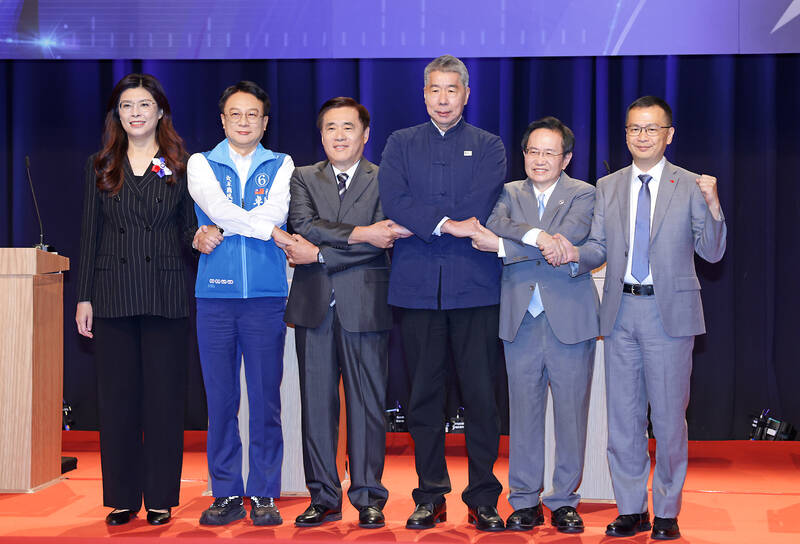
Photo: CNA
CHENG LI-WEN, THE DETERMINED FRONTRUNNER
The clear frontrunner, increasing her lead from Apollo’s earlier poll, is 56-year-old Cheng Li-wun (鄭麗文) with 30 percent support. She also led the pack on the question “who can return the KMT to power” at 28.3 percent.
Tall and striking, she is a powerhouse of energy and determination. She is also an interesting character and popular on talk shows and online.
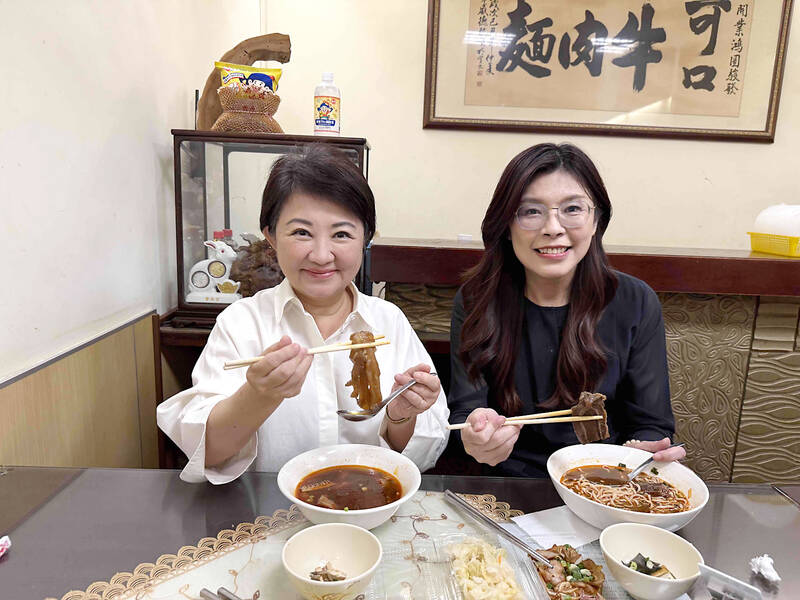
Photo: Tsai Shu-yuan, Taipei Times
Originally a Democratic Progressive Party (DPP) lawmaker, she was either kicked out of the party or — according to her — resigned in 2002. After a few years as an independent, she joined the KMT and has served several roles, including two terms as a party-list lawmaker.
She has adroitly used her backstory to her advantage. She was born into a family that fled the Chinese Civil War and grew up in a military dependent’s village in Yunlin County.
This background appeals to many in the powerful KMT military faction, and being from Yunlin helps with KMT patronage faction supporters. She also plays up her modest upbringing, which contrasts with the party elites, especially Hau Lung-bin (郝龍斌).
Taichung Mayor Lu Shiow-yen (盧秀燕) has been meeting candidates. As the presumed KMT presidential candidate in 2028, her support could tip the race.
Lu has not endorsed anyone — a smart strategy — but does appear to be signaling which candidates she finds acceptable. She said of Cheng, “We are sisters, sisters take care of sisters.”
Cheng has been doing so-so on endorsements, garnering some key figures in the military and in business circles. She has released an economic white paper and suggested she might reinstate the powerful Huang Fuhsing military faction disbanded under current Chairman Eric Chu (朱立倫).
However, some worry about her ideology, which is frequently compared to the deeply unpopular Hung Hsiu-chu’s (洪秀柱).
HAU LUNG-BIN, THE UNINSPIRER
The frontrunner in endorsements is 73-year-old former Taipei Mayor Hau. He has been endorsed by media mogul Jaw Shaw-kong (趙少康), New Taipei City Council Speaker Chiang Ken-huang (蔣根煌) of the association of city and county council speakers and deputies, Chang Chia-chun (張嘉郡) of the powerful Yunlin Chang clan and reportedly also has the backing of KMT caucus convener Fu Kun-chi (傅?萁).
Lu Shiow-yen also met with him and said encouraging words, suggesting she also finds him acceptable.
Hau looks and speaks like a KMT official from central casting, and is the son of former premier and general Hau Pei-tsun (郝柏村). He ran and lost in two previous runs for KMT chair and has seen his political fortunes slump since stepping down as mayor.
Hau’s problem is that his support appears to be “I guess he will have to do,” rather than any particular excitement about him. Reportedly, despite high-level endorsements, some local factional supporters are giving Cheng a second look.
Hau only has 17.4 percent support, but comes out ahead in expectation he will win at 27 percent, slightly ahead of Cheng’s 26.1 percent. The bad news for Hau is that only 12.6 percent think he could lead the KMT back to power, coming in third.
His debate appearances have been mediocre, coming across as bland though making no big mistakes.
He has also discussed reviving the Huang Fuhsing, suggesting he is worried about military support, despite his legendary father.
Some KMT members in the south reportedly demanded he choose Cheng as his vice chair, which he initially rejected, but has since reversed course on, and is now actively touting working with her and fellow candidate Lo Chih-chiang (羅智強) to bridge the generations.
LO CHIH-CHIANG, THE TALKER
The 55-year-old Lo is nipping at Hau’s heels, with 16.3 percent support, or within the margin of error. He also beat out Hau to come in second in returning the KMT to power at 14.4 percent.
Lo was a close aide to former president Ma Ying-jeou (馬英九), and Ma released a video endorsing him. However, this showed how far Ma’s influence has fallen since the days he could play kingmaker behind the scenes without having to show his hand publicly.
His other endorsements have largely been limited to mid-level, younger figures such as lawmaker Hsu Chiao-hsin (徐巧芯). He lacks the institutional backing of Hau, and has not been as successful as Cheng at winning organizations over.
Like Cheng, Lo is also energetic and popular on talk shows. He has a gift for self-promotion and drawing online followers, but there is a sense that he has trouble being taken seriously within the party.
His big selling points are that he is younger and the KMT needs a generational change, and has been active in “selflessly” supporting KMT figures whenever he can. He claims he has already been doing the things that KMT Chairman Chu should have been doing.
Lo also touts his good relationship with the Taiwan People’s Party (TPP), which is a strong point.
I suspect his primary motivation for running is to raise his political profile for the future, but if Cheng stumbles and Hau continues to fail to inspire, Lo could win.
CHANG YA-CHUNG, THE PURIST BUZZSAW
Chang Ya-chung (張亞中) is in the race to influence the debate. He only has 3.2 percent support, despite having run a strong second in 2021.
He is an ideological purist and very blunt. In the debates, he has openly called his opponents “hypocrites” and skewered them very effectively for their political games.
His criticisms are often very on point, and calls attention to real issues rather than sweeping them under the rug. In one debate, he bluntly called on the other candidates to state their stance on unification with China and to explain what the “1992 consensus” really means. The other candidate’s answers were predictably mushy.
He sometimes dresses in traditional Chinese style and probably views himself as the avatar of Sun Yat-sen (孫逸仙), which would be fitting considering he runs the Sun Yat-sen School.
TSAI AND CHO, THE DREAMERS
The least likely candidate to win is Tsai Chih-hong (蔡志弘), a legal scholar who has served in various roles. He comes across as a nice, elderly professor, but in the latest poll, he garnered zero percent support.
Former Changhua County Commissioner Cho Po-yuan (卓伯源) is also a long shot with only 1.3 percent support, but unlike Tsai, he has had some press coverage.
He was not invited to the first CTiTV News debate, but stormed the event press conference in protest. Ironically, his accusations against CTiTV were similar to the criticisms that the outlet leveled against the National Communications Commission for taking away their license to broadcast on cable television. Due to his behavior after the first debate, he was not invited to the second one.
Cho also got attention for promising to “personally” go to Beijing to invite Secretary-General Xi Jinping (習近平) to visit Taiwan, and then plans to invite US President Donald Trump for the two to have a peace summit. He also claims he can get the UN to relocate its headquarters to Taiwan, with the approval of Xi.
Donovan’s Deep Dives is a regular column by Courtney Donovan Smith (石東文) who writes in-depth analysis on everything about Taiwan’s political scene and geopolitics. Donovan is also the central Taiwan correspondent at ICRT FM100 Radio News, co-publisher of Compass Magazine, co-founder Taiwan Report (report.tw) and former chair of the Taichung American Chamber of Commerce. Follow him on X: @donovan_smith.
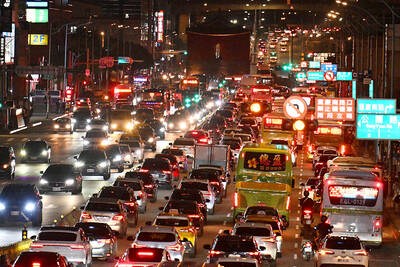
By global standards, the traffic congestion that afflicts Taiwan’s urban areas isn’t horrific. But nor is it something the country can be proud of. According to TomTom, a Dutch developer of location and navigation technologies, last year Taiwan was the sixth most congested country in Asia. Of the 492 towns and cities included in its rankings last year, Taipei was the 74th most congested. Taoyuan ranked 105th, while Hsinchu County (121st), Taichung (142nd), Tainan (173rd), New Taipei City (227th), Kaohsiung (241st) and Keelung (302nd) also featured on the list. Four Japanese cities have slower traffic than Taipei. (Seoul, which has some

In our discussions of tourism in Taiwan we often criticize the government’s addiction to promoting food and shopping, while ignoring Taiwan’s underdeveloped trekking and adventure travel opportunities. This discussion, however, is decidedly land-focused. When was the last time a port entered into it? Last week I encountered journalist and travel writer Cameron Dueck, who had sailed to Taiwan in 2023-24, and was full of tales. Like everyone who visits, he and his partner Fiona Ching loved our island nation and had nothing but wonderful experiences on land. But he had little positive to say about the way Taiwan has organized its
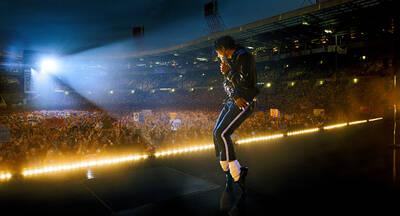
Michael slides a sequin glove over the pop star’s tarnished legacy, shrouding Michael Jackson’s complications with a conventional biopic that, if you cover your ears, sounds great. Antoine Fuqua’s movie is sanctioned by Jackson’s estate and its producers include the estate’s executors. So it is, by its nature, a narrow, authorized perspective on Jackson. The film ends before the flood of allegations of sexual abuse of children, or Jackson’s own acknowledgment of sleeping alongside kids. Jackson and his estate have long maintained his innocence. In his only criminal trial, in 2005, Jackson was acquitted. Michael doesn’t even subtly nod to these facts.
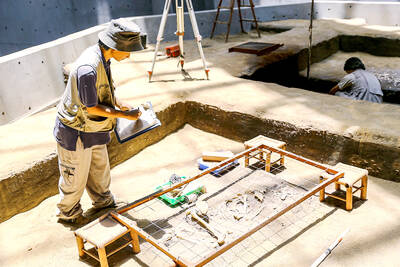
Writing of the finds at the ancient iron-working site of Shihsanhang (十 三行) in New Taipei City’s Bali District (八里), archaeologist Tsang Cheng-hwa (臧振華) of the Academia Sinica’s Institute of History and Philology observes: “One bronze bowl gilded with gold, together with copper coins and fragments of Tang and Song ceramics, were also found. These provide evidence for early contact between Taiwan aborigines and Chinese.” The Shihsanhang Web site from the Ministry of Culture says of the finds: “They were evidence that the residents of the area had a close trading relation with Chinese civilians, as the coins can be


 RSS
RSS