


A theater experience co-produced by Taiwan has been selected to be part of the extended reality (XR) section of the 82nd Venice International Film Festival (VIFF) in late August, while a Taiwanese animated film has been shortlisted for the festival's best short film award.
"Blur," an XR experience co-produced with Canada's PHI Studio and Greece's Onassis Culture, is to make its overseas premiere at the 2025 edition of VIFF's "Venice Immersive Selection and Competition" from Aug. 27 to Sept. 6 this year, according to a press release from Taiwan's Riverbed Theater Wednesday.
The experience garnered widespread attention after it was first shown during the Taiwan International Festival of Arts (TIFA) at the National Theater and Concert Hall's Experimental Theater from March 22 to April 2.
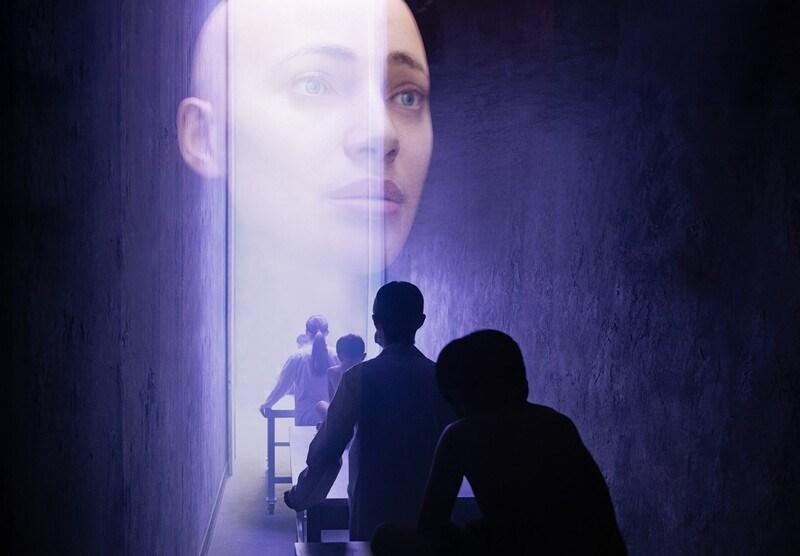
Photo courtesy of the National Taichung Theater via CNA
After the festival, Riverbed Theater took the experience to the National Taichung Theater Arts NOVA at the end of May.
Written and directed by Riverbed Theater's American director Craig Quintero with Canadian actress Phoebe Greenberg, Blur is a mixed-reality theater experience which blends virtual reality technology (VR), augmented reality programming, artificial intelligence (AI) algorithm calculations, 4D VIEW motion capture and 3D interactive animation with a live performance by an actress who only engages with a limited 10-member audience in each show.
The show ponders the question "What if we could defeat death?" by exploring the territory between life and death as well as fact and fiction.
The experience takes the 10-member audience on a journey where they encounter magical possibilities and the terrifying consequences of scientific advancements that conquer death in the near future.
Initiated in 2017, the XR section of the annual VIFF is the first A-list level competition of its kind for XR works.
Orizzonti Short Films
In addition to Blur, Taiwanese animation director Joe Hsieh's (謝文明) "Praying Mantis" was also shortlisted by VIFF for its latest Orizzonti Short Films International Competition.
Praying Mantis will premiere alongside 13 other short films during the selection process, with the winner of the Orizzonti Award for Best Short Film getting to screen their short out of competition.
The selection of the short marked the first time a Taiwanese animation was chosen to participate in the Orizzonti Short Films International Competition.
"I am honored to bring this new work to this hallowed hall of films (VIFF)," Hsieh told CNA. "I am grateful to all the partners that have teamed up with me along the way. This honor is the fruit of all of our hard work."
According to Hsieh, it took four years and a team of 40 local animators and crew to craft the short with its pencil-sketch aesthetic.
The short film is set amid Taiwan's 1980s drinking establishment culture where a lady lures men from bars to murder them and feed their remains to her children.
The cast features the voices of Golden Horse Awards best leading actress winner Chen Shu-fang (陳淑芳) and best supporting actor winner Bamboo Chen (陳竹昇) in a full Taiwanese-Hoklo dialect animated short thriller production.
Ajay Verma, a consultant gastroenterologist at Kettering general hospital in Northamptonshire, says our gut is a “complex machine.” “It is constantly providing us with the nutrition we need, initially to grow and develop, and then for us to survive, thrive and repair from injury and illness.” How can we keep it functioning well? Put simply: “Make sure what you put into it is balanced, and that you clear out its waste products adequately,” Verma says. “In a general gastroenterology clinic, the most common conditions we see are irritable bowel syndrome (IBS), gastroesophageal reflux disease, inflammatory bowel disease and constipation,” says Nisha
The arithmetic is straightforward and uncomfortable. By the end of 2025, Taiwan had committed itself to a 50-30-20 electricity mix — half natural gas, 30 per cent coal, 20 per cent renewables. The Ministry of Economic Affairs’s (MOEA) own monthly energy reports tell a different story. Natural gas reached 47.8 per cent of generation last year. Coal stood at 35.4 per cent, comfortably above its target ceiling. Renewables came in at 13.1 per cent, well short of the 20 per cent Taipei had pledged a decade earlier. Installed renewable capacity reached roughly half of the 12 gigawatts (GW) the government

Last week US President Donald Trump was asked by a reporter whether he would speak on the phone to the President of Taiwan. “l’ll speak to him. I speak to everybody. We have that situation very well in hand,” Trump said. This marked the second time in a couple of weeks he had said he would talk to the President of Taiwan. In 2016 he famously took a call from then-president Tsai Ing-wen (蔡英文), when he was president-elect. Despite warnings that the apocalypse was nigh because of a phone call, the world quickly forgot about the conversation between two democratically-elected presidents.

May 25 to May 31 Few believed that apples could be cultivated on a commercial scale in Taiwan’s high mountains. When horticulturalist Cheng Chao-hsiung (程兆熊) first proposed the idea in 1955, both American and Taiwanese colleagues dismissed it as implausible, arguing that temperate fruit could not be reliably grown on a subtropical island, especially on rugged terrain. However, it was this terrain in the Central Mountain Range where many Chinese Civil War veterans were resettled in the late 1950s. With limited job prospects and no family in Taiwan, they were placed on cooperative farms aimed toward self-sufficiency. Some say the conditions


 RSS
RSS