


Time was, the ultimate honor for any ambitious chef was to gain a Michelin star or two. Better still, three. But these days, the world of fine dining is in a state of flux. Far from going to any lengths to schmooze critics or diners, restaurateurs are taking them on, from publicly berating customers who don’t spend enough to ejecting anyone who even threatens to leave an unfavorable review.
Nowhere is this gear change more noticeable than in attitudes towards the esteemed “red book,” the Michelin Guide. Last October, Giglio, a restaurant in the Italian town of Lucca, asked for its star to be removed from the guide. It had become a burden, according to co-owner, Benedetto Rullo. Many diners were deterred by the prospect of “fussy” food and a formal atmosphere.
“One should be able to go to a fine restaurant in a T-shirt, flip-flops and shorts,” Rullo said.
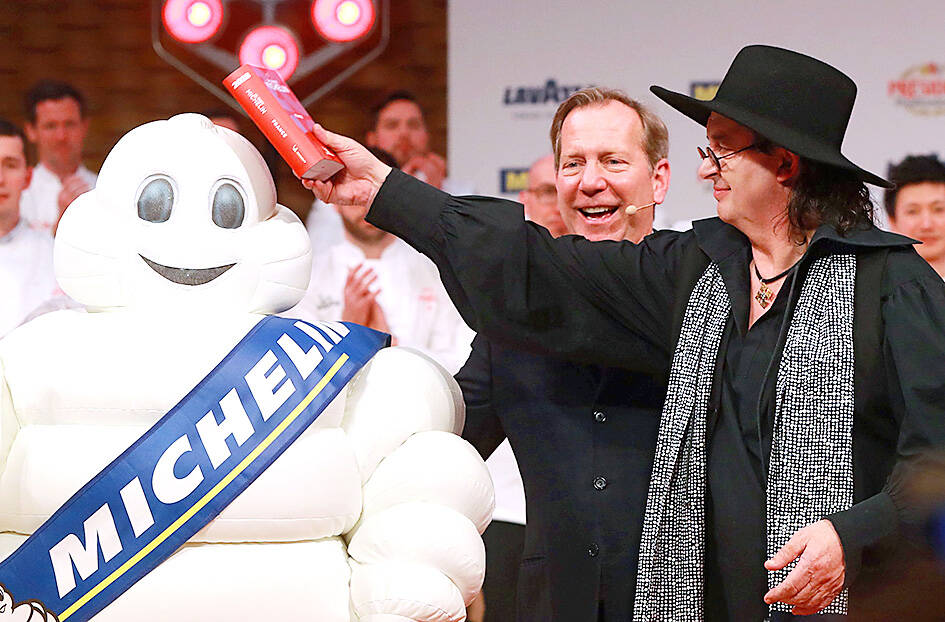
Photo: AFP
This year in France, the chef Marc Veyrat took the unprecedented step of banning Michelin inspectors from his eponymous new restaurant in the super-chic ski resort of Megeve. It must be said that Veyrat has form with Michelin. In 2019, at his previous restaurant, he was outraged to have one of his three stars removed. The reason? Inspectors accused him of using cheddar in a souffle. Imagine! Rather than taking it on the chin, Veyrat took Michelin to court. He lost the case and Michelin called him “a narcissistic diva.”
Given that Michelin stars are known to significantly boost a restaurateur’s takings (by 20 percent for a single star, 40 percent for two and 100 percent for three, said the late Joel Robuchon, who won 31 of them), why would anyone want to keep the inspectors at bay? Particularly as Michelin’s undercover reviewers pay the bill rather than expecting to eat for nothing, and Veyrat’s current eight-course tasting menu (sample dish: meadowsweet emulsion on a lobster tartlet) costs a crunchy €450 (US$511) per head.
’GRAVE DIGGERS OF FRENCH GASTRONOMY’
Veyrat said that, although the matter was very close to his heart, he was too busy to explain his reasoning. Instead, he sent us a photo of his chalkboard message to Michelin. It opens with the line: “Shame on the gravediggers of French gastronomy.”
One reason for chefs’ antipathy towards the guide is the extreme pressure to live up to the accolade. These criticisms of Michelin have been rumbling for a long time: in 2012, the chef Skye Gyngell complained that the star she won at Petersham Nurseries in London had become a curse, and “prayed” she would never be awarded another. Finally walking away from the restaurant, she said it had become too busy and there had been too many complaints from customers expecting a type of fine dining experience at odds with her more casual style.
Running a restaurant at this level is stressful. Last year, the Belfast-based restaurateur Michael Deane was faced with a dilemma. A veteran of the city’s dining scene, he gained his first Michelin star 30 years ago and not only held on to it but also opened several other establishments. Then his head chef at the one-star Eipic left to set up his own business.
“I was left on the back foot,” Deane says. “Did I want to hire an egotistical high-end chef to come in on £50,000 to do three tables at lunch, two at dinner and have to employ six waiters? Did I want to get back into the kitchen at that level? I didn’t think so. I’m better at business than cooking. Or was it time to think about change? It was a very, very difficult decision.”
In the end, he decided to renovate the space, merging it with an adjacent restaurant.
“I decided to do a menu that chefs didn’t rate, and to stop using cheffy nonsense words like ‘emulsion’ and ‘textures.’ I brought the prices down to what people could afford.”
The result was the 90-seater MrDeanes, serving sweet and sour chicken wings, burgers and fish and chips alongside oysters and brie fritters with truffle honey.
He admits he misses the glamour of having a star.
“It was very, very difficult to hold on to it. Some people say it’s just a stick to beat yourself with. But I enjoyed having it and for nearly 30 years I stood over that stove and Michelin was the holy grail. It’s an international currency. If you go abroad and you tell someone you’ve got a Michelin star, they know about you and they know you’ve got a standard.”
But in recent years, Michelin has struggled to stay relevant to a new generation of diners and influencers. It has introduced “green stars” to honor sustainability, and expanded its geographical and culinary reach — which might explain why El Califa de Leon, a three-meter-square taco restaurant in Mexico City, ended up being awarded a star.
These changes have not all been successful, according to Andy Hayler, a food blogger who has reviewed 1,000 restaurants in London and 2,000 worldwide. Until the pandemic, Hayler had eaten at every three-star Michelin restaurant in the world, a project he funded with his day job as an IT professional.
“Between 2016 and 2018, Michelin were forced to change their business model,” he says. “No one was buying print guidebooks any more, so they started taking money from tourist boards in places like America, China and Korea.”
In South Korea, tourist officials were reported to have offered Michelin £1.4 million (US$1.85 million) to produce a guide to Seoul.
“The problem is, there is a conflict of interest with that,” says Hayler. “It’s extremely unlikely that Michelin is going to take millions of dollars from a tourist board and then say: ‘Oh, sorry — all your restaurants are crap, so no stars for you.”
Michelin insist that the process of selecting restaurants and awarding stars has not been compromised, with separate teams responsible for sponsorships and ratings. But Hayler says that the standard of the newer three-star establishments was getting “dodgier and dodgier” and eventually, with the advent of lockdown travel restrictions, he decided to abandon his mission.
“I wasn’t prepared to jump on a plane and fly to Taipei or South Korea every time Michelin landed a new contract with a tourist board.”
POOR PRO
There are also problems with the quality of Michelin’s online prose — much of which suggests artificial intelligence. One example, for a two-star Japanese establishment in Seoul, reads: “A culmination of such painstaking effort, the fare at Mitou genuinely reflects a sense of earnestness, modesty and dedication harbored by the two chefs as eternal students of culinary art. It thus comes as no surprise that customers eagerly anticipate Mitou’s new offerings every season.”
Hayler takes issue with this, though.
“Oh no, the writing was that bad long before AI came around,” he says. “Historically, the guides only included symbols, not text — like the Rosetta Stone but for restaurants. Then, when the first city guide, New York, appeared, they started to hire copywriters. People were hoping to read all these juicy insights from Michelin inspectors — but that isn’t what they got.”
Of course, there are reasons beyond economic pressure why Michelin is struggling to retain cultural capital. When the guide was launched in 1900 by the tire company’s founders, brothers Andre and Edouard Michelin, it was designed to help car owners plan their trips. Nowadays, its selling point is catering-industry expertise.
Michelin’s PR hub claims that its assessments are made based on five objective criteria: quality of the ingredients used, mastery of flavor and cooking techniques, the personality of the chef in his cuisine, value for money and consistency between visits. But now we have TripAdvisor, Google reviews and endless influencers peddling their opinions, does anyone care very much about opaque points systems and meticulous industry knowledge?
Elizabeth Auerbach has been writing her blog Elizabeth on Food for 15 years.
“I do believe that if you are a chef, Michelin still carries a lot of weight. For most, the day they are awarded their first Michelin star is probably still one of the most important days of their life. But for diners, I’m not so sure. I mean, for someone my age — I’m 51 — we still value the whole fine dining experience with all the bells and whistles. But many younger people don’t care about it because they can’t afford it. It’s getting increasingly expensive, too.”
She mentions that the two-star Ikoyi, a West African-inspired restaurant in London, now charges £350 for its tasting menu, the kind of prices you only used to see at three-star restaurants. Although Auerbach is known as an expert in her field and now publishes a food guide to Amsterdam, she has never been approached to be an inspector.
“I couldn’t do it, anyway. You have to eat two full meals a day, five days a week. That would be too much!”
Karan Gokani, co-founder of Hoppers Sri Lankan restaurants in London and author of a bestselling cookbook, agrees that the concept of fine dining is out of step with how we live now. He fell in love with Michelin-star food when he came to the UK from India to study law.
“I used to be very enamored of these chefs who do multi-course kitchen concepts and about 15 processes in every dish. But now it’s got to the point where, as a diner, I just want a quick meal. It’s not only the cost — sometimes you just want things to be on your terms. I want wholesome food at a pace that I can dictate. Maybe I want the starters and mains to turn up at the same time. Maybe I want to order a few dishes, and then I want a few more. A restaurant should be a dialogue. A lot of the Michelin-star places have turned a meal into one long monologue.”
INCONSISTENCY
Gokani says that one of his biggest frustrations with the guide is its inconsistency.
“When you go out and give a star to a street-food vendor, it becomes very tricky. You’re not comparing like with like. Even in fine dining, it’s not consistent across territory. I used to live in Copenhagen and I know that the one-star restaurants there were often of equivalent standard to a two-star kitchen in London. The criteria are still cryptic. What gets you a star?”
We asked Michelin to comment on this and other points, but got no response.
Ironically, Gokani’s Hoppers has had a Michelin Bib Gourmand star since 2017.
“We never chased a star, or expected one,” he says. “I’m not just saying this because we’re in it, but I do think that the best guide for the way we eat out now is one based on price.”
The Bib awards started off by honoring menus under £30 but now have the more nebulous criteria of “affordable dining.”
And, for all his protests about Michelin, Deane has also been awarded a Bib. However, he, too, questions the affordability of fine dining in the current economic climate.
“If I had a Michelin star at the moment, would my old restaurant be packed out? I’m not so sure,” he says. “We struggled a bit towards the end. I’ve got a mortgage. I’ve got to put petrol in the car. I’ve got the VAT. Having a Michelin star is not always top of mind. And you have to get real. These days, our biggest competitor is probably not Michelin Bibs or even any other restaurant. As their Dine In menus get better and better, it’s Marks & Spencer.”

The small platform at Duoliang Train Station in Taitung County’s Taimali Township (太麻里) served villagers from 1992 to 2006, but was eventually shut down due to lack of use. Just 10 years later, the abandoned train station had become widely known as the most beautiful station in Taiwan, and visitors were so frequent that the village had to start restricting traffic. Nowadays, Duoliang Village (多良) is known as a bit of a tourist trap, with a mandatory, albeit modest, admission fee of NT$10 giving access to a crowded lane of vendors with a mediocre view of the ocean and the trains

For many people, Bilingual Nation 2030 begins and ends in the classroom. Since the policy was launched in 2018, the debate has centered on students, teachers and the pressure placed on schools. Yet the policy was never solely about English education. The government’s official plan also calls for bilingualization in Taiwan’s government services, laws and regulations, and living environment. The goal is to make Taiwan more inclusive and accessible to international enterprises and talent and better prepared for global economic and trade conditions. After eight years, that grand vision is due for a pulse check. RULES THAT CAN BE READ For Harper Chen (陳虹宇), an adviser

Traditionally, indigenous people in Taiwan’s mountains practice swidden cultivation, or “slash and burn” agriculture, a practice common in human history. According to a 2016 research article in the International Journal of Environmental Sustainability, among the Atayal people, this began with a search for suitable forested slopeland. The trees are burnt for fertilizer and the land cleared of stones. The stones and wood are then piled up to make fences, while both dead and standing trees are retained on the plot. The fences are used to grow climbing crops like squash and beans. The plot itself supports farming for three years.

President William Lai (賴清德) on Nov. 25 last year announced in a Washington Post op-ed that “my government will introduce a historic US$40 billion supplementary defense budget, an investment that underscores our commitment to defending Taiwan’s democracy.” Lai promised “significant new arms acquisitions from the United States” and to “invest in cutting-edge technologies and expand Taiwan’s defense industrial base,” to “bolster deterrence by inserting greater costs and uncertainties into Beijing’s decision-making on the use of force.” Announcing it in the Washington Post was a strategic gamble, both geopolitically and domestically, with Taiwan’s international credibility at stake. But Lai’s message was exactly


 RSS
RSS