


From retaliatory tariffs on US goods like car parts and soy beans to controls on raw minerals essential for American manufacturing — analysts say China has plenty of options if it wants to reply to fresh US levies.
US President Donald Trump over the weekend announced 10 percent tariffs on Chinese products, upping the stakes in a trade confrontation between the global superpowers that started eight years ago in his first term.
Beijing in response warned there were “no winners” in a trade war and vowed as yet unspecified countermeasures.
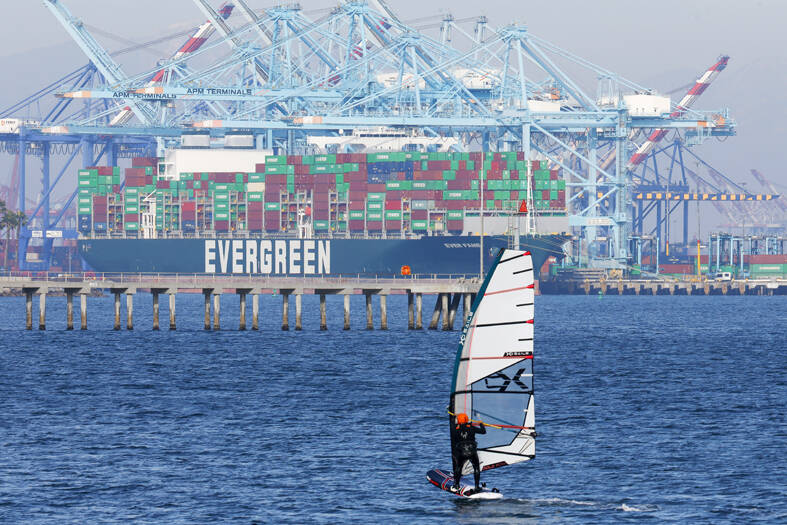
Photo: EPA-EFE
News that Canada and Mexico had agreed a deal with Trump to delay 25 percent tariffs on their goods was followed by his announcement that he would be holding talks with China “probably in the next 24 hours” to try for an agreement.
But, as the threat of new measures continues to hang over Beijing, eyes are on what officials there have lined up as a response. With its economy still struggling with sluggish consumption and slow growth, observers expect China to keep its powder dry for now — at least until another round of tariffs that could do greater damage.
“We expect China not to jump to immediate retaliation following the 10 percent tariff hike, but will keep the doors of negotiation and cooperation open,” UBS bank analysts wrote in a note.
“We do not expect China to follow the same strategy as in the first round of tariff hikes in 2018-19.”
Bilateral trade totaled more than US$530 billion last year, according to US data, with exports of Chinese goods to the United States exceeding US$400 billion. That was second only to Mexico.
But that yawning trade imbalance — US$270.4 billion in January-November last year — has long raised hackles in Washington.
LESSON LEARNED?
Key US demands in the first trade war were greater access to China’s markets, broad reform of a business playing field that heavily favors Chinese firms, and a loosening of heavy state controls.
This time around Washington has also called for China to crack down on exports to Mexico of chemical components used to make the synthetic opioid fentanyl, responsible for tens of thousands of overdose deaths a year. After long, fraught negotiations during Trump’s first term the two agreed what became known as the “phase one” deal — a ceasefire in the nearly two-year-old trade war.
Beijing was quick to retaliate throughout that standoff — imposing tariffs of its own on everything from cars to soybeans, designed to inflict harm on Trump’s voting base in rural America.
It also floated restrictions on exports of rare earth metals, of which China dominates global supplies and on which the United States remains heavily dependent.
And should a new trade war escalate, “measures could include tariffs, export controls on critical minerals essential for US manufacturing, restricted market access to US firms operating in China, or the depreciation of the yuan,” said Harry Murphy Cruise, head of China and Australia economics at Moody’s Analytics.
But he added Beijing may have learned its lesson from the first standoff.
“The tit-for-tat trade war in Trump’s first term benefited no one; it made trade more costly and hindered growth in both countries,” Murphy Cruise said.
CHINA’S WEAKER POSITION
For now, analysts believe the latest measures won’t bite too hard.
“The 10 percent tariff is not a big shock to China’s economy,” Zhang Zhiwei at Pinpoint Asset Management said in a note.
“It’s unlikely to change the market expectation on China’s macro outlook this year, which already factored in higher tariffs from the US,” he added.
And that could allow China to keep its powder dry in the event Trump’s first wave of tariffs are the prelude to a bigger showdown.
The US president has ordered an in-depth review of Chinese trade practices, the results of which are due by April 1.
That could serve as a “catalyst for more tariffs,” said Murphy Cruise, pushing Beijing to shift tactics.
“This strategy of no retaliation may change if the US imposes additional significant tariffs later on,” UBS economists said.
“In such a case, we think China may retaliate on a targeted basis and in a restrained manner, imposing tariffs on selected agricultural products, auto parts, energy,” they said.
Experts added that China could also let the value of its currency devalue, increasing the competitiveness of its exports.
Trump’s flagged talks with Beijing offer the two sides a chance to step back from the brink of a trade war that could hit hundreds of billions’ worth of goods.
“China is looking to diffuse tensions,” Murphy Cruise said.
“China’s economy is in a much weaker position this time around; it will be substantially harder to withstand a barrage of tariffs.”

As I finally slid into the warm embrace of the hot, clifftop pool, it was a serene moment of reflection. The sound of the river reflected off the cave walls, the white of our camping lights reflected off the dark, shimmering surface of the water, and I reflected on how fortunate I was to be here. After all, the beautiful walk through narrow canyons that had brought us here had been inaccessible for five years — and will be again soon. The day had started at the Huisun Forest Area (惠蓀林場), at the end of Nantou County Route 80, north and east
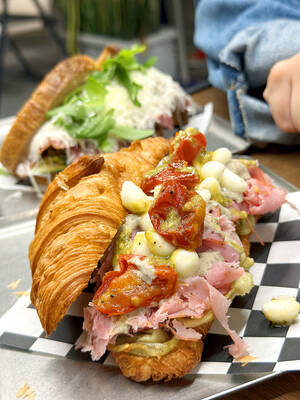
Specialty sandwiches loaded with the contents of an entire charcuterie board, overflowing with sauces, creams and all manner of creative add-ons, is perhaps one of the biggest global food trends of this year. From London to New York, lines form down the block for mortadella, burrata, pistachio and more stuffed between slices of fresh sourdough, rye or focaccia. To try the trend in Taipei, Munchies Mafia is for sure the spot — could this be the best sandwich in town? Carlos from Spain and Sergio from Mexico opened this spot just seven months ago. The two met working in the

Exceptions to the rule are sometimes revealing. For a brief few years, there was an emerging ideological split between the Democratic Progressive Party (DPP) and Chinese Nationalist Party (KMT) that appeared to be pushing the DPP in a direction that would be considered more liberal, and the KMT more conservative. In the previous column, “The KMT-DPP’s bureaucrat-led developmental state” (Dec. 11, page 12), we examined how Taiwan’s democratic system developed, and how both the two main parties largely accepted a similar consensus on how Taiwan should be run domestically and did not split along the left-right lines more familiar in
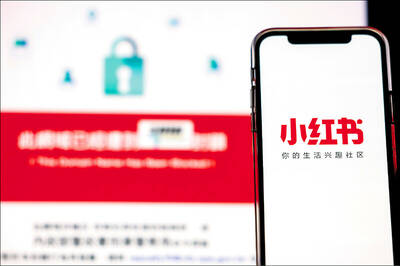
This month the government ordered a one-year block of Xiaohongshu (小紅書) or Rednote, a Chinese social media platform with more than 3 million users in Taiwan. The government pointed to widespread fraud activity on the platform, along with cybersecurity failures. Officials said that they had reached out to the company and asked it to change. However, they received no response. The pro-China parties, the Chinese Nationalist Party (KMT) and Taiwan People’s Party (TPP), immediately swung into action, denouncing the ban as an attack on free speech. This “free speech” claim was then echoed by the People’s Republic of China (PRC),


 RSS
RSS