


Earlier this month, a Hong Kong ship, Shunxin-39, was identified as the ship that had cut telecom cables on the seabed north of Keelung. The ship, owned out of Hong Kong and variously described as registered in Cameroon (as Shunxin-39) and Tanzania (as Xinshun-39), was originally People’s Republic of China (PRC)-flagged, but changed registries in 2024, according to Maritime Executive magazine.
The Financial Times published tracking data for the ship showing it crossing a number of undersea cables off northern Taiwan over the course of several days. The intent was clear.
Shunxin-39, which according to the Taiwan Coast Guard was crewed entirely by Chinese, was operating under two different registries and carried two sets of automatic identification system (AIS) equipment. According to reports, the AIS system was turned off shortly before the suspicious movements.
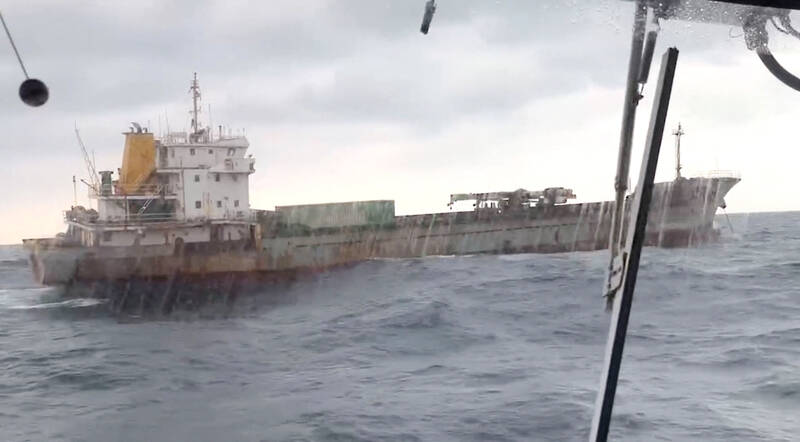
Photo: AFP
Kuma Academy chief executive officer Ho Cheng-hui (何澄輝) said that the incident was a test by the PRC of where the international community’s redlines lay.
Judging from the complete lack of concrete response, such redlines remain firmly concealed. The incident is no doubt practice for the isolation of Taiwan in the case of a blockade or invasion.
HISTORY REPEATED
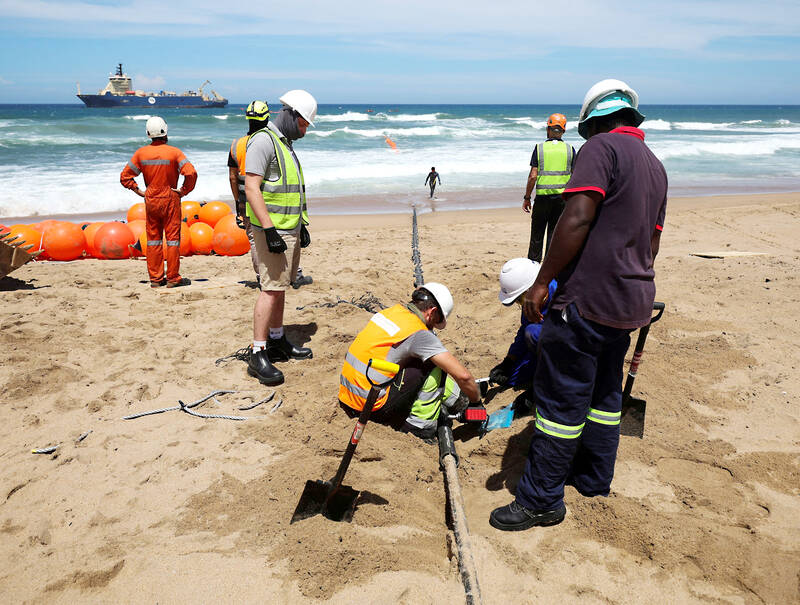
Photo: Reuters
A few days later, a second ship suspected of being on a cable-cutting errand, the Bao Shun, registered in the landlocked nation of Mongolia, was driven away from the cables north of Taiwan by the Taiwan Coast Guard.
As many media outlets reported, in February of 2023 PRC ships were suspected of cutting two cables that connected Matsu with the outside world, stopping internet service to the island.
Though it is not widely apprehended, there were more than two dozen cable cutting incidents from 2018 to 2023 around Matsu prior to the February 2023 incidents. Because of the large number of fishing boats in that area it is more difficult to identify and catch the perpetrators, never mind determine whether cable cutting was accidental or deliberate.
Photo: Reuters
It is easy to slot the cable-cutting incidents into PRC gray-zone activities against Taiwan. But they should also be looked at against the background of the vast struggle between the US and the PRC over the world’s subsea cable networks.
The PRC probably went “hmm” in 2006 when a quake of magnitude 7.0 occurred off the southwest coast of Taiwan. It cut critical subsea cables in 18 places, including the China-US CN cable, the first direct route internet cable linking the two nations (it was retired in 2016).
The presence of important cables linking the US and China in the Bashi Channel is probably why PRC cable cutting takes place elsewhere around Taiwan.
When the cables were cut in 2006, Chunghwa Telecom reported losing three-fourths of its connectivity to the PRC, but little effect on its connections to Japan.
The critical cable networks in the waters between the Philippines and Taiwan likely explain why the PRC wanted to build a smart city on tiny Fuga Island nearby, which Manila is now turning into a military base.
THE METAVERSE
The chip wars between the PRC and the democracies attract much attention, but another great struggle is taking place under the waves.
In 2017 Meta (Facebook) and Google partnered with a PRC-majority cable system.
The system was intended to link Hong Kong and Los Angeles, along with Taiwan and the Philippines. In 2020, a US Department of Justice team recommended that the system not be approved, for national security reasons.
Meta and Google then re-applied to connect Taiwan and the Philippines to the US, giving up the Hong Kong link, and with no PRC involvement. In early 2022 this was approved and the Chinese stakeholder in PLDC sold its share and was replaced by a Canadian investor.
The 2020 Department of Justice decision cascaded through the telecoms world.
In the fall of 2020 and spring of 2021, three trans-pacific cables projects that linked to Hong Kong withdrew their US landing applications. Meanwhile, additional cable projects backed by Meta and Google connecting the US to Southeast Asian nations, but without a link to Hong Kong, were announced.
In retaliation for the 2020 US Department of Justice decision not to authorize the connection to Hong Kong, the PRC pulled out of cable projects with other nations and has moved toward developing cable systems it controls. Since these cables are both made and laid by PRC tech power HMN Tech, whose predecessor was majority owned by Huawei (according to an excellent 2023 Reuters report on the struggle between the US and the PRC over cables), many nations may not be able to participate.
Indeed, Reuters reported that the US has either intervened to stop HMN Tech from winning the cable laying and manufacturing contracts or forced rerouting away from PRC destinations in at least six private undersea cable deals in the Asia-Pacific region between 2019 and 2023. In 2021, the US sanctioned HMN Tech, saying it was attempting to acquire US military technology.
Note that Meta and Google are major players in the recent AI trend: the two technologies are closely aligned. For eample, without undersea cables, data centers in other nations become inaccessible.
CUTOFF POINT
The attacks on the cables north of Taiwan represent not only a threat to Taiwan’s telecommunications connection but also to its dominance of chipmaking for the burgeoning AI industry, and its possible emergence as a hub for data centers.
If the PRC demonstrates that it can cut the undersea networks that connect Taiwan to the US at will, and does so from time to time, data center operators will be among the many firms searching for alternatives to Taiwan.
Note that the PRC has extensive links to the Philippines, where major telecoms players are trying to enter the data center competition. By cutting cables to the north of Taiwan, the PRC forces market players to consider that the links to the south and west of the island may continue to be safe.
North of Taiwan are the US bastions of Korea and Japan, while to the south, the Philippines is heavily penetrated by PRC telecoms firms, and Hong Kong remains a regional cable power even without US connections.
The cable cutting may also provide pro-PRC forces within Taiwan with the excuse to shift Taiwan away from US cable systems and toward PRC cable systems.
They can now contend that once the nation opts for PRC cable systems, the cable cutting will stop.
The cable cutting is thus not anti-Taiwan caprice, but anti-Taiwan strategy.
This is important because, as Philippines commentator Manuel Quezon III put it in a recent opinion piece on the undersea cable issue, “the dividing line moving forward, cable-wise, is Chinese participation.”
Nations considering cable networks must choose between rival PRC and US blocs, as they do with other key technologies. One reason they are hedging on the PRC vs. US choice is because, increasingly, choosing one side means becoming locked into a certain tech ecology, a position no third party wants to be in.
Notes from Central Taiwan is a column written by long-term resident Michael Turton, who provides incisive commentary informed by three decades of living in and writing about his adoptive country. The views expressed here are his own.

Taiwan’s English education system is being pulled apart by three opposing forces. Bilingual Nation 2030 pulls students toward English and global communication. Artificial Intelligence (AI) readiness pulls them toward digital judgment, verification and AI-mediated work. But Taiwan’s old exam culture pulls them back toward memorization, grammar drills, timed reading and correct answers. If the education system keeps using old exams to define success, it risks producing graduates who are neither genuinely bilingual nor genuinely AI-ready, but trained for tasks machines can already perform. The first force is Bilingual Nation 2030. Launched in 2018, the policy aimed to “help Taiwan’s workforce connect
It seems every few days one bumps into one of those “real man” comments in which Taiwan is urged to “face reality” or similar, and “make a deal,” with the speaker implying that soon it will be too late. “Deal” advocates always present themselves as having a superior grip on reality, and the manly ability to make the “hard choice.” Their testosterone-laden language often echoes that of Taiwan sellout advocates. Note that such commentary always specifies a process (“make a deal, work with, make progress”), never the end state of what occupation by a violent authoritarian colonialist state will entail. In

“Taiwan’s Opposition Leader Comes to US With a Message Straight Out of Beijing” read a May 31 headline in the Wall Street Journal. Top US administration officials and members of Congress almost certainly read the WSJ, and if there was a bullet point takeaway that people in Washington should absorb ahead of Chinese Nationalist Party (KMT) Chair Cheng Li-wun’s (鄭麗文) arrival in DC on June 9, that headline is it. The last few columns have discussed this very topic, and the timing is not coincidental. While those top officials likely do not read the Taipei Times, judging by the number

As someone who normally steers clear of books with “transcendence” or “metaphysics” in their subtitles, this reviewer — a casual observer of local belief systems since the 1990s — found Fabian Graham’s Money God Temples in Taiwan a challenging read. Those who’ve only dipped their toes into temple culture will likely need to parse several sections with special care if they’re to keep up with the author, a British ethnographic researcher whose previous books have investigated religious practices among ethnic Chinese in Southeast Asia. This scholarly volume examines a facet of Taiwan’s religious landscape that didn’t exist a century ago, and


 RSS
RSS