


With raging waters moving as fast as 3 meters per second, it’s said that the Roaring Gate Channel (吼門水道) evokes the sound of a thousand troop-bound horses galloping.
Situated between Penghu’s Xiyu (西嶼) and Baisha (白沙) islands, early inhabitants ranked the channel as the second most perilous waterway in the archipelago; the top was the seas around the shoals to the far north. The Roaring Gate also concealed sunken reefs, and was especially nasty when the northeasterly winds blew during the autumn and winter months.
Ships heading to the archipelago’s main settlement of Magong (馬公) had to go around the west side of Xiyu due to the unfriendly seas, making it an important pit stop for fishermen and settlers arriving from China’s Fujian Province. They would dock at the southwestern tip, pray to the deities Guanyin and Matsu and ask about the ocean conditions before disembarking.
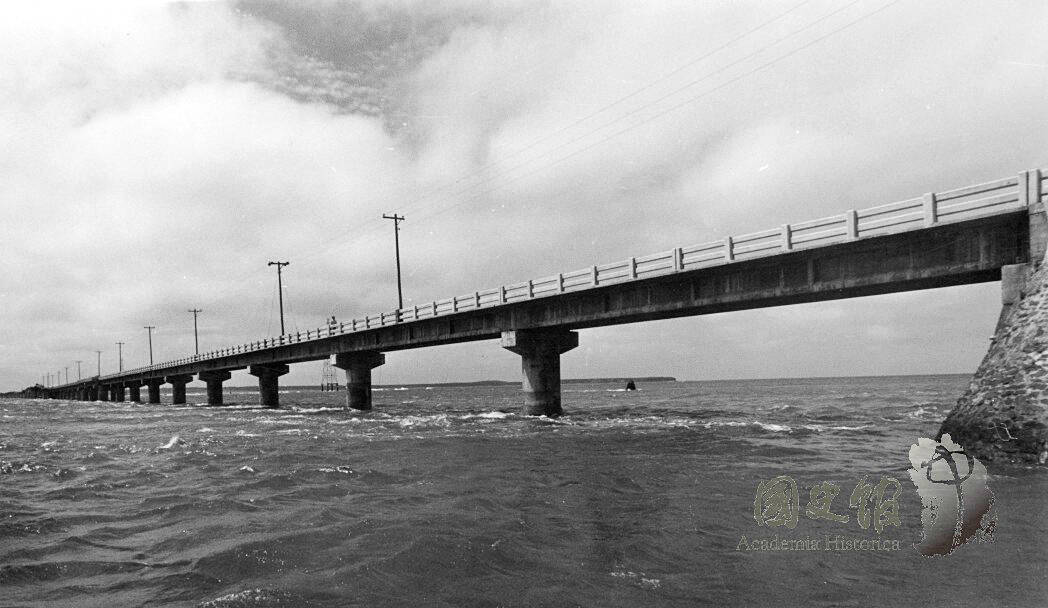
Photo courtesy of Academia Historica
The Roaring Gate was mentioned as early as 1685 in the Taiwan Province Annals (台灣府誌): “the waters are turbulent, and ships seldom pass through.” However, two years earlier, when Qing Dynasty general Shih Lang (施琅) routed the Tainan-based Kingdom of Tungning’s (東寧) navy in Penghu, losing commander Liu Kuo-hsuan (劉國軒) managed to escape back to Taiwan through the channel.
Until 1970, transportation to and from Xiyu relied solely on public and private ferries. This changed with the completion of the Penghu Great Bridge (澎湖跨海大橋) on Dec. 25 of that year, which was at that time the longest bridge in East Asia. This facilitated Xiyu’s rise as a tourist hotspot, but also led to serious rural flight.
The bridge quickly succumbed to the rough elements and heavy traffic. A new bridge was completed in 1996, but the foundations of the original structure can still be seen alongside it.
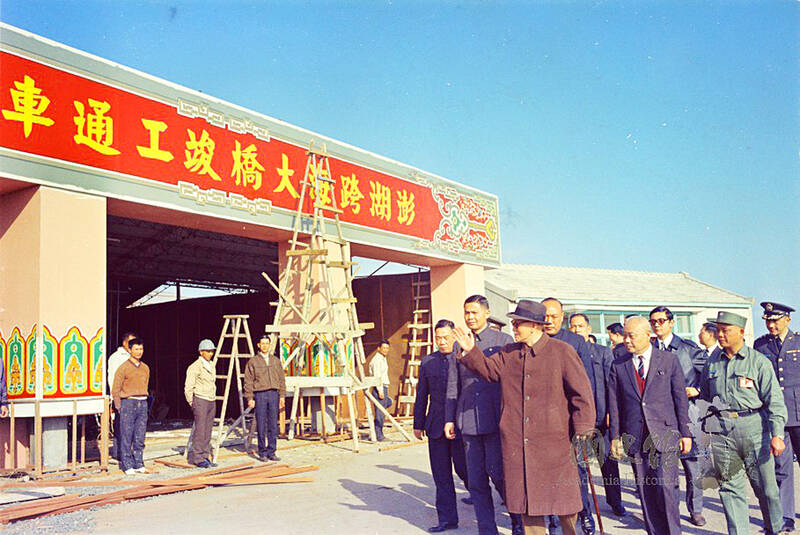
Photo courtesy of Academia Sinica
DANGEROUS SEAS
According to the Xiyu Township Annals (西嶼鄉誌), the Penghu archipelago was a hotbed for pirates and smugglers during the Ming Dynasty, and the empire in 1388 abandoned the islands, demolishing the infrastructure and institutions they set up and relocating the residents to Fujian Province.
Over the ensuing two centuries, fishermen visited Xiyu seasonally, but never stayed for too long. In 1595, the governor of Fujian allowed people to settle in Penghu again, and records show that the Chen (陳) family from Zhangzhou (漳州) put down roots in Xiyu shortly after.
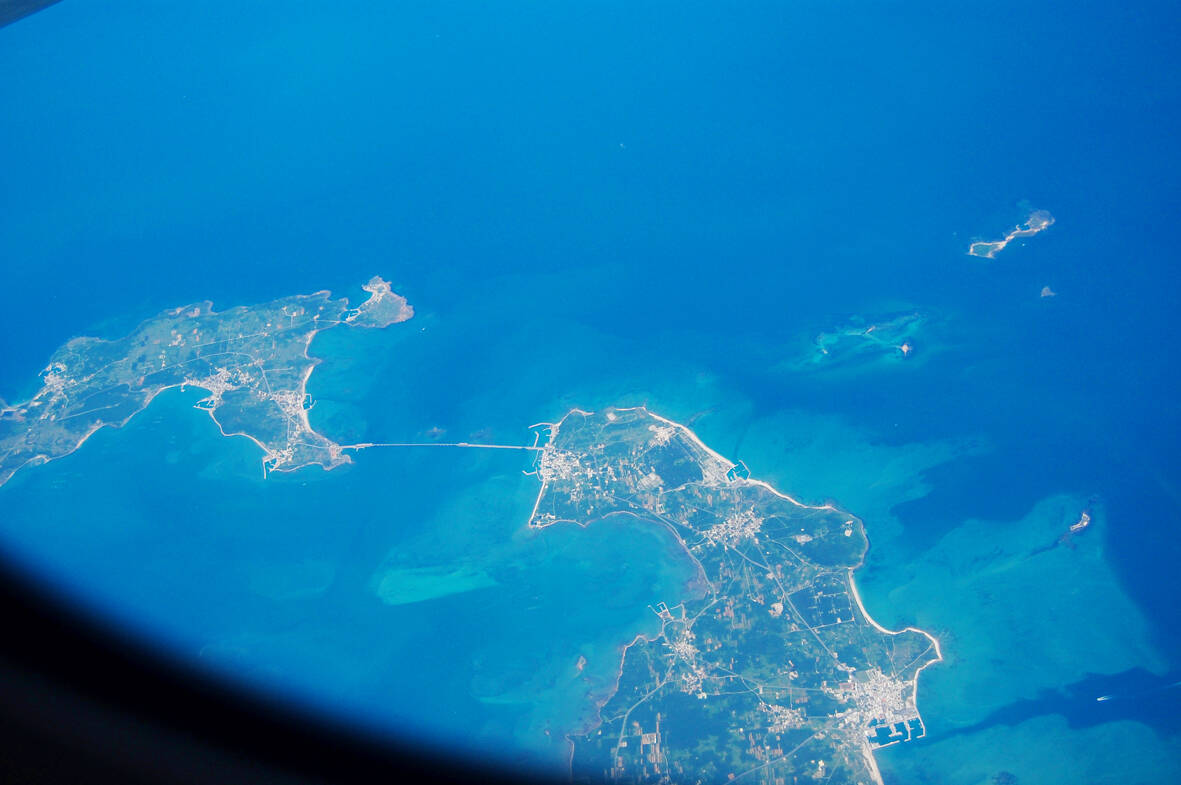
Photo courtesy of Wikimedia Commons
Between 1625 and 1631, two serious famines devastated Fujian, causing scores of refugees to flee abroad, many from Kinmen landed in Xiyu. The ensuing unrest caused by the Manchu invasion of China and Koxinga’s (鄭成功) attempt to restore the Ming Dynasty led to increased immigration over the next century, still mostly from Kinmen. In 1660, Koxinga defeated the pirates for good and drove them from the archipelago.
Xiyu had long been a navigation reference point for those heading to Penghu from Fujian, its “dark silhouette resembling a bamboo stick” visible from afar,” states the Taiwan Province Annals.”
Shipwrecks were common, with an especially severe incident happening in 1765. In 1778, new Taiwan governor Chiang Yuan-shu (蔣元樞) ordered the erection of a granite tower with an oil lamp on top on the southwestern tip of the island, next to a shrine dedicated to those who perished at sea. This is considered Taiwan’s first lighthouse. In 1823, the lamp was upgraded into a glass lantern with much stronger projection capabilities. To maintain the contraption, the government raised the fees for ships arriving at Magong harbor.
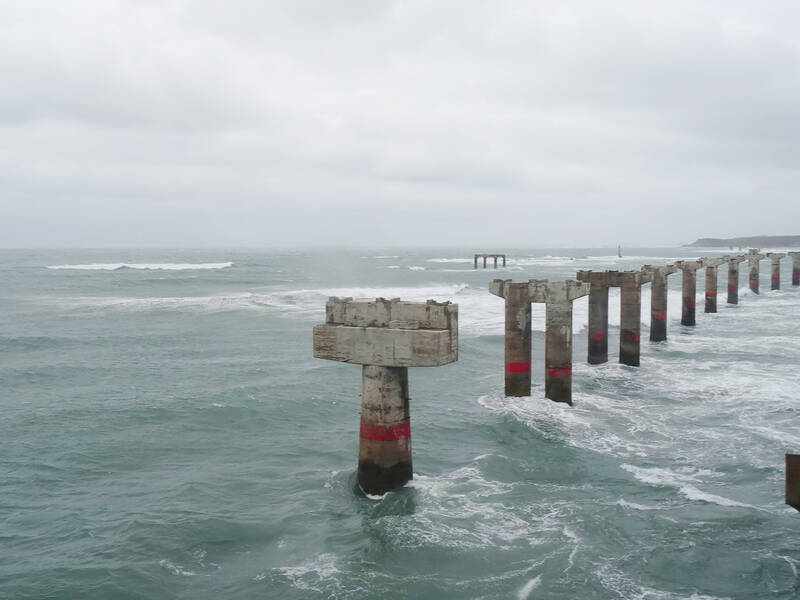
Photo courtesy of Penghu County Cultural Affairs Bureau
In 1875, the aging structure was replaced with an 11-meter tall Western lighthouse built by British engineer David M. Henderson. It was named the Fisher Island Lighthouse (漁翁島燈塔). The lamp continued to upgrade over time, switching to calcium carbide in 1915, kerosene in 1938 and electrical light in 1966.
MILITARY IMPORTANCE
Qing sources mostly mention Xiyu under the context of its military significance due to its strategic position, with little mention of the daily lives of the people, states the Xiyu Annals.
The 1790 Brief Account of Penghu (澎湖紀略) was the first to provide comprehensive information about the island’s demographics, listing the various settlements and noting a total population of 2,893, with an additional 100-odd troops stationed there.
Although the Qing built several cannon batteries around the island in the late 1600s, when the Sino-French War broke out in 1884 they realized this was not enough and hastily constructed a fort on the southern shores.
However, the French invaded in March 1885 before they could install the cannons and went on to occupy the entire archipelago (see “Taiwan in Time: Foreign views of French-occupied Penghu,” March 28, 2021). They evacuated four months later.
After the war, Qing officials significantly upgraded Taiwan’s defenses, building four new forts in Penghu in 1887, two of them in Xiyu. The largest was the 8.15 hectare Xiyu Western Fort (西臺). Armed with four British-made Armstrong guns, it was the most powerful defensive structure in Penghu at the time, according to the New Penghu Annals (續修澎湖縣志). A smaller East Fort (東臺) was also constructed nearby.
After the Qing ceded Penghu and Taiwan to Japan in 1895, the troops hastily dismantled the defenses, and till this day most of the cannons have not been found.
FROM BOATS TO BRIDGE
Xiyu remained pretty much isolated from the rest of Taiwan until the completion of the Penghu Great Bridge in 1970. The only means of transport outside the island was by boat, and in addition to private vessels, the Japanese set up a ferry between Xiyu and Magong that ran four times per day. Weather conditions often halted traffic, whether it be typhoons during the summer or the devastating northeasterly winds during the autumn and winter.
The ferry broke down after World War II. The new township government rented a temporary vessel from Penghu Maritime Vocational School (澎湖水產學校), and other private entities offered irregular service until a comprehensive transport plan was installed in 1951 with a new ship built by the county office. Four regular public and private vessels connected different parts of Xiyu to Magong, and the 50-ton Guangwu (光武輪) was inaugurated in 1969.
Work on the bridge commenced in May 1965 employing local engineers and material, completing what the Xiyu Annals called the “number one bridge in the Far East” (遠東第一大橋). By contrast, the previous bridge to bear this moniker, the 1953 Xiluo Bridge (西螺大橋) connecting Changhua and Yunlin counties, relied on US aid and foreign technicians. Curiously, this bridge was also completed on Dec. 25.
Workers building the Great Bridge toiled directly above the perilous Roaring Gate, and seven lost their lives during construction. Ferry ridership dropped dramatically, leading to the decline of Daguoye (大?葉) fishing port where they originated. The Guangwu burned down in 1979 and was never replaced.
Due to the foundations being right in the middle of the Roaring Gate, as well as saltwater rain, the bridge deteriorated rapidly under heavy traffic. After several attempts to repair it, a new bridge was planned in 1984. This structure took 12 years to complete, and great effort was put into making it weather and corrosion resistant. During construction, however, the old bridge was shut down for repairs several times, forcing residents to revert to boat travel once more.
Taiwan in Time, a column about Taiwan’s history that is published every Sunday, spotlights important or interesting events around the nation that either have anniversaries this week or are tied to current events.

It seems every few days one bumps into one of those “real man” comments in which Taiwan is urged to “face reality” or similar, and “make a deal,” with the speaker implying that soon it will be too late. “Deal” advocates always present themselves as having a superior grip on reality, and the manly ability to make the “hard choice.” Their testosterone-laden language often echoes that of Taiwan sellout advocates. Note that such commentary always specifies a process (“make a deal, work with, make progress”), never the end state of what occupation by a violent authoritarian colonialist state will entail. In

Taiwan’s English education system is being pulled apart by three opposing forces. Bilingual Nation 2030 pulls students toward English and global communication. Artificial Intelligence (AI) readiness pulls them toward digital judgment, verification and AI-mediated work. But Taiwan’s old exam culture pulls them back toward memorization, grammar drills, timed reading and correct answers. If the education system keeps using old exams to define success, it risks producing graduates who are neither genuinely bilingual nor genuinely AI-ready, but trained for tasks machines can already perform. The first force is Bilingual Nation 2030. Launched in 2018, the policy aimed to “help Taiwan’s workforce connect

There are shadowy cabals plotting to sell out Taiwan to be annexed by China, by invasion if necessary. Fortunately, they are buffoons. In 2019, former Bamboo Union gangster and founder of the China Unification Promotion Party (CUPP), Chang An-le (張安樂, colorfully known as “White Wolf”), led a protest at the Legislative Yuan against comments made by then-premier Su Tseng-chang (蘇貞昌) that in the event of an attack by China, he would never surrender, but would protect the nation by fighting to the end, even if he only had a broom. Chang had party members bring a wooden casket that they
June 1 to June 7 "If all Taiwanese were as afraid of dying as you, then what would happen?” Physician Shih Chiang-nan (施江南) reportedly said this to his wife Chen Chiao-tung (陳焦桐) after she urged him to stop intervening on behalf of Taiwanese soldiers stranded overseas after serving in the Japanese Army during World War II. Shih had clashed with high-ranking officials over the issue, engaged in several heated arguments with Taiwan governor-general Chen Yi (陳儀) and allegedly shouted at general Ko Yuan-fen (柯遠芬), chief of staff of the Taiwan Garrison Command, over


 RSS
RSS