


In northeast Asia the Cold War in many ways never ended and a series of interconnected stalled conflicts might be heating up.
If any line could be said to divide northeast from southeast Asia, it would be the Tropic of Cancer. Fittingly, it runs right through Taiwan.
For most of Taiwan’s history it was closer to southeast Asia via Austronesian migrations out of Taiwan and regional trade. For the last few hundred years starting with the onset of Chinese migration and Manchurian Qing and Japanese occupations it has been politically and economically northeast Asian.
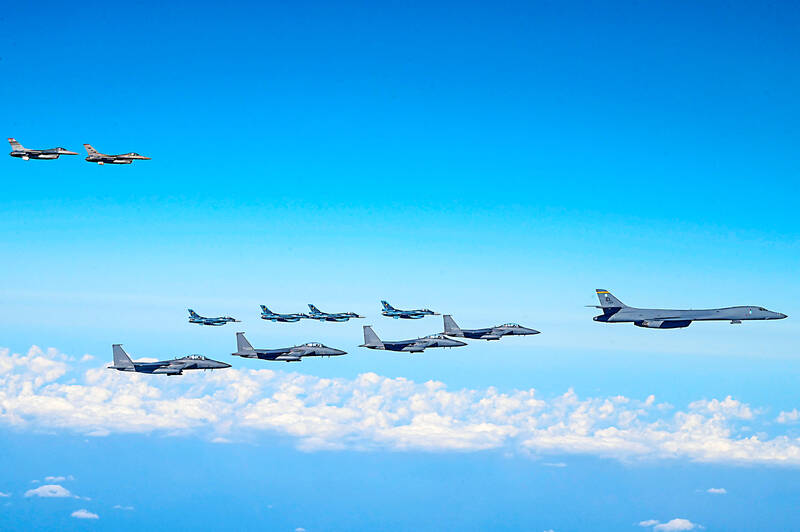
Photo: AFP
Taiwan’s current political status is deeply tied up with northeast Asia’s recent history.
MANCHURIANS AND CHINESE CLAIMS
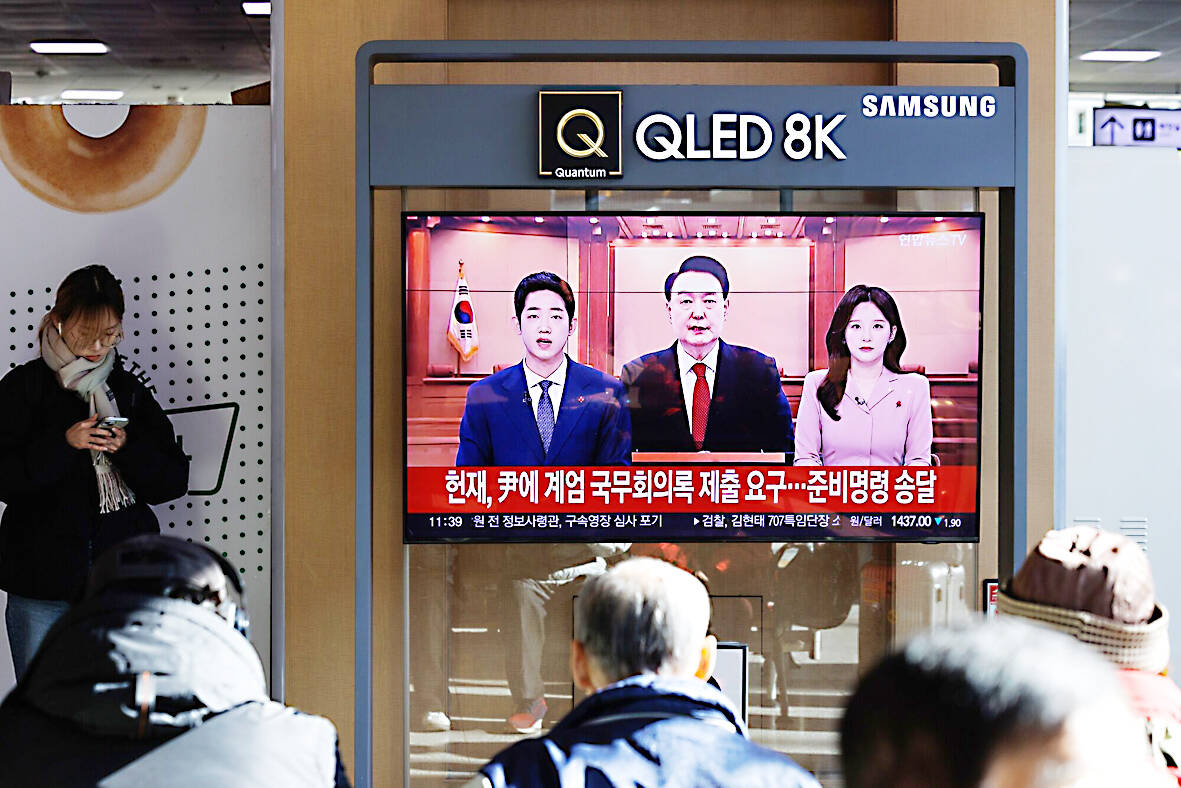
Photo: Bloomberg
This region is not normal politically.
There are four deeply destabilizing historical reasons for this. For starters, we can blame the Manchurians for invading China, the Uighurs, Mongolia, Tibet and Taiwan, calling it the Qing Dynasty and moving their emperor to Beijing, which was more centrally located and had a better nightlife.
Revolutionary Chinese groups, that largely coalesced to form the Chinese Nationalist Party (KMT), rallied under the banner “Overthrow the Qing, restore the Ming (反清復明)!” By this they wanted China to once again be ruled by Chinese, not foreigners.
Photo: EPA-EFE
They eventually succeeded, and established the Republic of China (ROC). Once in power, they changed their minds and claimed that “China” meant the entirety of the Qing Empire, which makes about as much sense as the Turks claiming the entirety of the Ottoman Empire.
The major colonial powers more or less went along with this, and since at the time they set the international standards of sovereignty and published most of the world’s maps they helped the Chinese maintain their colonial empire.
In practice, the ROC was largely limited to territory in historical China. Taiwan had been ceded to the Japanese Empire in 1895, and the Tibetans, the Uighur East Turkestan and Mongolia declared independence.
COLONIALISM AND COMMUNISM
A third force was colonialism, with the Russians and Japanese grabbing vast territories. The Russians forced the Manchurians to hand over vast chunks of Manchuria in 1856 and 1860, which is today the Russian Far East. The Manchurians must have been seething at losing much of their own homeland.
The Japanese forced the Qing to hand over Taiwan, and invaded Korea against the wishes of the Chinese. They also set up a puppet Manchukuo government in what was left of Manchuria, using the last Qing emperor as its figurehead.
The fourth force was the rise of communism, which first reached Asia in the Russian portion of the continent. The Mongolians followed suit, but knowing the Chinese would get upset, their requests to join the Union of Soviet Socialist Republics (USSR) were denied, but the Soviets ensured they maintained their independence as a generally pliant buffer state.
At the end of World War II, Nazi Germany and the Japanese Empire were split up into occupation zones by the allied powers. The occupation zones ruled by the USSR, East Germany and North Korea, split off to form separate communist regimes.
After the Chinese Communist Party (CCP) won the Chinese Civil War in 1949, the ROC government fled permanently to Taiwan.
Meanwhile, the Japanese simply renounced their claim to Taiwan at the end of World War II without specifying its status, leading to a situation where many countries (including Japan, the US and many others) consider Taiwan’s sovereignty “undetermined” under international law.
In theory, the freshly minted UN should have stepped in to determine Taiwan’s status, and under their principles should have asked the Taiwanese what they wanted. However, they were distracted by the Korean War, exhausted by World War II and KMT Generalissimo Chiang Kai-shek (蔣介石) basically said “Taiwan’s mine, buzz off” and no one was in the mood to challenge him and his over one million troops occupying Taiwan.
Interestingly, a court case in the US ruled that Taiwan’s status is undetermined legally, but since the responsibility for determining it belonged to the Allied powers and the Soviet Union no longer existed, there was nothing US courts could do about it.
Meanwhile, the CCP set about invading East Turkestan and Tibet. They also invaded the rump of Manchuria, but did not challenge the then-mighty Soviet Union over their occupied Manchurian territory or Mongolia (though for historical reasons they do occupy Inner Mongolia).
A REGION FROZEN SINCE THE 1950S
From the 1950s until very recently all of these interconnected conflicts remained frozen. Tibet, Manchuria and East Turkestan remained occupied by the CCP, while the ROC remained in Taiwan.
The armed forces of the CCP and ROC had generally refrained from breaching the unofficial Davis Line that ran down the middle of the Taiwan Strait, each keeping to their own side. This standoff between the two sides is made all the weirder by the military on Taiwan representing “China” in the form of the ROC, while in China the People’s Liberation Army (PLA) does not represent China, but is rather the armed wing of the CCP.
Russia continued to occupy much of Manchuria, and Mongolia remained a buffer state, without being challenged by Beijing. Yet the CCP remains aggressive in claiming sovereignty over Qing-occupied territory, including Taiwan, parts of India, Japanese islands and everything in their imaginary nine-dash line that claims virtually everything in the South China Sea in total disregard for international law.
North and South Korea continued their heavily armed military face off along the 38th parallel, both claiming to want to reunify and neither willing to actually do so. Until 1991, the US had nuclear weapons stationed in South Korea. In 2006 North Korea tested their first nuclear weapon.
Japan was demilitarized constitutionally after World War II, but the Korean War led it to form the Self-Defense Forces (JSDF), which was intended only for Japan’s defense, not projecting force elsewhere. That kept their military budgets small.
The US is also part of the region, and their Aleutian Islands border Russia’s Commander Islands which make up the furthest east end of the island chain. The US also maintains large military bases in Japan and South Korea.
THE 1950S STATUS QUO IS COMING APART
All of this is in the process of changing or is showing signs of instability. The status quo is coming apart in both the Taiwan Strait and on the Korean peninsula, the CCP is dropping hints on territories in Russian-occupied Manchuria, the Mongolians increasingly are caught between a rock and a hard place and the Japanese are rearming rapidly.
Japan is now being ruled by a weakened minority government, South Korea is in crisis following a declaration of martial law and the impeachment of the president and there are hints coming out of Beijing of instability in the government there.
Russia is headed for military and economic crisis, while the entire region leads the world in demographic collapse. Adding to the uncertainty is the return of the mercurial US president Donald Trump on Jan. 20.
These will be examined in far greater detail in upcoming columns, but this review of how these interconnected conflicts were frozen into a status quo since the 1950s provides the background to how and why they are coming apart and what that might mean for the region.
Donovan’s Deep Dives is a regular column by Courtney Donovan Smith (石東文) who writes in-depth analysis on everything about Taiwan’s political scene and geopolitics. Donovan is also the central Taiwan correspondent at ICRT FM100 Radio News, co-publisher of Compass Magazine, co-founder Taiwan Report (report.tw) and former chair of the Taichung American Chamber of Commerce. Follow him on X: @donovan_smith.
May 11 to May 17 Traversing the southern slopes of the Yushan Range in 1931, Japanese naturalist Tadao Kano knew he was approaching the last swath of Taiwan still beyond colonial control. The “vast, unknown territory,” protected by the “fierce” Bunun headman Dahu Ali, was “filled with an utterly endless jungle that choked the mountains and valleys,” Kano wrote. He noted how the group had “refused to submit to the measures of our authorities and entrenched themselves deep in these mountains … living a free existence spent chasing deer in the morning and seeking serow in the evening,” even describing them as

As a different column was being written, the big news dropped that Chinese Nationalist Party (KMT) caucus whip Fu Kun-chi (傅?萁) announced that negotiations within his caucus, with legislative speaker Han Kuo-yu (韓國瑜) of the KMT, party Chair Cheng Li-wun (鄭麗文), Taichung Mayor Lu Shiow-yen (盧秀燕) and Taiwan People’s Party (TPP) Chair Huang Kuo-chang (黃國昌) had produced a compromise special military budget proposal. On Thursday morning, prior to meeting with Cheng over a lunch of beef noodles, Lu reiterated her support for a budget of NT$800 or NT$900 billion — but refused to comment after the meeting. Right after Fu’s

Yesterday, the Democratic Progressive Party (DPP) nominated legislator Puma Shen (沈伯洋) as their Taipei mayoral candidate, the Chinese Nationalist Party (KMT) put their stamp of approval on Wei Ping-cheng (魏平政) as their candidate for Changhua County commissioner and former legislator Tsai Pi-ru (蔡壁如) of the Taiwan People’s Party (TPP) has begun the process to also run in Changhua, though she has not yet been formally nominated. All three news items are bizarre. The DPP has struggled with settling on a Taipei nominee. The only candidate who declared interest was Enoch Wu (吳怡農), but the party seemed determined to nominate anyone
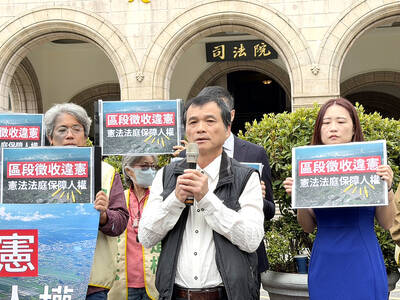
What government project has expropriated the most land in Taiwan? According to local media reports, it is the Taoyuan Aerotropolis, eating 2,500 hectares of land in its first phase, with more to come. Forty thousand people are expected to be displaced by the project. Naturally that enormous land grab is generating powerful pushback. Last week Chen Chien-ho (陳健和), a local resident of Jhuwei Borough (竹圍) in Taoyuan City’s Dayuan District (大園) filed a petition for constitutional review of the project after losing his case at the Taipei Administrative Court. The Administrative Court found in favor of nine other local landowners, but


 RSS
RSS