


Earlier this month the Interpret: China series at the US-based Center for International and Strategic Studies (CSIS) published a translation of a piece from the “Cross-Strait Institute of Urban Planning” at Xiamen University, arguing that the People’s Republic of China (PRC) should begin preparing for the occupation of Taiwan after a successful invasion.
It was swiftly deleted.
The “institute” is one of the many faux research organizations the PRC has established to give its propaganda a scholarly veneer. The article, “Start Taiwan Takeover Preparations as Soon as Possible,” whose authors were not named (though CSIS presented them as “experts”), called for the PRC to establish a “shadow government” that would immediately take control upon “reunification,” with policies for education, military, the economy and general governance in place and ready to go.
Photo: AFP
The writers argue that the PRC should establish a Central Taiwan Work Committee as rapidly as possible to act as a shadow government that would formulate policies for the minutiae of governance such as currency conversion and customs, along with screening of government and military personnel. Interestingly, the writers contend that Taiwan’s more advanced economy presents the PRC with challenges it has never faced.
COLONIAL OCCUPATION
This occupation will be avowedly colonial, according to the writers.
Photo: EPA-EFE
The “lessons learned from Japanese colonization, the [Chinese Nationalist Party’s (KMT)] post-war takeover and Hong Kong’s return” would form the basis for its actions. The piece also calls for “bringing together” the “anti-independence” forces on the island, whose actions are merely “unorganized individual behavior” since the KMT has weakened on independence.
The writers argue that public preparations for annexing the island will have a powerful effect on the public’s point of view, since the normalization of PRC military activities has not. Recent history shows that every time the PRC raises tensions, from the missile tests in the 1990s to Nancy Pelosi’s visit in August 2022, the people of Taiwan seek further distance from Beijing. The writers know that, but argue that the PRC needs to increase intimidation. What’s the definition of insanity, again?
The authors take the point of view that “one country, two systems” is a dead letter and the Hong Kong model is useless.
“For Taiwan, the aim from the outset should be full integration into the mainland,” the authors write.
They suggest recruiting retired Taiwanese civil servants and others to staff a “fully realistic” training environment, a “Taiwan Governance Experimental Zone.” They argue that bringing in Taiwanese for such programs will enable the people of Taiwan to feel like they had a hand in developing the new government. The appeal to retired civil servants and teachers, a population composed largely of supporters of the pro-China parties in Taiwan, to come together to support China (and provide it with intel) is obvious.
They call for policies in the experimental zone to be based on the actual policies to be implemented in Taiwan, including matters ranging from the electoral system and college entrance exams to “retention or elimination of traditional Chinese characters; from more distant matters such as the transition of the currency (including the transition of the real estate system, including land).”
The essay is recognition that the most daunting part of the conquest of Taiwan isn’t the military campaign, but the postwar occupation of a robust democracy with a long history of resistance to incorporation into external empires.
IMPERIALIST PLAYBOOK
Shouldn’t the PRC already have a program for post-annexation? It may or may not. Consider would-be imperialists through history. What is Putin’s detailed plan for the occupation of Ukraine? Recall that Japanese planners on the eve of World War II had looked south for decades, but never built up scholarly and social knowledge of those areas.
The omissions of the piece signal its intended audience: westerners. The writers carefully omit the inevitable savagery and brutality of the occupation, which will be little more than mass murder and rape (the current PRC colonial occupation of Xinjiang is a dry run for Taiwan).
For example, they call for screening of personnel, without mentioning that those who fail are headed for mass executions and concentration camps, as is a large chunk of the population.
“Details” are discussed, with no mention of the massive surveillance state that will have to be implemented. They call for reconstructing education, without noting that indigenous peoples will be redefined out of existence, lumped under the archaic term “mountain peoples,” their history subsumed into PRC fake history.
Terms and ideology related to PRC expansionism and communism are omitted — indeed, the idea of “Communist Party” appears only in the final paragraph, though the party will be making all the decisions governing the shape of the occupation. Hence, any “experimental zone” would simply be an intelligence operation and propaganda factory.
GOLD MINE
Nevertheless, this piece is a gold mine for the Democratic Progressive Party (DPP) administration, which should move to exploit it. Consider the passing mention of “land” in it. Too many people in Taiwan and abroad vaguely imagine that occupation will present a period of inconvenience followed by a return to “normality.” This must be directly and frequently addressed, and this document is essentially a list of talking points the DPP should be using.
The PRC has to make the invasion pay, and it can only do that by looting Taiwan. DPP leaders should be pointing out that PRC annexation, even peacefully, will result in millions of Taiwanese having their land titles threatened, from ordinary homeowners to large businesses — PRC local governments routinely made money via local land deals. The DPP needs to be highlighting that Taiwanese savings will be transitioned to Chinese money at a rate determined by PRC planners, impacting pensions as well.
To foreigners, it should be made clear that they will interact and invest in Taiwan entirely at the sufferance of the PRC, and as in the PRC, be subject to its policies of kidnapping foreigners and technology theft.
DPP party officials should also be pointing at the epic failure of PRC economic planners — the promotion of short-termism among party officials and business since policies and personnel are constantly changing, the falling investment from abroad in the PRC, the massive public debts and the PRC’s limp economic growth. Mentions of PRC public debt would be particularly useful, since in the event of annexation, Taiwan is going to be looted to help sustain PRC internal debts.
Who knows? If fear of being bombed, arrested, and tortured won’t mobilize the public, perhaps fear of paying off someone else’s debts will.
Notes from Central Taiwan is a column written by long-term resident Michael Turton, who provides incisive commentary informed by three decades of living in and writing about his adoptive country. The views expressed here are his own.
The breakwater stretches out to sea from the sprawling Kaohsiung port in southern Taiwan. Normally, it’s crowded with massive tankers ferrying liquefied natural gas from Qatar to be stored in the bulbous white tanks that dot the shoreline. These are not normal times, though, and not a single shipment from Qatar has docked at the Yongan terminal since early March after the Strait of Hormuz was shuttered. The suspension has provided a realistic preview of a potential Chinese blockade, a move that would throttle an economy anchored by the world’s most advanced and power-hungry semiconductor industry. It is a stark reminder of
May 11 to May 17 Traversing the southern slopes of the Yushan Range in 1931, Japanese naturalist Tadao Kano knew he was approaching the last swath of Taiwan still beyond colonial control. The “vast, unknown territory,” protected by the “fierce” Bunun headman Dahu Ali, was “filled with an utterly endless jungle that choked the mountains and valleys,” Kano wrote. He noted how the group had “refused to submit to the measures of our authorities and entrenched themselves deep in these mountains … living a free existence spent chasing deer in the morning and seeking serow in the evening,” even describing them as

As a different column was being written, the big news dropped that Chinese Nationalist Party (KMT) caucus whip Fu Kun-chi (傅?萁) announced that negotiations within his caucus, with legislative speaker Han Kuo-yu (韓國瑜) of the KMT, party Chair Cheng Li-wun (鄭麗文), Taichung Mayor Lu Shiow-yen (盧秀燕) and Taiwan People’s Party (TPP) Chair Huang Kuo-chang (黃國昌) had produced a compromise special military budget proposal. On Thursday morning, prior to meeting with Cheng over a lunch of beef noodles, Lu reiterated her support for a budget of NT$800 or NT$900 billion — but refused to comment after the meeting. Right after Fu’s
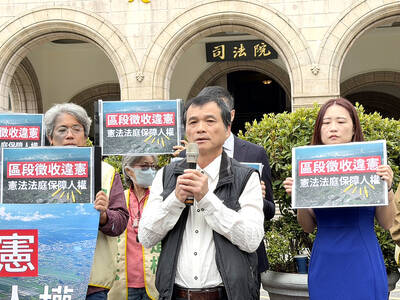
What government project has expropriated the most land in Taiwan? According to local media reports, it is the Taoyuan Aerotropolis, eating 2,500 hectares of land in its first phase, with more to come. Forty thousand people are expected to be displaced by the project. Naturally that enormous land grab is generating powerful pushback. Last week Chen Chien-ho (陳健和), a local resident of Jhuwei Borough (竹圍) in Taoyuan City’s Dayuan District (大園) filed a petition for constitutional review of the project after losing his case at the Taipei Administrative Court. The Administrative Court found in favor of nine other local landowners, but


 RSS
RSS