


On the shores of the River Seine, a fan zone dotted with rainbow-themed paraphernalia hopes to draw in the crowds to celebrate a record number of openly LGBTQ athletes at this year’s Olympics.
The event’s Pride House, which was first set up during the 2010 Vancouver Winter Olympics, opened on Monday in Paris.
“The idea is to welcome everybody,” said organizer Jeremy Goupille. “With a platform like the Olympics, we know we can change things.”

Photo: Reuters
The Summer Games this year include 193 openly LGBTQ athletes, up from 186 in the 2020 Games and 53 in 2016, specialized Web site Outsports says.
They include openly gay British diver Tom Daley, who on Monday won silver with partner Noah Williams in the 10m synchronized platform to give him a fifth medal in five Olympics. US basketball star and LGBTQ activist Brittney Griner is back on the court after spending a gruelling nine months in a Russian jail in 2022.
Her team won gold in the last two Olympics in Rio and Tokyo.
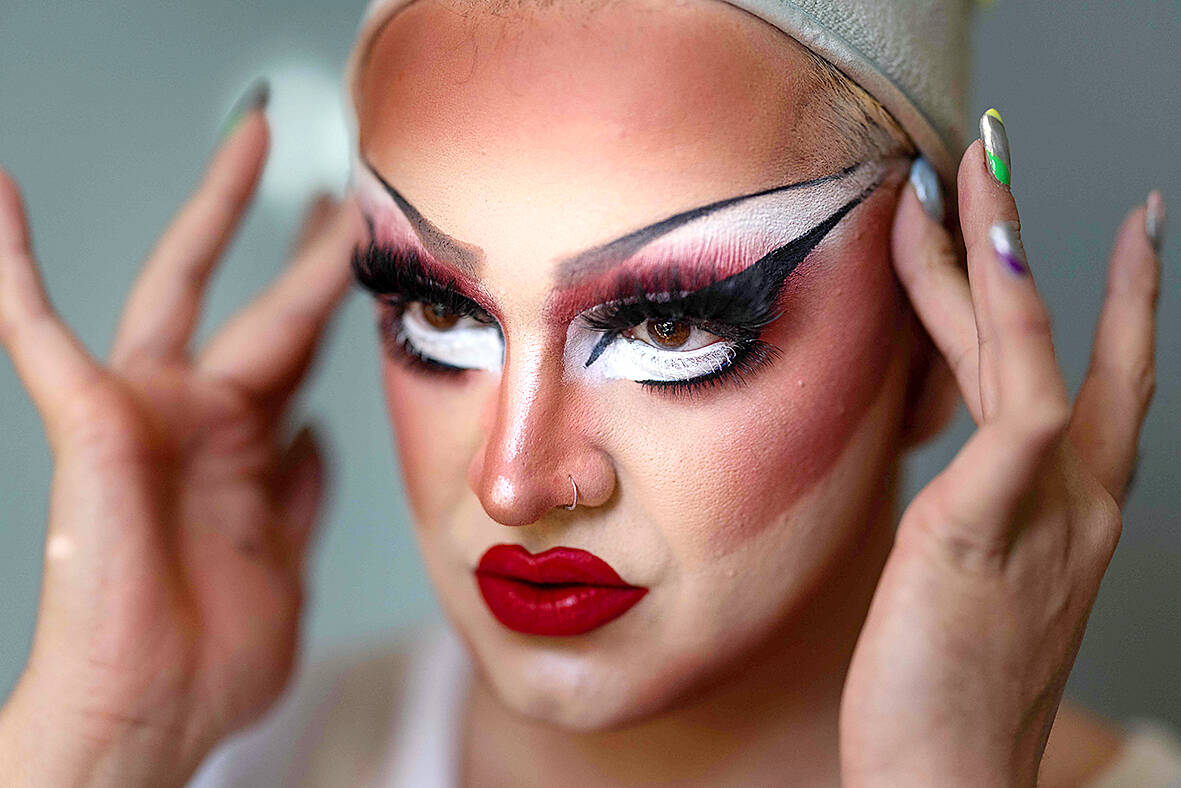
Photo: AFP
Brazilian judoka Rafaela Silva, who won a gold at the Rio Games in 2016, will also be competing.
‘WELCOMING SPACE’
Pride House has been a feature of most Games since Vancouver, excluding the Winter Games in Sochi, Russia in 2014.
Organizers hope the LGBTQ athletes in Paris will provide inspiration for members of the community worldwide.
At least 67 countries criminalize same-sex relations between consenting adults, Human Rights Watch says.
Violence and harassment against LGBTQ people in Europe have reached a “new high” in the past few years, the European Union’s rights agency says.
“Paris is the city of love, of all loves,” exclaimed deputy mayor Jean-Luc Romero-Michel at the opening on Monday night.
In the crowd, 23-year-old Lucas and 26-year-old Remy, neither of whom wished to share their surname, had painted their cheeks with a French flag and were excited.
“After the backlash of the right and the far right, it’s important to have a space that is welcoming, whatever a person’s gender or sexual orientation,” said Lucas, a student.
Australian skateboarder Poppy Starr Olsen said she was not competing this year after taking part in the Tokyo Games, but was there to cheer on the initiative.
“Skateboarding itself is really queer. So it’s been a super awesome place for me to grow up as a queer person,” the 24-year-old said.
“But you definitely experience hate sometimes, even if the people don’t mean it... It’s still there, which is why it’s really important to have a Pride House.”
‘WE ARE ALL EQUAL’
French Sports Minister Amelie Oudea-Castera said she too thought having the venue was key to “a message of inclusion”.
“It’s important for us to keep fighting against all types of discrimination,” she said.
“We are all equal and we all deserve to be respected,” she added.
She spoke after the Olympics opening ceremony on Friday sparked some controversy.
The sequence, a Greek mythology-inspired celebration including members of the LGBTQ community and a semi-naked singer painted in blue, had intended to promote diversity.
But Catholic groups and French bishops have accused it of being a disrespectful parody of the Last Supper between Jesus and his apostles.
US presidential candidate Donald Trump has called the segment “a disgrace.”
Turkey’s President Recep Tayyip Erdogan condemned the ceremony for “immorality against all Christians” and said he would report it to Pope Francis.
Oudea-Castera said the aim was not “to have any sort of provocation against any type of religion.”
“It was a message of inclusion, reconciliation and celebration of the Olympics god Dionysos,” who was father of Sequana, the goddess of the River Seine, she said.

Taiwan’s English education system is being pulled apart by three opposing forces. Bilingual Nation 2030 pulls students toward English and global communication. Artificial Intelligence (AI) readiness pulls them toward digital judgment, verification and AI-mediated work. But Taiwan’s old exam culture pulls them back toward memorization, grammar drills, timed reading and correct answers. If the education system keeps using old exams to define success, it risks producing graduates who are neither genuinely bilingual nor genuinely AI-ready, but trained for tasks machines can already perform. The first force is Bilingual Nation 2030. Launched in 2018, the policy aimed to “help Taiwan’s workforce connect
It seems every few days one bumps into one of those “real man” comments in which Taiwan is urged to “face reality” or similar, and “make a deal,” with the speaker implying that soon it will be too late. “Deal” advocates always present themselves as having a superior grip on reality, and the manly ability to make the “hard choice.” Their testosterone-laden language often echoes that of Taiwan sellout advocates. Note that such commentary always specifies a process (“make a deal, work with, make progress”), never the end state of what occupation by a violent authoritarian colonialist state will entail. In

June 1 to June 7 "If all Taiwanese were as afraid of dying as you, then what would happen?” Physician Shih Chiang-nan (施江南) reportedly said this to his wife Chen Chiao-tung (陳焦桐) after she urged him to stop intervening on behalf of Taiwanese soldiers stranded overseas after serving in the Japanese Army during World War II. Shih had clashed with high-ranking officials over the issue, engaged in several heated arguments with Taiwan governor-general Chen Yi (陳儀) and allegedly shouted at general Ko Yuan-fen (柯遠芬), chief of staff of the Taiwan Garrison Command, over

“Taiwan’s Opposition Leader Comes to US With a Message Straight Out of Beijing” read a May 31 headline in the Wall Street Journal. Top US administration officials and members of Congress almost certainly read the WSJ, and if there was a bullet point takeaway that people in Washington should absorb ahead of Chinese Nationalist Party (KMT) Chair Cheng Li-wun’s (鄭麗文) arrival in DC on June 9, that headline is it. The last few columns have discussed this very topic, and the timing is not coincidental. While those top officials likely do not read the Taipei Times, judging by the number


 RSS
RSS