


For decades, Robert Lecker has read, taught and written about Alice Munro, the Nobel laureate from Canada renowned for her short stories. A professor of English at McGill University in Montreal, and author of numerous critical studies of Canadian fiction, he has thought of Munro as the “jewel” in the crown of her country’s literature and source of some of the richest material for classroom discussion.
But since learning that Munro declined to leave her husband after he had sexually assaulted and harassed her daughter, Lecker now wonders how to teach her work, or if he should even try.
“I had decided to teach a graduate course on Munro in the winter of 2025,” Lecker says. “Now I have serious questions whether I feel ethically capable of offering that course.”
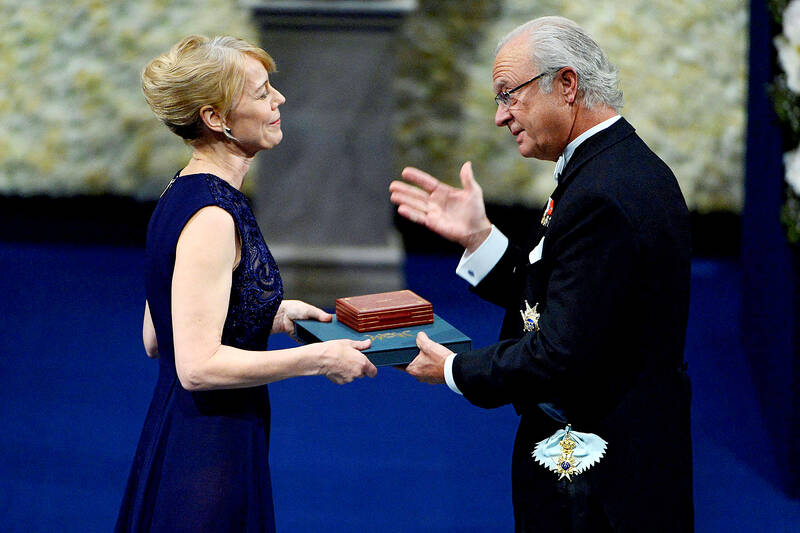
Photo: Reuters
Andrea Robin Skinner, daughter of Munro and James Munro, wrote in the Toronto Star earlier this month that she had been assaulted at age 9 by Munro’s second husband, Gerard Fremlin. She alleged that he continued to harass and abuse her for the next few years, losing interest when she reached her teens. In her 20s, she told her mother about Fremlin’s abuse. But Munro, after briefly leaving Fremlin, returned and remained with him until his death in 2013. She would explain to Skinner that she “loved him too much” to remain apart.
When Munro died in May at age 92, she was celebrated worldwide for narratives which documented rare insight into her characters’ secrets, motivations, passions and cruelties, especially those of girls and women. Admirers cited her not just as a literary inspiration, but as a kind of moral guide, sometimes described as “Saint Alice.” A New York Times essay that ran shortly after her death, by Canadian author Sheila Heti, was titled “I Don’t Write Like Alice Munro, But I Want to Live Like Her.”
“No one knows the compromises another makes, especially when that person is as private as she was and transforms her trials into fiction,” Heti wrote. “Yet whatever the truth of her daily existence, she still shines as a symbol of artistic purity.”
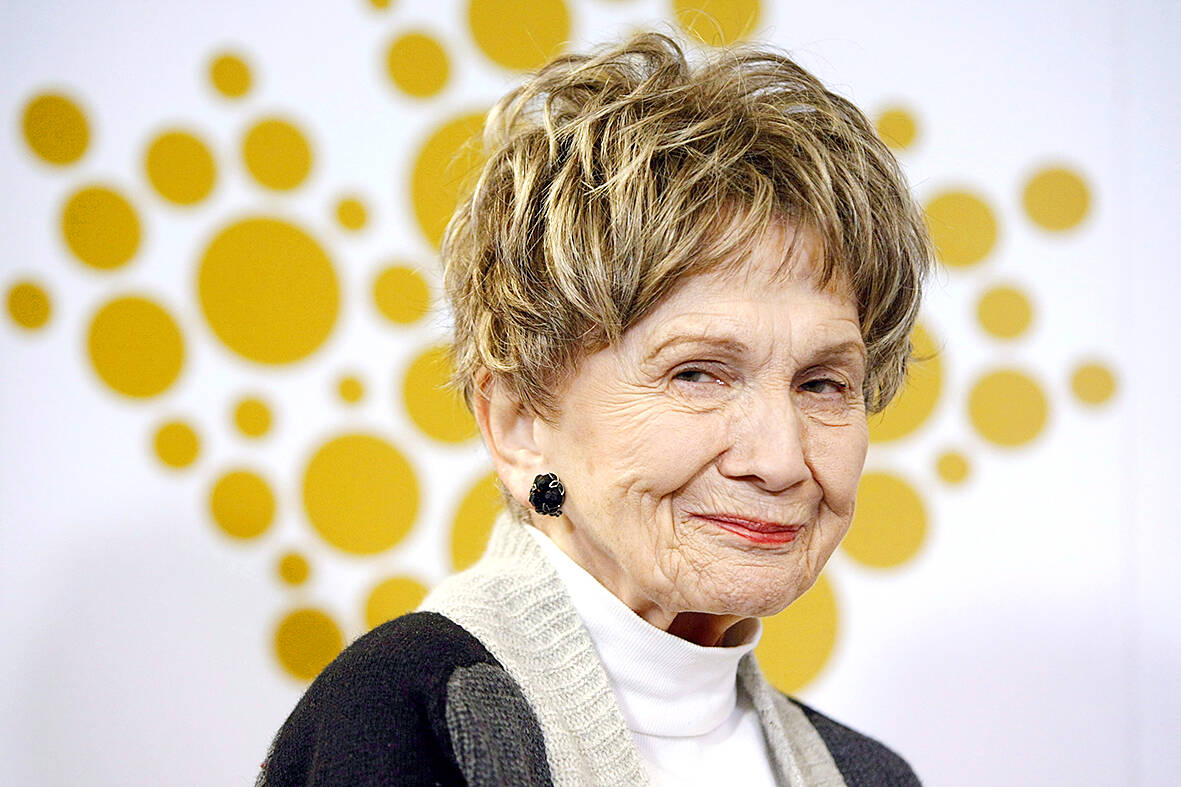
Photo: AP
REEVALUATING A LIFE
Educators in Canada and beyond are now rethinking her life and work. At Western University in London, Ontario, Munro’s alma mater, the school has posted a statement on its Web site saying that it was “taking time to carefully consider the impact” of the revelations. Since 2018, Western University has offered an Alice Munro Chair in Creativity, with a mission to “Lead the creative culture of the Faculty of Arts and Humanities, serving as a mentor and a model.”
That chair, held for the past academic year by Heti, will be left unfilled as “we carefully consider Munro’s legacy and her ties to Western,” according to the school.
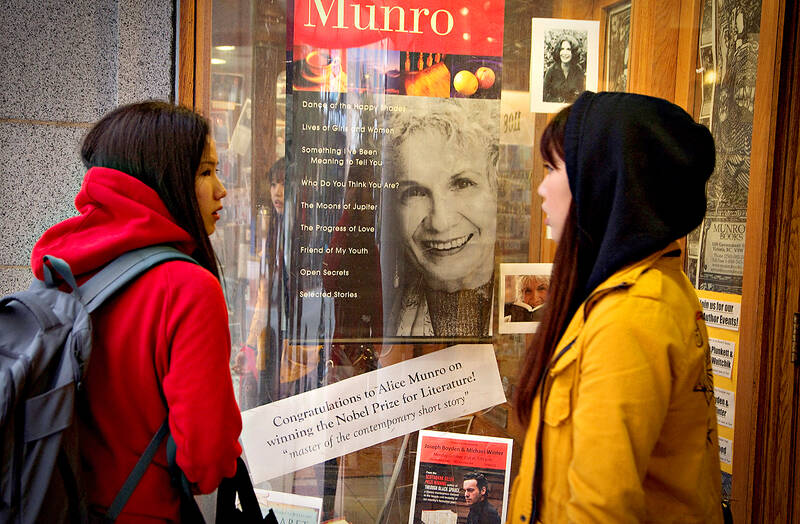
Photo: Reuters
Requests with Heti’s agent and publicists for comment were not immediately answered.
For the fall semester at Harvard University, authors and faculty members Laura van den Berg and Neel Mukherjee will be co-teaching “Reading for Fiction Writers,” a review of literary works ranging from the science fiction of Octavia Butler to the “realist” fiction of Munro. Van den Berg, a prize-winning writer whose books include the story collection The Isle of Yout and the novel State of Paradise, says that Munro’s failure to support Skinner has forced her to rethink her approach to the class.
“I’ll never read Munro the same away again, and won’t be teaching her the same way,” she says. “To me, what was so painful about what Andrea Skinner has been through is the silence. And feeling that she could break her silence after her mother was gone. To me, to just stand in front a group of students and read the lecture I had originally prepared would feel like a second silencing.”
A former student of Lecker’s, Kellie Elrick, says she is still figuring out how Munro should be taught and how to think of her work. Munro’s stories have enriched her life, she says, and she doesn’t regret reading them. Elrick, entering her fourth year at McGill, sees parallel narratives, “difficult to reconcile,” of “Munro the writer” and “Munro the mother.”
“I think that it’s perhaps both productive and dangerous to read an author’s work biographically,” she added. “It may allow us (the readers) to think we may understand things, but there are things we can never truly know about the lives and intentions of writers.”
One of the Munro stories that van den Berg and Mukherjee plan to teach is Friend of My Youth, narrated by a woman long estranged from her mother, whose “ideas were in line with some progressive notions of her times, and mine echoed the notions that were favored in mine.”
Mukherjee, a Booker Prize finalist in 2014 for the novel The Lives of Others, is unsure about how, or whether, to work in the recent news about Munro when teaching Friend of My Youth, which the author had dedicated to her own mother.
He believes in separating the “art from the artist, that we all have done bad things.” He considers himself “very conflicted,” sharing van den Berg’s horror that Munro chose her husband over her daughter, but also finding that her work may have gained “richer depth, now that we know something in her life that she may have been trying to come to terms with.”
“I don’t see writers as would-be saints,” he says.
The Portuguese never established a presence on Taiwan, but they must have traded with the indigenous people because later traders reported that the locals referred to parts of deer using Portuguese words. What goods might the Portuguese have offered their indigenous trade partners? Among them must have been slaves, for the Portuguese dealt slaves across Asia. Though we often speak of “Portuguese” ships, imagining them as picturesque vessels manned by pointy-bearded Iberians, in Asia Portuguese shipping between local destinations was crewed by Asian seamen, with a handful of white or Eurasian officers. “Even the great carracks of 1,000-2,000 tons which plied
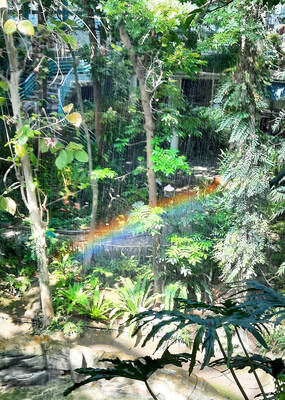
It’s only half the size of its more famous counterpart in Taipei, but the Botanical Garden of the National Museum of Nature Science (NMNS, 國立自然科學博物館植物園) is surely one of urban Taiwan’s most inviting green spaces. Covering 4.5 hectares immediately northeast of the government-run museum in Taichung’s North District (北區), the garden features more than 700 plant species, many of which are labeled in Chinese but not in English. Since its establishment in 1999, the site’s managers have done their best to replicate a number of native ecosystems, dividing the site into eight areas. The name of the Coral Atoll Zone might

On Monday morning, in quick succession, the Chinese Communist Party (CCP) and the Chinese Nationalist Party (KMT) released statements announcing “that the Central Committee of the Communist Party of China and General Secretary Xi Jinping (習近平) have invited KMT Chairwoman Cheng Li-wun (鄭麗文) to lead a delegation on a visit to the mainland” as the KMT’s press release worded it. The KMT’s press release added “Chairwoman Cheng expressed her gratitude for the invitation and has gladly accepted it.” Beijing’s official Xinhua news release described Song Tao (宋濤), head of the Taiwan Work Office of the CCP Central Committee, as
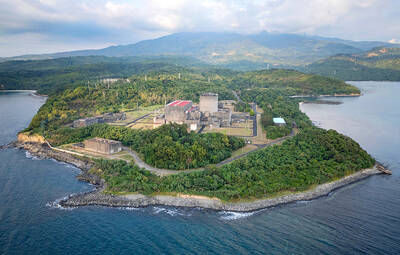
Nuclear power is getting a second look in Southeast Asia as countries prepare to meet surging energy demand as they vie for artificial intelligence-focused data centers. Several Southeast Asian nations are reviving mothballed nuclear plans and setting ambitious targets and nearly half of the region could, if they pursue those goals, have nuclear energy in the 2030s. Even countries without current plans have signaled their interest. Southeast Asia has never produced a single watt of nuclear energy, despite long-held atomic ambitions. But that may soon change as pressure mounts to reduce emissions that contribute to climate change, while meeting growing power needs. The


 RSS
RSS