


Once home to paramilitary prisoners during Northern Ireland’s “Troubles,” a notorious Belfast jail is now home to a whiskey still that is drawing tourists to a formerly strife-torn area.
For Graeme Millar, master distiller at McConnell’s Whiskey, the repurposed Crumlin Road Gaol, whose four forbidding Victorian granite wings are still surrounded by high fences, is an “iconic part of Belfast’s history.”
“We want to do it justice, by bringing distilling back to Belfast and into a building of such significance,” the 53-year-old said.
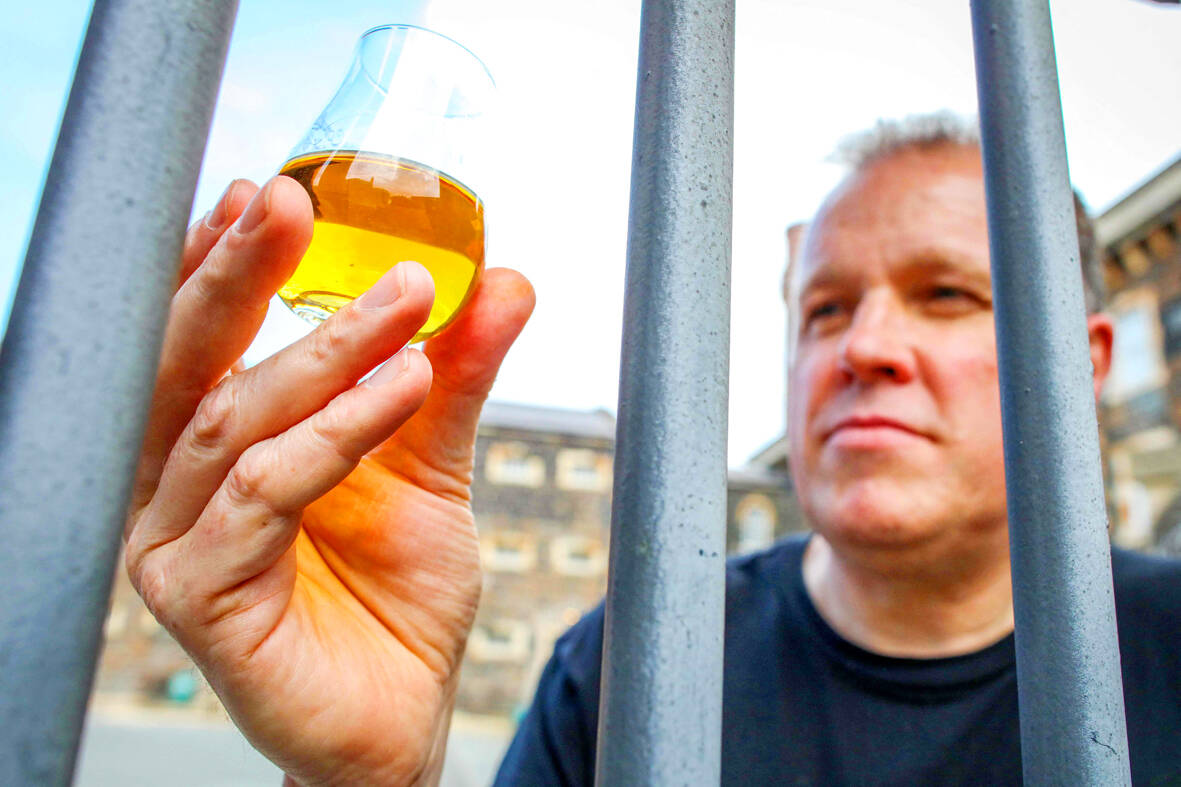
Photo: AFP
“It feels very calm and peaceful for me when I come to work in the morning. I’m sure it’s very different from what it used to be like when it was a prison,” he said.
The Troubles claimed over 3,500 lives during three decades of sectarian violence over British rule of Northern Ireland, which largely ended in a 1998 peace deal.
For many Northern Irish people, Crumlin Road Gaol — located in the northwest of the city which was an epicenter of the conflict — was associated with riots, bombings and breakouts.
“I would have driven here with my mum and dad as a child and would have seen the barriers up at the front and the big tall fences, I remember those sights,” said Millar, who grew up near the city.
WHISKEY REVIVAL
Since closing in 1996 the prison’s A-wing lay derelict but reopened in April after a US$40 million joint investment by the US-backed Belfast Distillery Company and the UK government.
The prison’s thick stone walls and rows of cramped cells along gangways presented “a challenge” when fitting the distillery into the space, Millar said. “Small rooms to put things like air compressors into work well, but something like grain handling equipment which should be outside needed to be fitted into a few cells over the course of three floors,” he said.
The firm now provides jobs for over 30 people, including distillers and tourism staff at a brand new visitors center. It has also resurrected both a long dormant brand — “McConnell’s Irish Whiskey” that dates back to 1776 — and is helping revive whiskey-making in Belfast, which died in the 1930s after Prohibition in the US. “We are bringing employment and distillation skills that haven’t been used in Belfast for years,” said Millar.
‘BUILDING ON HISTORY’
“We’re not the first whiskey distillers in this prison though,” Ross Wade, a tour guide, told a group of English tourists from Nottingham. “The prisoners used to make their own home brew with fermented fruit, crackers and yeast, but their speciality wouldn’t be as nice as our whiskey,” laughed Wade, 27. Opened in 1846, more than 25,000 people were incarcerated there including “suffragette” women’s rights activists, pro-Irish unity republican and pro-UK loyalist paramilitary prisoners, as well as murderers and petty crooks. Famous inmates included former Irish president Eamon de Valera and ex-IRA commander Martin McGuinness, who became Northern Ireland’s deputy premier after the Troubles ended.
The jail — colloquially known as the “Crum” — opened its doors as a tourist attraction in 2012 and the firm hopes the distillery will draw even more visitors. Wade said it complements other major sights in the city such as the museum commemorating the doomed Titanic liner which was built in Belfast.
“We are expecting to get roughly 100,000 people annually here, especially in the high season when the cruise ships and coaches come into Belfast,” he said.
One tourist, Simon Simmons, said the prison distillery was “definitely a great experience.”
“Being from the mainland UK we had definitely heard of the Troubles in Northern Ireland,” said the 54-year-old IT manager. “We hadn’t necessarily heard of this prison itself but we were aware of what was going on as we grew up. It’s good that that history is being built upon,” he said.
Warning: Excessive consumption
of alcohol can damage your health.

If one asks Taiwanese why house prices are so high or why the nation is so built up or why certain policies cannot be carried out, one common answer is that “Taiwan is too small.” This is actually true, though not in the way people think. The National Property Administration (NPA), responsible for tracking and managing the government’s real estate assets, maintains statistics on how much land the government owns. As of the end of last year, land for official use constituted 293,655 hectares, for public use 1,732,513 hectares, for non-public use 216,972 hectares and for state enterprises 34 hectares, yielding

The small platform at Duoliang Train Station in Taitung County’s Taimali Township (太麻里) served villagers from 1992 to 2006, but was eventually shut down due to lack of use. Just 10 years later, the abandoned train station had become widely known as the most beautiful station in Taiwan, and visitors were so frequent that the village had to start restricting traffic. Nowadays, Duoliang Village (多良) is known as a bit of a tourist trap, with a mandatory, albeit modest, admission fee of NT$10 giving access to a crowded lane of vendors with a mediocre view of the ocean and the trains

The March/April volume of Foreign Affairs, long a purveyor of pro-China pablum, offered up another irksome Beijing-speak on the issues and solutions for the problems vexing the People’s Republic of China (PRC) and the US: “America and China at the Edge of Ruin: A Last Chance to Step Back From the Brink” rang the provocative title, by David M. Lampton and Wang Jisi (王緝思). If one ever wants to describe what went wrong with US-PRC relations, the career of Wang Jisi is a good place to start. Wang has extensive experience in the US and the West. He was a visiting

One of the challenges with the sheer availability of food in today’s world is that lots of us end up spending many of our waking hours eating. Whether it’s full meals, snacks or desserts, scientists have found that it’s not uncommon for us to be mindlessly grazing at some point during all of our 16 or so waking hours. The problem? As soon as this food hits the bloodstream in the form of glucose, it initiates the release of the hormone insulin. This in turn activates a switch present in every one of our cells, which is responsible for driving cell


 RSS
RSS