


Last week the New York Times published Oriana Skylar Mastro’s “This is what America is getting wrong about China and Taiwan.” The piece was a fairly typical example of the well-worn genre claiming that peace can be achieved by selling out Taiwan, arguing that the US should “try to understand China’s deep sensitivities about Taiwan” and that it “should recommit — clearly and unequivocally — to the idea that only China and Taiwan can work out their political differences.”
Yes, Skylar Mastro actually argues that the people with the knife at their throat should be allowed to “work out their differences” with the knife-wielding assassin.
Indeed, Skylar Mastro contends that this may mean that Beijing use “its clout to isolate Taiwan and eventually convince the island’s people that it should strike a deal with Beijing.” This claim is followed by “But it isn’t Washington’s place to prevent the unification of the two sides — only to ensure that doesn’t happen through military force or coercion.”
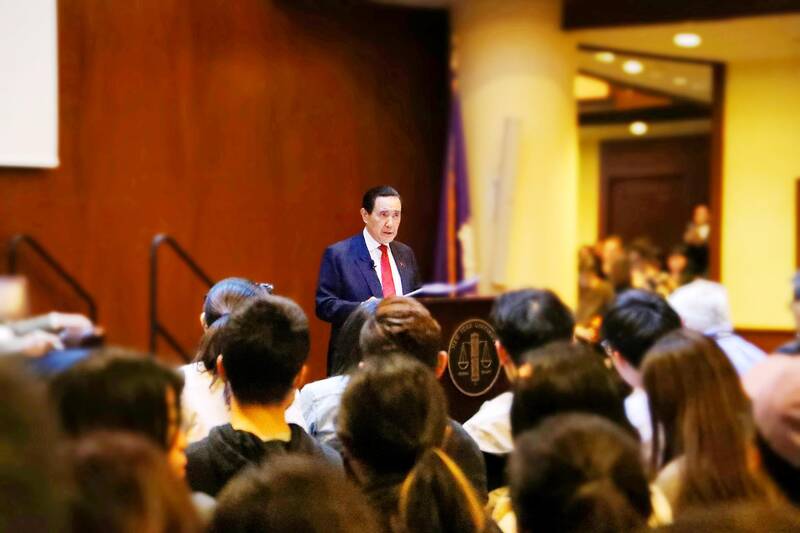
Photo: CNA
Like most pieces in this genre, it is written from a fantasy universe where both time and Chinese expansion stop when Taiwan is annexed, Tokyo, Manila and other regional actors do not exist, and the Taiwanese are pawns without true agency. It is peppered with bizarre contradictions, including contending that isolating Taiwan and forcing it to capitulate is not military force or coercion, and that Washington must prevent the use of force — presumably by using force.
This weird position, that Washington go to war against Beijing to prevent Beijing from making war, makes no rational sense because it is completely divorced from reality. In fact, it is very much in the interests of the US and its allies to keep Beijing out of Taiwan, a fact everyone including Beijing knows, but few will say aloud.
IN PRAISE OF MA
Photo: AP
For those of us out here watching Americans who are supposed to have some inkling of strategy being completely unable to identify their nation’s interests is scary enough, but other pieces advocating pro-China positions are popping up as well.
Longtime China hand Jerome Cohen, along with Chen Yu-jie (陳玉潔), had a piece in The Hill on Oct. 12 marguing that we don’t pay enough attention to the policies of former Taiwan president Ma Ying-jeou (馬英九), whom Cohen once told in an interview that he should have been given a Nobel Peace Prize. For years Cohen has pimped Ma, his former student. According to Cohen and Chen, the Ma era saw “over 20 useful cross-strait agreements that forged cooperation in trade, investment, tourism, transportation and even joint crime fighting and mutual judicial assistance.”
Ma’s policies were largely failures and/or very bad for Taiwan. The economic agreements gutted Taiwan’s trade surplus with China and their obvious sellout nature sparked the Sunflower Movement and mass protests on the theme of “protecting Taiwan.” The “joint crime fighting” which Cohen avers later “brought back to Taiwan many alleged offenders wanted for prosecution” is quite ironic, given that the People’s Republic of China (PRC) began seizing Taiwanese scammers overseas for prosecution because it was angered at the Ma government for letting them get off lightly after repatriation to Taiwan.
Cohen and Chen do argue that the PRC should try to change its policies given that the Democratic Progressive Party’s (DPP) William Lai (賴清德) is likely to win the election. But the reference to the Ma era is important.
Consider what this entire sequence of events looks like, a friend suggested. Skylar Mastro reports in her piece that she had gone to China and met with leaders there before returning to shower us with her wisdom. Anyone who follows Taiwan has seen this pattern of a person visiting the PRC and then returning to their home country to scribe a piece advocating on its behalf. People who claim that PRC soft power is poor have never considered this constantly expanding class of part-time PRC interlocutors.
PARALLEL CLAIMS
Skylar Mastro’s piece comes on the heels of Ma’s talk at New York University (NYU) and subsequent seminar at World Journal that parallel the claims Skylar Mastro made about the US once being committed to a “peaceful outcome” between the PRC and Taiwan. He argued that “countries friendly to Taiwan, including the United States ... encourage the Taiwanese authorities to seek cross-strait mutual trust and hold peace talks.”
This idea that there was a time when the US was committed to a peaceful outcome but that has changed now, a common pro-PRC claim, is also orthogonal to reality. The US could take an “only through peaceful unification” position because until a decade ago the PRC lacked the power to annex Taiwan by force. The PRC’s relentless military expansion has forced the US to respond.
Note that people who call for “peace talks” or similar never describe what Taiwan’s future would be as part of the PRC. Skylar Mastro’s piece calls for unification talks but stops short of recognizing the consequences for Taiwan’s society: concentration camps, surveillance, the loss of basic freedoms and economic devastation.
People sometimes comfort themselves by imagining that economic life might somehow continue under PRC rule. This is wrong. Writers on Taiwan often point to Hong Kong’s loss of freedoms, but PRC savagery has imposed deep economic costs on Hong Kong. A recent piece in Canada’s Financial Post gives the numbers: “Hong Kong’s IPO market is only about one-tenth what it was a few years ago.” There’s been an “exodus” of professionals, and net financial inflows have plummeted. “China’s crackdown is killing Hong Kong’s economy,” the headline screamed.
COORDINATED EFFORT?
To continue, Ma’s speech and Skylar Mastro’s piece were both picked up and juxtaposed in the pro-blue media here in Taiwan, to show that US experts agree with Ma. A prominent pan-Blue talk show host used them as part of the list to hammer home the pan-Blue talking point that the US is unreliable, which obviously implies that Taiwan should cut a deal with Beijing while it still can. Then, a couple of days later, Cohen and Chen come out with a piece extolling the Ma administration’s approach to Beijing.
Oh yeah, that talk on Oct. 16 that Ma gave at NYU? It was at the US-Asia Law Institute, which hosted Ma in conversation with institute founder and Director Emeritus Jerome Cohen.
Stephen A. Orlins, head of the National Committee on US-China Relations after stints at Lehman and Carlyle, was quoted in a Focus Taiwan report on Ma’s speech as saying that the US should consider Ma’s advice. Orlins was a student of Cohen’s.
It’s that time of year again, when the major media drone with commentary from longtime establishment writers who support the KMT and take pro-China positions. May be a coordinated effort, may not be.
Either way, push back folks, there’s an election on.
Notes from Central Taiwan is a column written by long-term resident Michael Turton, who provides incisive commentary informed by three decades of living in and writing about his adoptive country. The views expressed here are his own.
Ajay Verma, a consultant gastroenterologist at Kettering general hospital in Northamptonshire, says our gut is a “complex machine.” “It is constantly providing us with the nutrition we need, initially to grow and develop, and then for us to survive, thrive and repair from injury and illness.” How can we keep it functioning well? Put simply: “Make sure what you put into it is balanced, and that you clear out its waste products adequately,” Verma says. “In a general gastroenterology clinic, the most common conditions we see are irritable bowel syndrome (IBS), gastroesophageal reflux disease, inflammatory bowel disease and constipation,” says Nisha
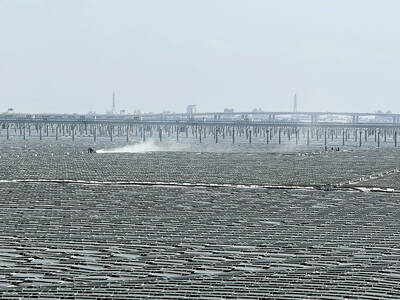
The arithmetic is straightforward and uncomfortable. By the end of 2025, Taiwan had committed itself to a 50-30-20 electricity mix — half natural gas, 30 per cent coal, 20 per cent renewables. The Ministry of Economic Affairs’s (MOEA) own monthly energy reports tell a different story. Natural gas reached 47.8 per cent of generation last year. Coal stood at 35.4 per cent, comfortably above its target ceiling. Renewables came in at 13.1 per cent, well short of the 20 per cent Taipei had pledged a decade earlier. Installed renewable capacity reached roughly half of the 12 gigawatts (GW) the government
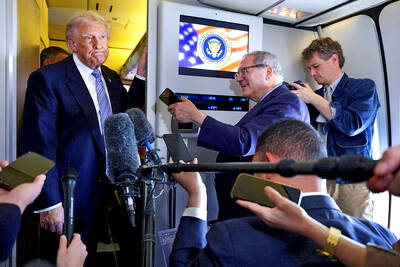
Last week US President Donald Trump was asked by a reporter whether he would speak on the phone to the President of Taiwan. “l’ll speak to him. I speak to everybody. We have that situation very well in hand,” Trump said. This marked the second time in a couple of weeks he had said he would talk to the President of Taiwan. In 2016 he famously took a call from then-president Tsai Ing-wen (蔡英文), when he was president-elect. Despite warnings that the apocalypse was nigh because of a phone call, the world quickly forgot about the conversation between two democratically-elected presidents.
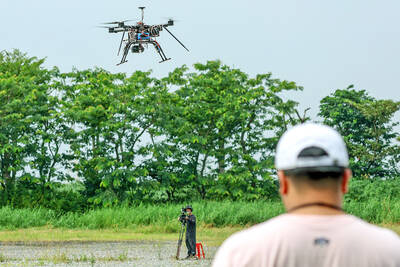
Taiwan’s drone exports are taking off, fuelled by the war in Ukraine, as Taiwanese companies seek a stake in the fast-growing global market for unmanned aerial vehicles (UAV). Low-cost drones used for reconnaissance and strikes are in high demand as governments around the world boost defense spending in the face of intensifying conflicts. A relative new player in the increasingly competitive industry, Taiwan’s pitch is to be an “Asian hub” for the production of UAVs and components free of Chinese materials, or “non-red.” That means its UAVs can be up to three times more expensive than their Chinese competitors, like the world’s biggest


 RSS
RSS