


New York City Mayor Eric Adams has been using artificial intelligence to make robocalls that contort his own voice into several languages he doesn’t actually speak, posing new ethical questions about the government’s use of the rapidly evolving technology.
The mayor told reporters about the robocalls on Monday and said they’ve gone out in languages such as Mandarin and Yiddish to promote city hiring events. They haven’t included any disclosure that he only speaks English or that the calls were generated using AI.
“People stop me on the street all the time and say, ‘I didn’t know you speak Mandarin, you know?’” said Adams, a Democrat. “The robocalls that we’re using, we’re using different languages to speak directly to the diversity of New Yorkers.”
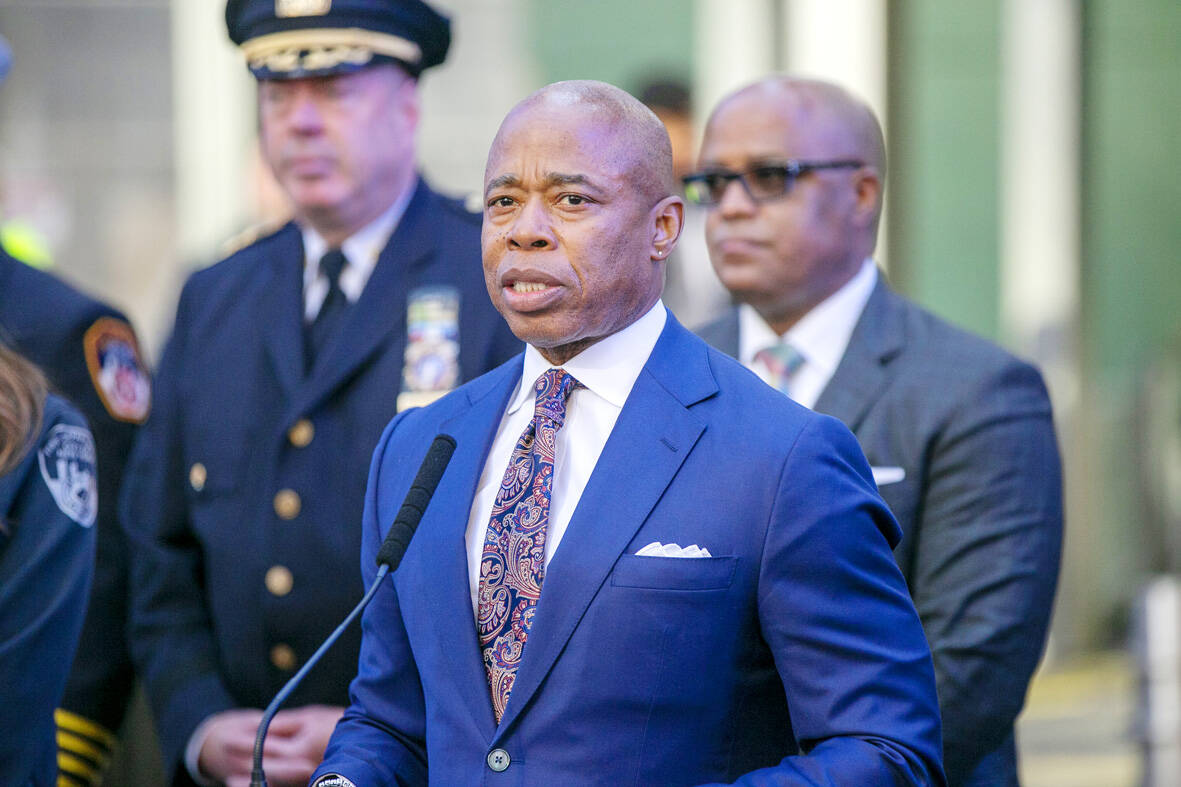
Photo: AP
The calls come as regulators struggle to get a handle on how best to ethically and legally navigate the use of artificial intelligence, where deepfake videos or audio can make it appear that anyone anywhere is doing anything a person on the other side of a computer screen wants them to do.
In New York, the watchdog group Surveillance Technology Oversight Project slammed Adams’ robocalls as an unethical use of artificial intelligence that is misleading to city residents.
“The mayor is making deep fakes of himself,” organization director Albert Fox Cahn said. “This is deeply unethical, especially on the taxpayer’s dime. Using AI to convince New Yorkers that he speaks languages that he doesn’t is outright Orwellian. Yes, we need announcements in all of New Yorkers’ native languages, but the deep fakes are just a creepy vanity project.”
The growing use of artificial intelligence and deepfakes, especially in politics and election misinformation, has prompted calls and moves toward greater regulation from government and major media companies.
Google was the first big tech company to say it would impose new labels on deceptive AI-generated political advertisements that could fake a candidate’s voice or actions for election misinformation. Facebook and Instagram parent Meta doesn’t have a rule specific to AI-generated political ads but has a policy restricting “faked, manipulated or transformed” audio and imagery used for misinformation.
A bipartisan bill in the US Senate would ban “materially deceptive” deepfakes relating to federal candidates, with exceptions for parody and satire. This month, two Democratic members of Congress sent a letter to the heads of Meta and X, formally known as Twitter, to express concerns about AI-generated political ads on their social media platforms.
In recent weeks, a number of technology companies have shown off AI tools that can synthetically dub a person’s speech in another language in a way that makes it sounds as if that person is speaking in that language.
Last month, the music streaming service Spotify introduced an AI feature to translate a podcast into multiple languages in the podcaster’s voice. More recently, the startup ElevenLabs this month introduced a voice translation tool that it said “can convert spoken content to another language in minutes, while preserving the voice of the original speaker.”
A spokesperson for the mayor’s office said they used ElevenLabs’ tool for their robocalls. Native speakers listened to the recordings before they went out to ensure the translations were accurate. Calls have been made in Spanish, Yiddish, Mandarin, Cantonese and Haitian Creole. The city has also used the technology to promote a series of concerts organized by the Adams administration, the spokesperson said.
Adams defended himself against ethical questions about his use of artificial intelligence, saying his office is trying to reach New Yorkers through the languages they speak.
“I got one thing: I’ve got to run the city, and I have to be able to speak to people in the languages that they understand, and I’m happy to do so,” he said. “And so, to all, all I can say is a ni hao.”

The Portuguese never established a presence on Taiwan, but they must have traded with the indigenous people because later traders reported that the locals referred to parts of deer using Portuguese words. What goods might the Portuguese have offered their indigenous trade partners? Among them must have been slaves, for the Portuguese dealt slaves across Asia. Though we often speak of “Portuguese” ships, imagining them as picturesque vessels manned by pointy-bearded Iberians, in Asia Portuguese shipping between local destinations was crewed by Asian seamen, with a handful of white or Eurasian officers. “Even the great carracks of 1,000-2,000 tons which plied

It’s only half the size of its more famous counterpart in Taipei, but the Botanical Garden of the National Museum of Nature Science (NMNS, 國立自然科學博物館植物園) is surely one of urban Taiwan’s most inviting green spaces. Covering 4.5 hectares immediately northeast of the government-run museum in Taichung’s North District (北區), the garden features more than 700 plant species, many of which are labeled in Chinese but not in English. Since its establishment in 1999, the site’s managers have done their best to replicate a number of native ecosystems, dividing the site into eight areas. The name of the Coral Atoll Zone might

On Monday morning, in quick succession, the Chinese Communist Party (CCP) and the Chinese Nationalist Party (KMT) released statements announcing “that the Central Committee of the Communist Party of China and General Secretary Xi Jinping (習近平) have invited KMT Chairwoman Cheng Li-wun (鄭麗文) to lead a delegation on a visit to the mainland” as the KMT’s press release worded it. The KMT’s press release added “Chairwoman Cheng expressed her gratitude for the invitation and has gladly accepted it.” Beijing’s official Xinhua news release described Song Tao (宋濤), head of the Taiwan Work Office of the CCP Central Committee, as

Nuclear power is getting a second look in Southeast Asia as countries prepare to meet surging energy demand as they vie for artificial intelligence-focused data centers. Several Southeast Asian nations are reviving mothballed nuclear plans and setting ambitious targets and nearly half of the region could, if they pursue those goals, have nuclear energy in the 2030s. Even countries without current plans have signaled their interest. Southeast Asia has never produced a single watt of nuclear energy, despite long-held atomic ambitions. But that may soon change as pressure mounts to reduce emissions that contribute to climate change, while meeting growing power needs. The


 RSS
RSS