


Nestled between shops offering traditional Taiwanese snacks and handicrafts on a busy street in Anping’s old city in Tainan lies an unexpected find that stops passers-by in their tracks: A storefront decked with toys, souvenirs and wooden puppets from the Czech Republic.
The shop’s Czech proprietor, Michal Dattel, hails from Prague and first came to Taiwan in 2007, after meeting his now-wife during a visit to New Zealand. He briefly returned to the Czech Republic before coming back to Taiwan in 2010 and starting to import goods from the central European country.
IMPORTS
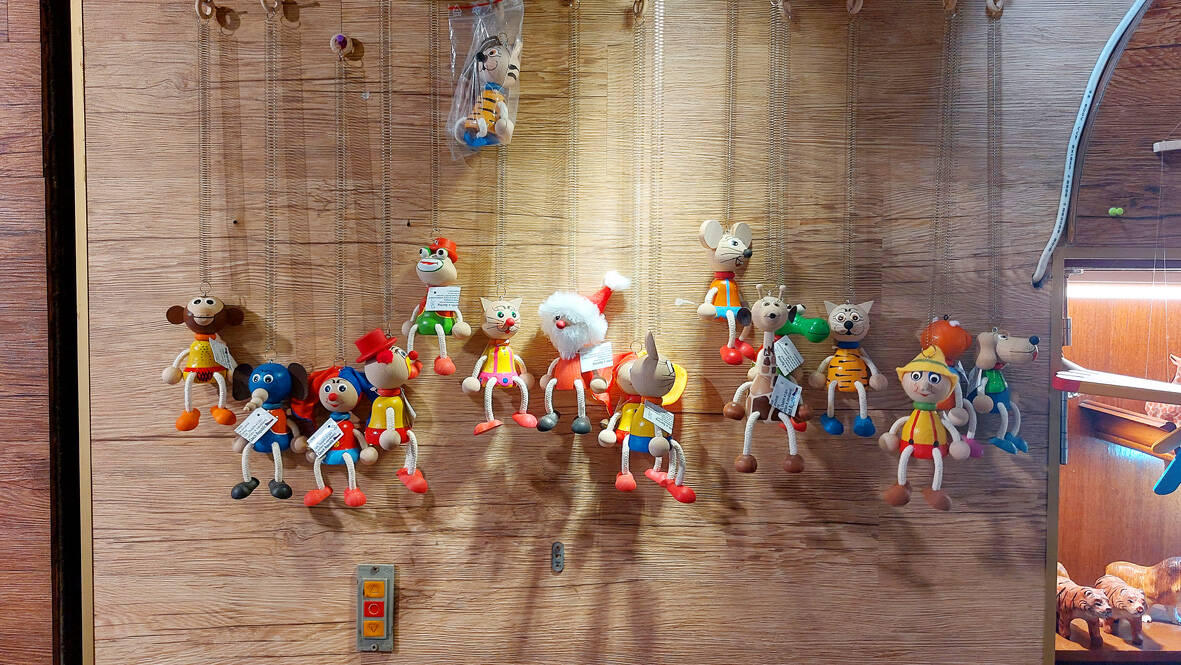
Photo: Doruk Sargin
Dattel said on a recent Friday that he sells the most popular souvenir items his country has to offer, pointing to a colorful array of wooden building blocks, puppets and toys as rain pounded on the tarp covering the storefront. The narrow street, which is usually crowded with shoppers at this time of the day, was deserted save for a few intrepid tourists huddled under umbrellas.
Dattel said after the couple started their import business, they started selling their products at an Eslite outlet. He struggled, at first, as he spoke little Mandarin at the time.
So, he listened carefully to his wife, “trying to figure out what people [were] asking... I slowly picked up more Chinese,” said the 41-year-old, who now speaks the language fluently.
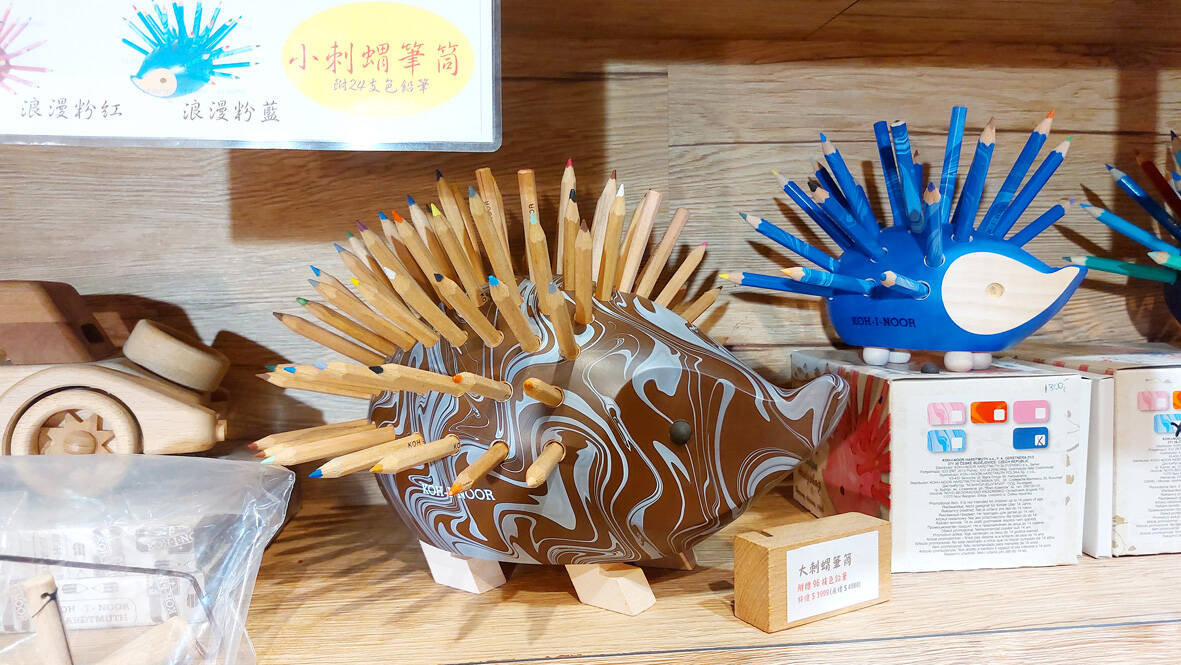
Photo: Doruk Sargin
“It’s funny when you first come to Taiwan, you’re like a kid, you start from scratch,” he said about the challenges of learning a new language.
He has also operated stands near the Matsu temple and Confucius temple, where he said the local Taiwanese vendors were most helpful and welcoming.
“I met so many nice people who helped me,” he said.
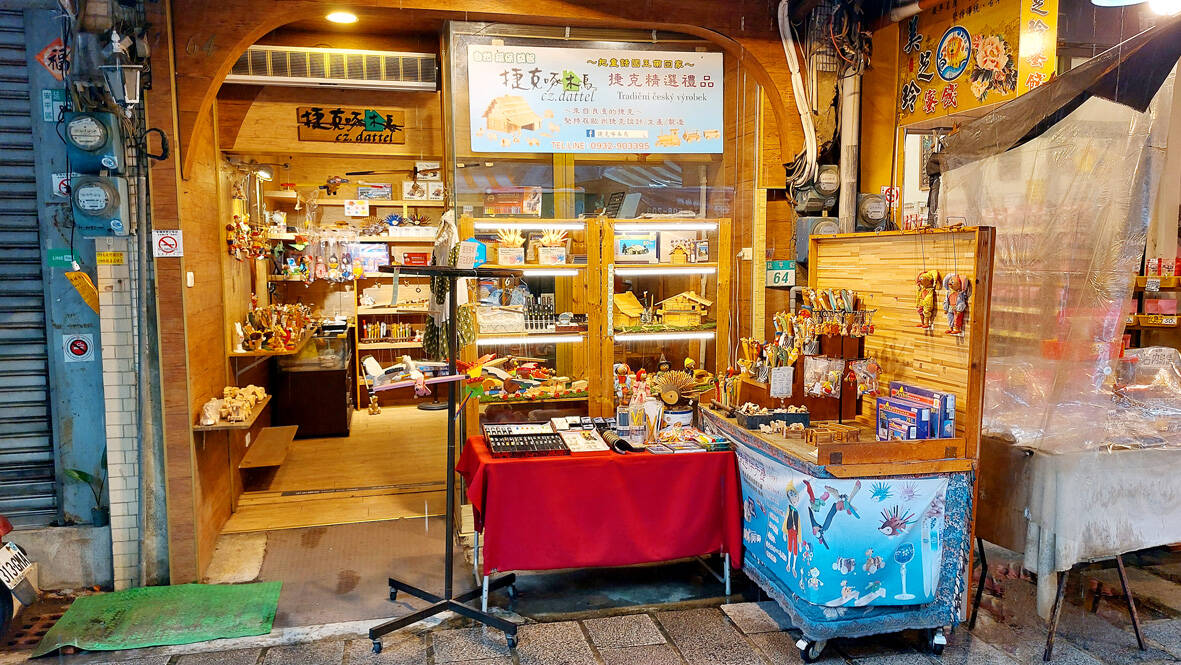
Photo: Doruk Sargin
Dattel said he found the Anping location purely by chance, after an Egyptian friend who also runs a store nearby let him know about it. He opened about three and a half years ago, right before the COVID pandemic hit.
“I had to struggle. This is business; sometimes you make money, sometimes you lose,” he said, before gesturing at his store and adding: “I’m still here,” with a hint of pride.
He has friendly relations with the Taiwanese shopkeepers along the street, Dattel said, alluding to an almost guild-like camaraderie.
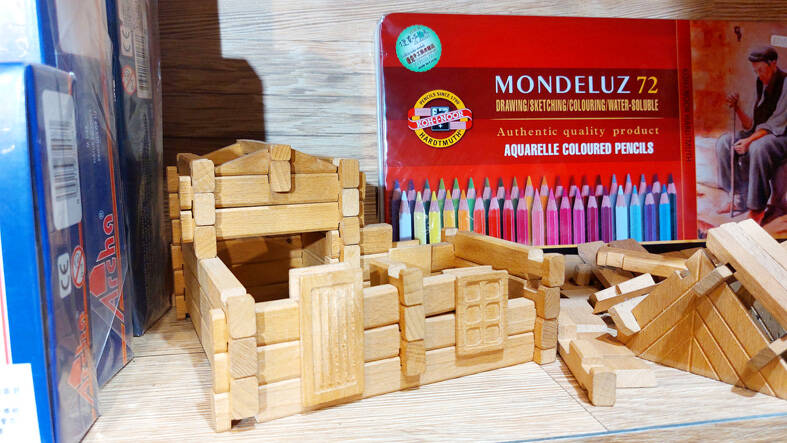
Photo: Doruk Sargin
“Sometimes when I close [and] a customer shows up, they [the other shopkeepers] call me and I come back,” he said. “That’s how it works... People are helping each other.”
“We encourage each other. We are happy to see someone make money,” he said.
CZECH-TAIWAN TIES
The improvement of ties between Taiwan and the Czech Republic has also been good for business, Dattel said.
Czech Senate President Milos Vystrcil visited Taiwan in a landmark trip in 2020, when he addressed the Legislative Yuan and declared “I am Taiwanese.” More high-level visits have followed since, with several Czech and Taiwanese officials visiting each other’s country.
“It’s very interesting that the president of a small country in Europe chose to support Taiwan ... instead of flattering China,” he said, referring to Czech President Petr Pavel, who accepted a congratulatory telephone call from President Tsai Ing-wen (蔡英文) following his election in January.
“I’ve got a lot of customers coming here: ‘Oh we have very good relations now, so I will buy something,’” Dattel said.
It also helps that the Czech Republic is a popular honeymoon destination among Taiwanese newlyweds.
Dattel said he plans to live in Taiwan for the foreseeable future with his wife and two children. However, despite having continuously lived in the country for years, he has no intention of applying for naturalization, because that would mean he would have to forgo his Czech citizenship.
“I would have to give up my passport. And when I go back to my county I would have to apply for a visa,” he said. “I’ll just keep it this way... I will probably stay here as long as I can.”
Regarding the tensions between Taiwan and China, Dattel said he does not follow the news, as he feels the media are exaggerating the issue.
“You just feel hopeless and threatened by something I cannot change or influence,” he said. “I try not to think about it. I don’t know what’s going to happen.”
Dattel said his friends back in the Czech Republic are more concerned.
“They read some BBC article [that] China is going to attack Taiwan in March 2023, [but] nothing happens. Everyone panics in Europe” and send text messages, he added.
“I was making fun of this. [I said] we have military exercises... We get up at 4am and do drills and CPR and we live in the barracks,” Dattel said.
CRAZY TRAFFIC
He is more concerned about issues that matter to him and his family on a day-to-day basis, such as Taiwan’s notorious drivers.
Crossing the street used to be a hazard in Tainan until “that mother and kid got hit at the traffic lights,” Dattel said.
A three-year-old girl was killed and her mother was injured when a car hit them as they were crossing at an intersection in Tainan in early May.
“Everyone started to be aware of green lights. Before, they were waiting on the green light — pedestrians — here in Tainan, and the trucks were going through. That was crazy,” Dattel said.
His hope is that his children will grow up to learn to obey the traffic rules, he added.
Another, smaller, issue he has faced is the closure of nearby beaches in Tainan due to strong rip currents.
“I hope they’re going to allow people to swim in the beach here... You plunge yourself into the water and some guy comes and says you can’t swim here,” he said.
The rain has become even heavier, driving the last of the shoppers away. Dattel started collecting the racks in front of his store as a man with a beaming smile rode in on a scooter. It was the Egyptian friend who helped Dattel find his store.
“Man, are you still here?” he asked. He had already closed his shop due to the heavy rain.
“No, I’m going home,” Dattel said. “Let’s get out of here.”
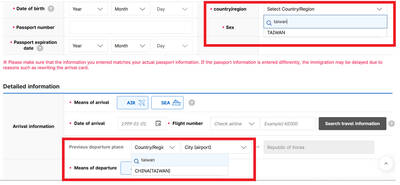
Jason Han says that the e-arrival card spat between South Korea and Taiwan shows that Seoul is signaling adherence to its “one-China” policy, while Taiwan’s response reflects a reciprocal approach. “Attempts to alter the diplomatic status quo often lead to tit-for-tat responses,” the analyst on international affairs tells the Taipei Times, adding that Taiwan may become more cautious in its dealings with South Korea going forward. Taipei has called on Seoul to correct its electronic entry system, which currently lists Taiwan as “China (Taiwan),” warning that reciprocal measures may follow if the wording is not changed before March 31. As of yesterday,

The Portuguese never established a presence on Taiwan, but they must have traded with the indigenous people because later traders reported that the locals referred to parts of deer using Portuguese words. What goods might the Portuguese have offered their indigenous trade partners? Among them must have been slaves, for the Portuguese dealt slaves across Asia. Though we often speak of “Portuguese” ships, imagining them as picturesque vessels manned by pointy-bearded Iberians, in Asia Portuguese shipping between local destinations was crewed by Asian seamen, with a handful of white or Eurasian officers. “Even the great carracks of 1,000-2,000 tons which plied
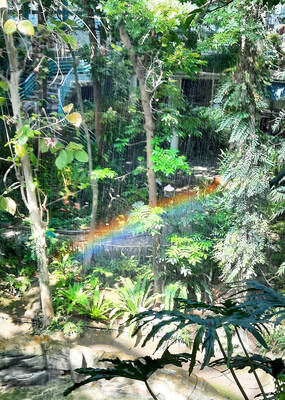
It’s only half the size of its more famous counterpart in Taipei, but the Botanical Garden of the National Museum of Nature Science (NMNS, 國立自然科學博物館植物園) is surely one of urban Taiwan’s most inviting green spaces. Covering 4.5 hectares immediately northeast of the government-run museum in Taichung’s North District (北區), the garden features more than 700 plant species, many of which are labeled in Chinese but not in English. Since its establishment in 1999, the site’s managers have done their best to replicate a number of native ecosystems, dividing the site into eight areas. The name of the Coral Atoll Zone might
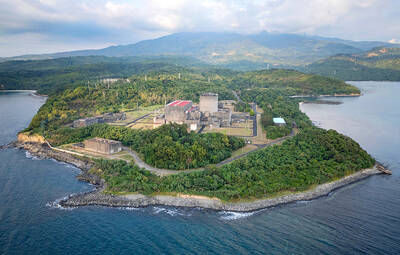
Nuclear power is getting a second look in Southeast Asia as countries prepare to meet surging energy demand as they vie for artificial intelligence-focused data centers. Several Southeast Asian nations are reviving mothballed nuclear plans and setting ambitious targets and nearly half of the region could, if they pursue those goals, have nuclear energy in the 2030s. Even countries without current plans have signaled their interest. Southeast Asia has never produced a single watt of nuclear energy, despite long-held atomic ambitions. But that may soon change as pressure mounts to reduce emissions that contribute to climate change, while meeting growing power needs. The


 RSS
RSS