


The use of artificial intelligence in breast cancer screening is safe and can almost halve the workload of radiologists, according to the world’s most comprehensive trial of its kind.
Breast cancer is the most prevalent cancer globally, according to the WHO, with more than 2.3 million women developing the disease every year.
Screening can improve prognosis and reduce mortality by spotting breast cancer at an earlier, more treatable stage. Preliminary results from a large study suggest AI screening is as good as two radiologists working together, does not increase false positives and almost halves the workload.
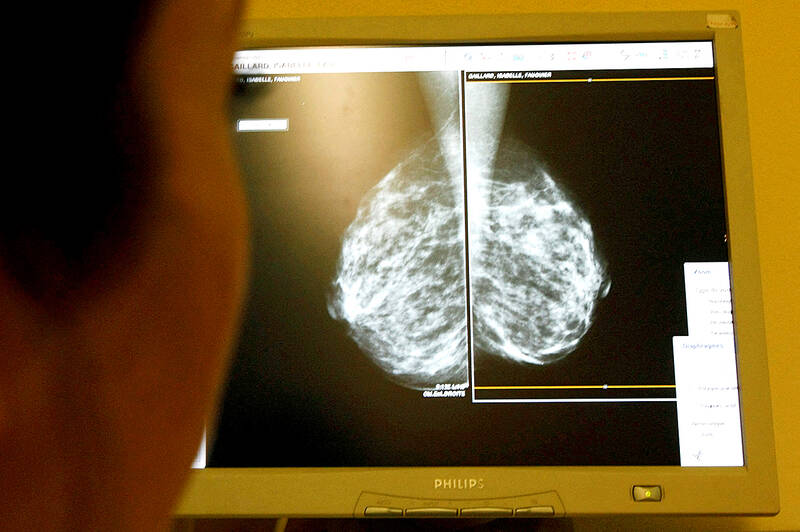
Photo: Reuters
The interim safety analysis results of the first randomized controlled trial of its kind involving more than 80,000 women were published in the Lancet Oncology journal.
Previous studies examining whether AI can accurately diagnose breast cancer in mammograms were carried out retrospectively, assessing scans that had been looked at by clinicians.
But the latest study, which followed women from Sweden with an average age of 54, compared AI-supported screening directly with standard care.
Half of the scans were assessed by two radiologists, while the other half were assessed by AI-supported screening followed by interpretation by one or two radiologists.
In total, 244 women (28 percent) recalled from AI-supported screening were found to have cancer compared with 203 women (25 percent) recalled from standard screening. This resulted in 41 more cancers being detected with the support of AI, of which 19 were invasive and 22 were in situ cancers.
The use of AI did not generate more false positives, where a scan is incorrectly diagnosed as abnormal. The false-positive rate was 1.5 percent in both groups.
There were 36,886 fewer screen readings by radiologists in the AI group compared with the group receiving standard care, resulting in a 44 percent reduction in the screen-reading workload of radiologists, the authors said.
The final results, looking at whether AI can reduce the number of interval cancers — cases detected between screenings that generally have a poorer prognosis — and whether the use of AI in screening is justified, are not expected for several years.
But the interim analysis concludes: “AI-supported mammography screening resulted in a similar cancer detection rate compared with standard double reading, with a substantially lower screen-reading workload, indicating that the use of AI in mammography screening is safe.”
The lead author, Kristina Lang, from Lund University in Sweden, said that the promising interim safety results should be used to inform new trials and program-based evaluations to address the pronounced radiologist shortage in many countries, but they are not enough on their own to confirm that AI is ready to be implemented in mammography screening.
She added that they still need to understand the implications on patients’ outcomes, especially whether combining radiologists’ expertise with AI can help detect interval cancers that are often missed by traditional screening, as well as the cost-effectiveness of the technology. The greatest potential of AI right now is that it could allow radiologists to be less burdened by the excessive amount of reading.
“While our AI-supported screening system requires at least one radiologist in charge of detection, it could potentially do away with the need for double reading of the majority of mammograms, easing the pressure on workloads and enabling radiologists to focus on more advanced diagnostics while shortening waiting times for patients,” she said.
Stephen Duffy, a professor of cancer screening at Queen Mary University of London, who was not involved with the trial, hailed the “high quality” study but said there may be concerns that AI-driven increases in breast cancer detection could include overdetection of relatively harmless lesions.
“For example, the results of this paper include an increase in detection of ductal carcinoma in situ, which is thought to be potentially overdiagnosed,” he said.
Kotryna Temcinaite, the head of research communications at the charity Breast Cancer Now, said the final trial results would ultimately determine whether AI could help improve breast cancer screening.
In the meantime, she said, “urgent issues” in breast screening programs must be addressed, such as outdated IT systems that take up valuable staff time and delay improvements.
Katharine Halliday, the president of the Royal College of Radiologists, said: “AI holds huge promise and could save clinicians time by maximizing our efficiency, supporting our decision-making, and helping identify and prioritize the most urgent cases.”

If one asks Taiwanese why house prices are so high or why the nation is so built up or why certain policies cannot be carried out, one common answer is that “Taiwan is too small.” This is actually true, though not in the way people think. The National Property Administration (NPA), responsible for tracking and managing the government’s real estate assets, maintains statistics on how much land the government owns. As of the end of last year, land for official use constituted 293,655 hectares, for public use 1,732,513 hectares, for non-public use 216,972 hectares and for state enterprises 34 hectares, yielding
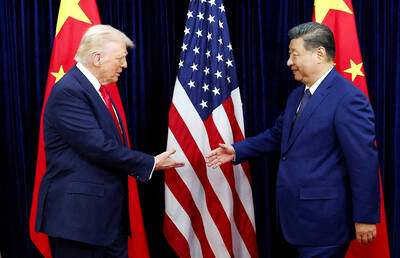
The March/April volume of Foreign Affairs, long a purveyor of pro-China pablum, offered up another irksome Beijing-speak on the issues and solutions for the problems vexing the People’s Republic of China (PRC) and the US: “America and China at the Edge of Ruin: A Last Chance to Step Back From the Brink” rang the provocative title, by David M. Lampton and Wang Jisi (王緝思). If one ever wants to describe what went wrong with US-PRC relations, the career of Wang Jisi is a good place to start. Wang has extensive experience in the US and the West. He was a visiting
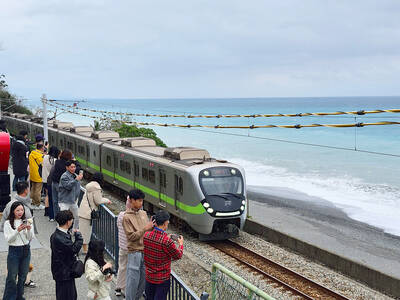
The small platform at Duoliang Train Station in Taitung County’s Taimali Township (太麻里) served villagers from 1992 to 2006, but was eventually shut down due to lack of use. Just 10 years later, the abandoned train station had become widely known as the most beautiful station in Taiwan, and visitors were so frequent that the village had to start restricting traffic. Nowadays, Duoliang Village (多良) is known as a bit of a tourist trap, with a mandatory, albeit modest, admission fee of NT$10 giving access to a crowded lane of vendors with a mediocre view of the ocean and the trains

One of the challenges with the sheer availability of food in today’s world is that lots of us end up spending many of our waking hours eating. Whether it’s full meals, snacks or desserts, scientists have found that it’s not uncommon for us to be mindlessly grazing at some point during all of our 16 or so waking hours. The problem? As soon as this food hits the bloodstream in the form of glucose, it initiates the release of the hormone insulin. This in turn activates a switch present in every one of our cells, which is responsible for driving cell


 RSS
RSS