


India should surpass China’s population midway through this year, according to the latest projection from the UN.
That’s of course unless it’s happened already — or happens later in the year.
Demographers are unsure exactly when India will take the title as the most populous nation in the world because they’re relying on estimates to make their best guess. The latest projection from the UN this week put it at midyear, though that remains an estimate.
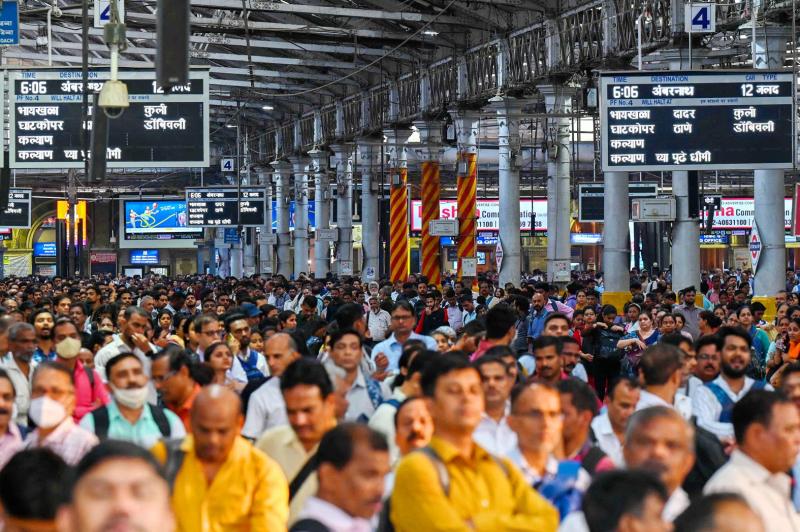
Photo: AFP
China has had the most people in the world since at least 1950, the year UN population data began. Both China and India have more than 1.4 billion people, and combined they make up more than a third of the world’s 8 billion people.
“Actually, there is no way we can know exactly when India will surpass China,” said Bruno Schoumaker, a demographer at Universite catholique de Louvain in Belgium. “There is some uncertainty, not only about India’s population, but also China’s population.”
STILL, WHEN IS IT HAPPENING?

Photo: AFP
The UN said in a report Wednesday that India will have about 2.9 million people more than China sometime in the middle of this year — an estimated 1.4286 billion for India, 1.4257 billion for mainland China. But demographers have said the limits of population data make it impossible to calculate an exact date.
Mathematical calculations are made from data including a range of surveys, as well as birth and death records.
“It’s a crude approximation, a best guess,” said Patrick Gerland, chief of the population estimates and projections section at the UN in New York.
Not long ago, India wasn’t expected to become most populous until later this decade. But the timing has been sped up by a drop in China’s fertility rate, with families having fewer children.
HOW IS IT CALCULATED?
Demographers at the UN Population Division make estimates based on projections from a wide variety of data sources to get what they believe are the most up-to-date demographic numbers. The last update to the data used for these calculations for both India and China was July last year, said Sara Hertog, a UN population affairs officer in New York.
The demographers then use a statistical technique to infer when India’s population has surpassed that of China, according to Stuart Gietel-Basten, a professor at Khalifa University of Science and Technology in Abu Dhabi.
“The reality, of course, is that these estimates are just that,” Gietel-Basten said. “But at least they are based on a relatively solid and consistent methodology.”
WHERE DO THE NUMBERS COME FROM?
The foundations of both nations’ numbers are censuses, or head counts, conducted every decade.
China’s last census was in 2020. Demographers used birth and death records, along with other administrative data, to calculate how the population has grown since then.
India’s last census was in 2011. Its scheduled 2021 census was postponed by COVID-19. Without an actual door-to-door count for more than a decade, sample surveys have filled in the gaps to help demographers and India itself understand its population, said Alok Vajpeyi of the New Delhi-based non-government organization, Population Foundation of India.
Among the most important is the Sample Registration System, India’s large-scale demographic survey that gathers data on such things as births, deaths, fertility and more.
Andrea Wojnar, the UN Population Fund’s representative for India, said the agency is confident in the survey’s numbers “because it uses a very robust methodology.”
WHY IS INDIA MOVING AHEAD?
China has an aging population with stagnant growth even after the government seven years ago retreated from a one-child policy, and just two years ago said couples could have three children.
India has a much younger population, a higher fertility rate and a decrease in infant mortality over the last three decades.
India has more babies born each year than in any other country, while China has joined many European countries in having more deaths each year than births, said Dudley Poston, an emeritus professor of sociology at Texas A&M University.
WHY DOES THIS MATTER?
There’s more than bragging rights at stake over which nation is the world’s most populous — there are social and economic consequences. In India, that means a growing labor force and growth that sparks economic activity. In China, that means fewer working-age adults able to support an aging population.
Once a country hits a low fertility level, it’s often hard to recover population growth, even with changes in government policy to encourage more births, said Toshiko Kaneda, technical director of demographic research at the Population Reference Bureau in Washington.
“Psychologically, it will be tough for China, especially given the rivalry in other areas between the two countries,” Gietel-Basten said. “It is a big moment in human history as the baton is passed to India.”
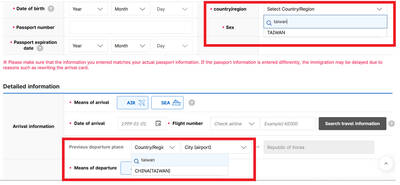
Jason Han says that the e-arrival card spat between South Korea and Taiwan shows that Seoul is signaling adherence to its “one-China” policy, while Taiwan’s response reflects a reciprocal approach. “Attempts to alter the diplomatic status quo often lead to tit-for-tat responses,” the analyst on international affairs tells the Taipei Times, adding that Taiwan may become more cautious in its dealings with South Korea going forward. Taipei has called on Seoul to correct its electronic entry system, which currently lists Taiwan as “China (Taiwan),” warning that reciprocal measures may follow if the wording is not changed before March 31. As of yesterday,

The Portuguese never established a presence on Taiwan, but they must have traded with the indigenous people because later traders reported that the locals referred to parts of deer using Portuguese words. What goods might the Portuguese have offered their indigenous trade partners? Among them must have been slaves, for the Portuguese dealt slaves across Asia. Though we often speak of “Portuguese” ships, imagining them as picturesque vessels manned by pointy-bearded Iberians, in Asia Portuguese shipping between local destinations was crewed by Asian seamen, with a handful of white or Eurasian officers. “Even the great carracks of 1,000-2,000 tons which plied

Nuclear power is getting a second look in Southeast Asia as countries prepare to meet surging energy demand as they vie for artificial intelligence-focused data centers. Several Southeast Asian nations are reviving mothballed nuclear plans and setting ambitious targets and nearly half of the region could, if they pursue those goals, have nuclear energy in the 2030s. Even countries without current plans have signaled their interest. Southeast Asia has never produced a single watt of nuclear energy, despite long-held atomic ambitions. But that may soon change as pressure mounts to reduce emissions that contribute to climate change, while meeting growing power needs. The

On Monday morning, in quick succession, the Chinese Communist Party (CCP) and the Chinese Nationalist Party (KMT) released statements announcing “that the Central Committee of the Communist Party of China and General Secretary Xi Jinping (習近平) have invited KMT Chairwoman Cheng Li-wun (鄭麗文) to lead a delegation on a visit to the mainland” as the KMT’s press release worded it. The KMT’s press release added “Chairwoman Cheng expressed her gratitude for the invitation and has gladly accepted it.” Beijing’s official Xinhua news release described Song Tao (宋濤), head of the Taiwan Work Office of the CCP Central Committee, as


 RSS
RSS