


The problem with mobile phones is that people look at them too much. At least, that’s according to the man who invented them 50 years ago.
Martin Cooper, an American engineer dubbed the “Father of the cell phone,” says the neat little device we all have in our pockets has almost boundless potential and could one day even help conquer disease.
But right now, we can be a little obsessed.

Photo: EPA-EFE
“I am devastated when I see somebody crossing the street and looking at their cell phone. They are out of their minds,” said the 94-year-old from his office in Del Mar, California.
“But after a few people get run over by cars, they’ll figure it out,” he joked.
Cooper wears an Apple Watch and uses a top-end iPhone, flicking intuitively between his e-mail, photos, YouTube and the controls for his hearing aid. He gets his hands on the latest model every time it is updated, and gives it a thorough road test.

Photo: Bloomberg
But, he confesses, with several million apps available, it can all feel a bit much.
“I will never, ever understand how to use the cell phone the way my grandchildren and great grandchildren do,” he says.
REAL MOBILITY
Cooper’s iPhone — which he says he likes to use mostly to speak to people — is certainly a very long way from the weighty block of wires and circuits that he used to make the very first mobile phone call on April 3, 1973.
At the time he was working for Motorola, leading a team of designers and engineers who were engaged in a sprint to come up with the first properly mobile technology and avoid being squeezed out of an up-and-coming market.
The company had invested millions of dollars in the project, hoping to beat out Bell System, a behemoth that dominated US telecoms for more than a century from its inception in 1877.
Bell’s engineers had floated the idea of a cellular phone system just after World War II, and by the late 1960s had taken it as far as putting phones in cars — partially because of the huge battery they needed.
But for Cooper, that didn’t represent real mobility.
At the tail end of 1972, he decided he wanted a device that you could use anywhere.
So with the entire resources of Motorola at his disposal, he pulled together experts on semiconductors, transistors, filters and antennae who worked around the clock for three months.
By the end of March, they had cracked it, unveiling the DynaTAC — Dynamic Adaptive Total Area Coverage — phone.
“This phone weighed over a kilo — about two and a half pounds — and had a battery life of roughly 25 minutes of talking,” he said.
“That was not a problem. This phone was so heavy, you couldn’t hold it up for 25 minutes.”
That very first phone call didn’t have to be long. It just had to work.
And who better for Cooper to call than his rival?
“So here I am standing on Sixth Avenue (in New York) And it occurred to me I had to call my counterpart at the The Bell System... Dr Joel Engel. And I said, ‘Joel, this is Martin Cooper... I’m talking to you on a handheld cell phone. But a real cell phone, personal, portable, handheld.’ There was silence on the other end of the line. I think he was gritting his teeth.”
‘CONQUER DISEASE’
Those first mobile phones were not cheap at around US$5,000 per handset, but they granted early adopters — who Cooper says included people trying to sell property — an edge.
“It turns out that what real estate people do is they show people houses, or they answer the phone for new clients.
“Now they could do both at the same time; it doubled their productivity.”
And mobile phones continue to improve people’s lives.
“The cell phone has now become an extension of the person, it can do so many more things,” he said. “And in that regard, we are just at the very beginning. We’re just starting to understand what that could do.
Cooper says that the cell phone will revolutionize education and healthcare.
“I know that sounds like an exaggeration, but I want you to know within a generation or two, we are going to conquer disease.”
Just like his watch monitors his heartrate while he swims, and his phone monitors his hearing aids, phones will one day be connected to an array of bodily sensors that will catch illness before it develops, he says.
It’s all a long way from where it started with that monster handset, but while he didn’t envisage every development, Cooper always knew the device he and his team came up with would change the world.
“We really knew that everybody someday would have a cell phone. We’re almost there. “There are more mobile phone subscriptions in the world today than there are people. So that part of our dream has come true.”
As for the problem of people gawping at their phones too much— even as they cross the road — he’s not worried.
New technology often throws up challenges.
“When television first came out, people were just hypnotized. “But we somehow... managed to understand that there is a quality associated with looking at a television.”
Right now, we’re at the mindless staring phase with our phones, he says, but that won’t last.
“Each generation is going to be smarter... They will learn how to use the cell phone more effectively.
“Humans sooner or later figure it out.”

Taiwan’s overtaking of South Korea in GDP per capita is not a temporary anomaly, but the result of deeper structural problems in the South Korean economy says Chang Young-chul, the former CEO of Korea Asset Management Corp. Chang says that while it reflects Taiwan’s own gains, it also highlights weakening growth momentum in South Korea. As design and foundry capabilities become more important in the AI era, Seoul risks losing competitiveness if it relies too heavily on memory chips. IMF forecasts showing Taiwan widening its lead over South Korea have fueled debate in Seoul over memory chip dependence, industrial policy and
“China wants to unify with Taiwan at the lowest possible cost, and it currently believes that unification will become easier and less costly as time passes,” wrote Amanda Hsiao (蕭嫣然) and Bonnie Glaser in Foreign Affairs (“Why China Waits”) this month, describing how the People’s Republic of China (PRC) is playing the long game in its quest to seize Taiwan. This has been a favorite claim of many writers over the years, easy to argue because it is so trite. Very obviously, if the PRC isn’t attacking Taiwan, it is waiting. But for what? Hsiao and Glaser’s main point is trivial,
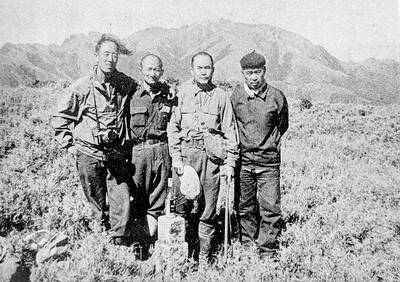
May 18 to May 24 Gathered on Yangtou Mountain (羊頭山) on Dec. 5, 1972, Taiwan’s hiking enthusiasts formally declared the formation of the “100 Peaks Club” (百岳俱樂部) and unveiled the final list of mountains. Famed mountaineer Lin Wen-an (林文安) led this effort for the Chinese Alpine Association (中華山岳協會). Working with other experienced climbers, he chose 100 peaks above 10,000 feet (3,048m) that featured triangulation points and varied in difficulty and character. The list sparked an alpine hiking craze, inspiring many to take up mountaineering and competing to “conquer” the summits. A common misconception is that the 100 Peaks represent Taiwan’s 100 tallest

And so, in the wake of US President Donald Trump’s trip to the People’s Republic of China (PRC), all the experts on the Strait of Hormuz suddenly became experts on US-China-Taiwan relations. The Internet has certainly expanded human knowledge. Lots of these sudden experts made noise this week about Trump’s words after the meeting with PRC dictator Xi Jin-ping (習近平). Trump is going to sell out Taiwan! Longtime Taiwan commentator J. Michael Cole summed the situation up neatly in the Guardian: “We need to keep in mind that he has a tendency to say many things — sometimes contradicting himself within


 RSS
RSS