


Until recently, Brett Schickler never imagined he could be a published author, though he had dreamed about it. But after learning about the ChatGPT artificial intelligence program, Schickler figured an opportunity had landed in his lap.
“The idea of writing a book finally seemed possible,” said Schickler, a salesman in Rochester, New York. “I thought ‘I can do this.’”
Using the AI software, which can generate blocks of text from simple prompts, Schickler created a 30-page illustrated children’s e-book in a matter of hours, offering it for sale last month through Amazon.com Inc’s self-publishing unit.

Photo: Reuters
In the edition, Sammy the Squirrel, crudely rendered also using AI, learns from his forest friends about saving money after happening upon a gold coin. He crafts an acorn-shaped piggy bank, invests in an acorn trading business and hopes to one day buy an acorn grinding stone.
Sammy becomes the wealthiest squirrel in the forest, the envy of his friends and “the forest started prospering,” according to the book.
The Wise Little Squirrel: A Tale of Saving and Investing, available in the Amazon Kindle store for US$2.99, or US$9.99 for a printed version, has netted Schickler less than US$100, he said. While that may not sound like much, it is enough to inspire him to compose other books using the software.
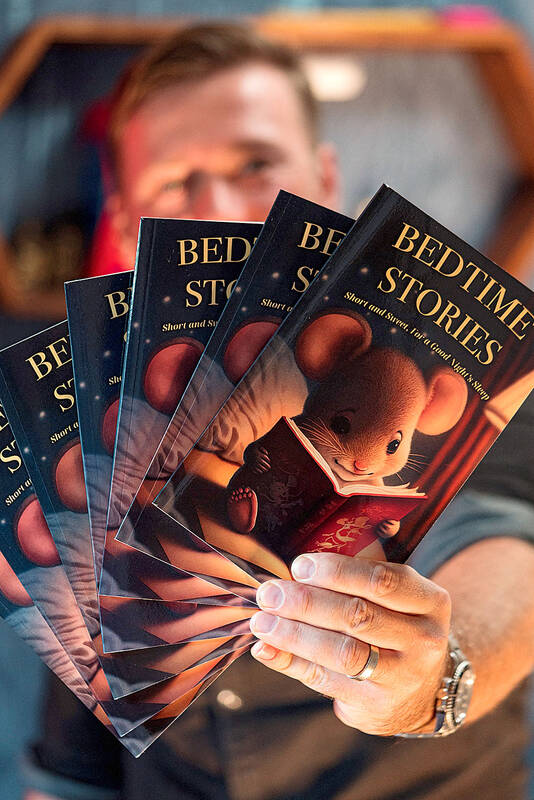
Photo: Reuters
“I could see people making a whole career out of this,” said Schickler, who used prompts on ChatGPT like “write a story about a dad teaching his son about financial literacy.”
FAILURE TO DISCLOSE
Schickler is on the leading edge of a movement testing the promise and limitations of ChatGPT, which debuted in November and has sent shock waves through Silicon Valley and beyond for its uncanny ability to create cogent blocks of text instantly.
There were over 200 e-books in Amazon’s Kindle store as of two weeks ago listing ChatGPT as an author or co-author, including How to Write and Create Content Using ChatGPT, The Power of Homework and poetry collection Echoes of the Universe. And the number is rising daily. There is even a new sub-genre on Amazon: Books about using ChatGPT, written entirely by ChatGPT.
But due to the nature of ChatGPT and many authors’ failure to disclose they have used it, it is nearly impossible to get a full accounting of how many e-books may be written by AI.
The rapid consumer adoption of ChatGPT has spurred frenzied activity in tech circles as investors pour money into AI-focused startups and given technology firms new purpose amid the gloom of massive layoffs. Microsoft, for one, received fawning coverage this month over its otherwise moribund Bing search engine after demonstrating an integration with ChatGPT.
But already there are concerns over authenticity, because ChatGPT learns how to write by scanning millions of pages of existing text. An experiment with AI by CNET resulted in multiple corrections and apparent plagiarism before the tech news site suspended its use.
THREAT TO REAL AUTHORS?
Now ChatGPT appears ready to upend the staid book industry as would-be novelists and self-help gurus looking to make a quick buck are turning to the software to help create bot-made e-books and publish them through Amazon’s Kindle Direct Publishing arm. Illustrated children’s books are a favorite for such first-time authors. On YouTube, TikTok and Reddit hundreds of tutorials have spring up, demonstrating how to make a book in just a few hours. Subjects include get-rich-quick schemes, dieting advice, software coding tips and recipes.
“This is something we really need to be worried about, these books will flood the market and a lot of authors are going to be out of work,” said Mary Rasenberger, executive director of writers’ group the Authors Guild. Ghostwriting — by humans — has a long tradition, she said, but the ability to automate through AI could turn book writing from a craft into a commodity.
“There needs to be transparency from the authors and the platforms about how these books are created or you’re going to end up with a lot of low-quality books,” she said.
One author, who goes by Frank White, showed in a YouTube video how in less than a day he created a 119-page novella called Galactic Pimp: Vol. 1 about alien factions in a far-off galaxy warring over a human-staffed brothel. The book can be had for just US$1 on Amazon’s Kindle e-book store. In the video, White says anyone with the wherewithal and time could create 300 such books a year, all using AI.
Many authors, like White, feel no duty to disclose in the Kindle store that their great American novel was written wholesale by a computer, in part because Amazon’s policies do not require it.
When asked for comment, Amazon did not address whether it had plans to change or review its Kindle store policies around authors’ use of AI or other automated writing tools. “All books in the store must adhere to our content guidelines, including by complying with intellectual property rights and all other applicable laws,” Amazon spokeswoman Lindsay Hamilton said via E-mail.
A spokeswoman for ChatGPT developer OpenAI declined to comment.
A PRODUCT IN JUST HOURS
Amazon is by far the largest seller of both physical and e-books, commanding well over half of sales in the United States and, by some estimates, over 80 percent of the e-book market. Its Kindle Direct Publishing service has spawned a cottage industry of self-published novelists, carving out particular niches for enthusiasts of erotic content and self-help books.
Amazon created Kindle Direct Publishing in 2007 to allow anyone to sell and market a book from their couch without the hassle or expense of seeking out literary agents or publishing houses. Generally, Amazon allows authors to publish instantly through the unit without any oversight, splitting whatever proceeds they generate.
That has attracted new AI-assisted authors like Kamil Banc, whose primary job is selling fragrances online, who bet his wife he could make a book from conception to publication in less than one day. Using ChatGPT, an AI image creator and prompts like “write a bedtime story about a pink dolphin that teaches children how to be honest,” Banc published an illustrated 27-page book in December. Available on Amazon, Bedtime Stories: Short and Sweet, For a Good Night’s Sleep took Banc about four hours to create, he said.
Consumer interest so far has been admittedly sleepy: Banc said sales have totaled about a dozen copies. But readers rated it worthy of five stars, including one who praised its “wonderful and memorable characters.”
Banc has since published two more AI-generated books, including an adult coloring book, with more in the works. “It actually is really simple,” he said. “I was surprised at how fast it went from concept to publishing.”
Not everyone is blown away by the software. Mark Dawson, who has reportedly sold millions of copies of books he wrote himself through Kindle Direct Publishing, was quick to call ChatGPT-assisted novels “dull.”
“Merit plays a part in how books are recommended to other readers. If a book gets bad reviews because the writing is dull then it’s quickly going to sink to the bottom.”

Taiwan’s English education system is being pulled apart by three opposing forces. Bilingual Nation 2030 pulls students toward English and global communication. Artificial Intelligence (AI) readiness pulls them toward digital judgment, verification and AI-mediated work. But Taiwan’s old exam culture pulls them back toward memorization, grammar drills, timed reading and correct answers. If the education system keeps using old exams to define success, it risks producing graduates who are neither genuinely bilingual nor genuinely AI-ready, but trained for tasks machines can already perform. The first force is Bilingual Nation 2030. Launched in 2018, the policy aimed to “help Taiwan’s workforce connect

It seems every few days one bumps into one of those “real man” comments in which Taiwan is urged to “face reality” or similar, and “make a deal,” with the speaker implying that soon it will be too late. “Deal” advocates always present themselves as having a superior grip on reality, and the manly ability to make the “hard choice.” Their testosterone-laden language often echoes that of Taiwan sellout advocates. Note that such commentary always specifies a process (“make a deal, work with, make progress”), never the end state of what occupation by a violent authoritarian colonialist state will entail. In

“Taiwan’s Opposition Leader Comes to US With a Message Straight Out of Beijing” read a May 31 headline in the Wall Street Journal. Top US administration officials and members of Congress almost certainly read the WSJ, and if there was a bullet point takeaway that people in Washington should absorb ahead of Chinese Nationalist Party (KMT) Chair Cheng Li-wun’s (鄭麗文) arrival in DC on June 9, that headline is it. The last few columns have discussed this very topic, and the timing is not coincidental. While those top officials likely do not read the Taipei Times, judging by the number
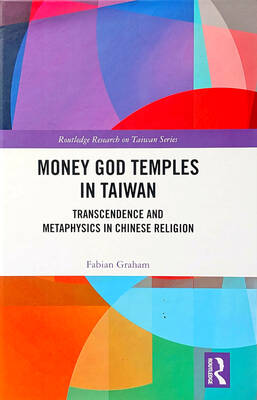
As someone who normally steers clear of books with “transcendence” or “metaphysics” in their subtitles, this reviewer — a casual observer of local belief systems since the 1990s — found Fabian Graham’s Money God Temples in Taiwan a challenging read. Those who’ve only dipped their toes into temple culture will likely need to parse several sections with special care if they’re to keep up with the author, a British ethnographic researcher whose previous books have investigated religious practices among ethnic Chinese in Southeast Asia. This scholarly volume examines a facet of Taiwan’s religious landscape that didn’t exist a century ago, and


 RSS
RSS