


Kaohsiung’s Linyuan District (林園) isn’t on any of Taiwan’s tourist trails. Despite its proximity to Taiwan’s second-busiest international airport and visitor magnets like Dapeng Bay (大鵬灣), few outsiders spend their precious leisure time here.
The district’s southeastern corner has a tree which gets photographed more often than its modest height and unremarkable appearance would justify. The Kaohsiung City Government has declared it to be the Municipality’s Southernmost Tree (市境之南樹) — even though it’s been pointed out that, because Taiping Island (太平島) falls under Kaohsiung’s jurisdiction, the city’s most southerly trees are in fact far closer to the equator.
About 3.5km along the coast, closer to central Kaohsiung, there’s a far more interesting spot: Linyuan Ocean Wetland Park (林園海洋溼地公園), home to a remarkable jellyfish population. The park is open 24 hours a day, every day of the week, and there’s no admission charge.
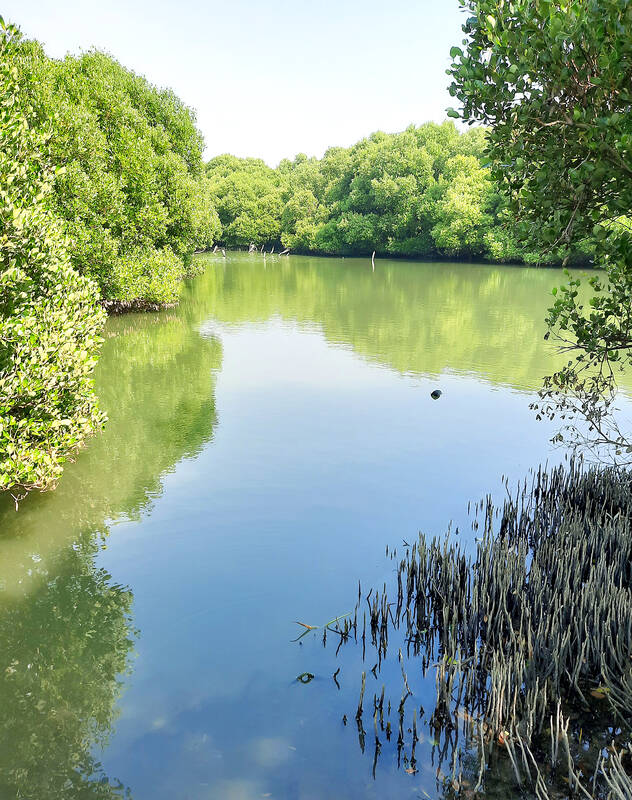
Photo: Steven Crook
At first glance, but for its ocean views, this 6.2-hectare patch of green looks similar to many other parks around Taiwan. But instead of ordinary trees, it has an abundance of mangroves. They thrive on the edges of two brackish lagoons and beside a narrow channel.
Peer into the wetland’s shallow waters between November and February, and you’re sure to find clusters of light-brown Cassiopea andromeda jellyfish. These creatures appear to self-segregate according to size. Around the footbridge across the channel, most are the width of a passion fruit. Elsewhere, there are specimens quite a bit bigger than a compact disc.
The jellyfish spend most of their time upside down and in one location. If disturbed — for instance, if someone who hasn’t read the notices that urge visitors to leave the park’s aquatic residents alone mischievously uses a stick to flip one over — they come to life, gradually right themselves, and settle back down after a minute or two. There’s something soothing about their languid movements.
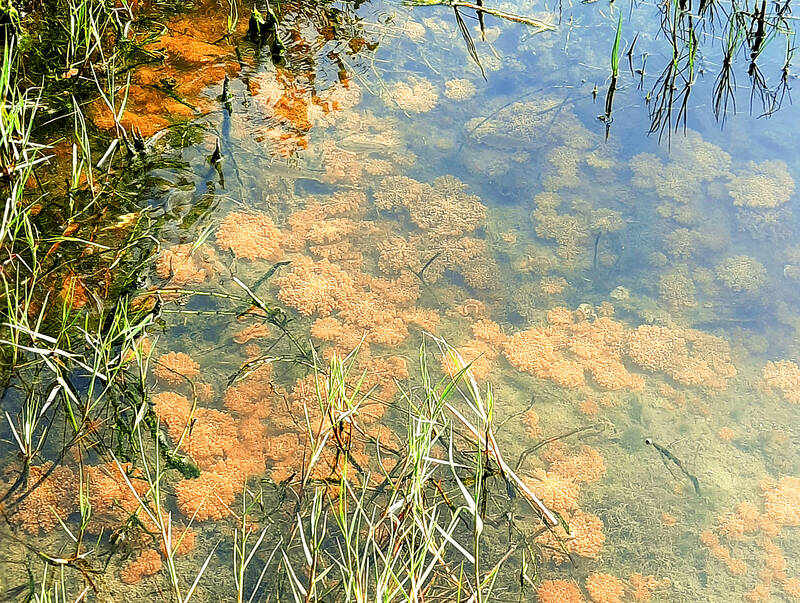
Photo: Steven Crook
Like all jellyfish, Linyuan’s Cassiopea andromeda are carnivorous. But that’s not why they like to stay upside down.
Each of the park’s jellyfish plays host to, and is in a symbiotic relationship with, countless single-celled algae called dinoflagellates. These microscopic living things are the reason why Cassiopea andromeda tend to be brownish, and why they bask in shallow water.
More importantly, because the dinoflagellates are photosynthetic (like plants), they can provide each jellyfish with up to 90 percent of the energy it needs during daytime. In return, the dinoflagellates gain nutrition and carbon dioxide, as well as a protected position close to the surface of the water where they can receive more sunlight.
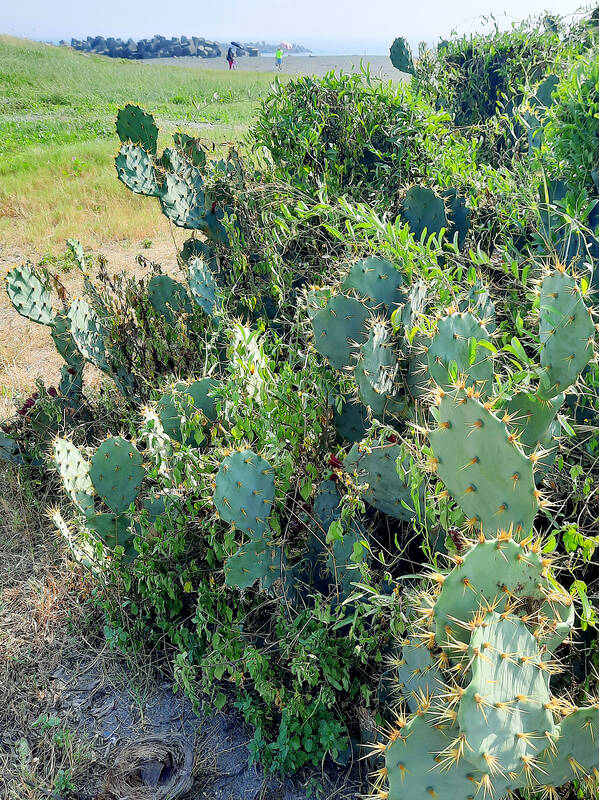
Photo: Steven Crook
March is breeding season for Cassiopea andromeda. In summertime, Linyuan’s jellyfish population tends to shrink from its peak of over 10,000, because the species struggles to survive in temperatures above 35 degrees Celsius.
A Sept. 19 report in Liberty Times (the Chinese-language sister newspaper of the Taipei Times) quoted Chen Chun-chiang (陳俊強), president of the Linyuan People’s Association, as saying that the installation of a pump, to bring cooler water into the wetland, could encourage the jellyfish to stay in the park year-round.
Some Cassiopea andromeda are more orange than brown. Very occasionally a brilliant blue specimen makes an appearance; some think that color may be the result of a genetic mutation.
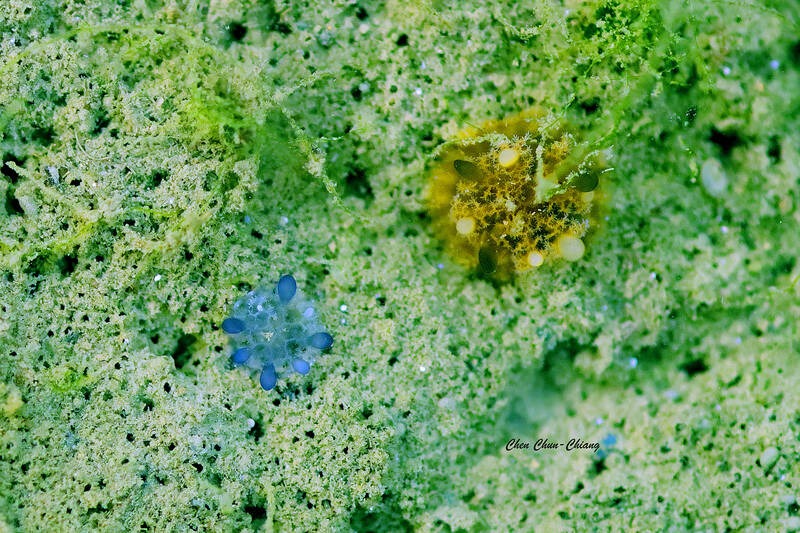
Photo: Chen Chun-chiang, Taipei Times
When the park first opened to the public in 2014, volunteers often had to remind visitors who wanted to feed the fish not to pollute the lagoon by throwing in bread.
Something far worse happened in spring 2016. The waters turned an alarming shade of red after the owner of a nearby fish farm used powerful chemicals to kill bacteria in his pond. This was catastrophic for the jellyfish, and they didn’t return in meaningful numbers until the start of 2018.
The beach beside Linyuan Ocean Wetland Park is like a dozen others in southern Taiwan. In other words, it’s not especially inviting. The sand is dark gray, and — depending on tides and currents — sometimes a depressing amount of litter is visible.
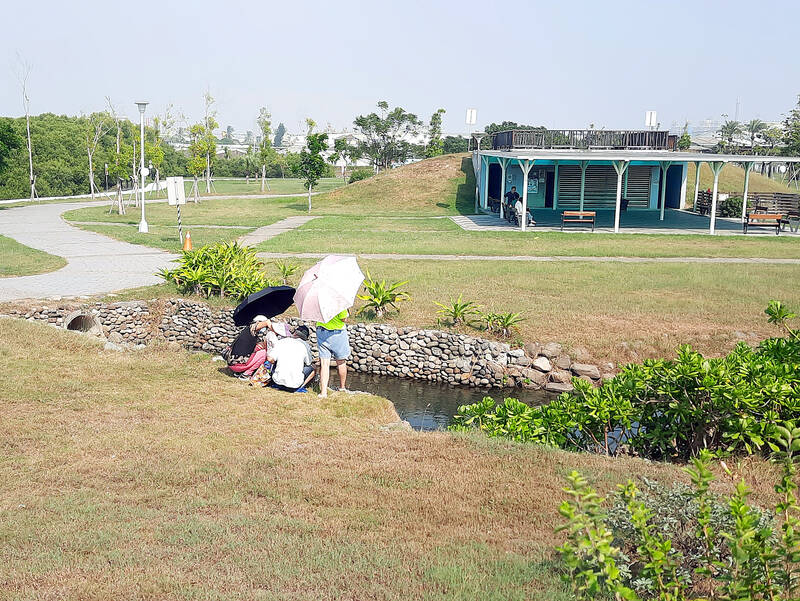
Photo: Steven Crook
That said, it’s possible to see the island of Siaoliouciou (小琉球), which is about 14 km to the south. There are also some thickets of Opuntia dillenii, a type of cactus associated with the Penghu Islands, where the purple flesh of its fruit is used to make ice cream.
If you’re going to spend any time in the park or on the beach, bring a hat or an umbrella, as the sun can be strong even in wintertime. There’s a bathroom, and most of the paths are wheelchair and stroller-friendly.
While in Linyuan, consider also taking a look at Dinglin Zihbian Police Station (頂林仔邊派出所), which dates from the 1895-1945 period of Japanese colonial rule. For more details including directions, see “Handcuffed to the past” in the Dec. 4, 2020 Taipei Times.
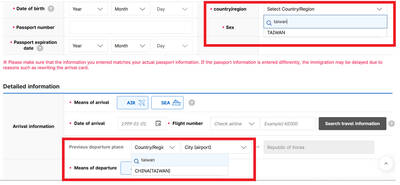
Jason Han says that the e-arrival card spat between South Korea and Taiwan shows that Seoul is signaling adherence to its “one-China” policy, while Taiwan’s response reflects a reciprocal approach. “Attempts to alter the diplomatic status quo often lead to tit-for-tat responses,” the analyst on international affairs tells the Taipei Times, adding that Taiwan may become more cautious in its dealings with South Korea going forward. Taipei has called on Seoul to correct its electronic entry system, which currently lists Taiwan as “China (Taiwan),” warning that reciprocal measures may follow if the wording is not changed before March 31. As of yesterday,

The Portuguese never established a presence on Taiwan, but they must have traded with the indigenous people because later traders reported that the locals referred to parts of deer using Portuguese words. What goods might the Portuguese have offered their indigenous trade partners? Among them must have been slaves, for the Portuguese dealt slaves across Asia. Though we often speak of “Portuguese” ships, imagining them as picturesque vessels manned by pointy-bearded Iberians, in Asia Portuguese shipping between local destinations was crewed by Asian seamen, with a handful of white or Eurasian officers. “Even the great carracks of 1,000-2,000 tons which plied
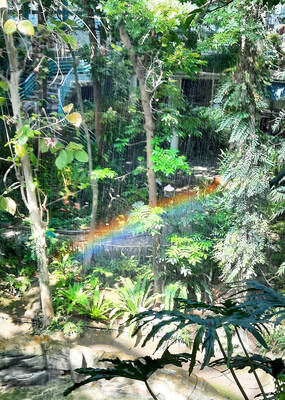
It’s only half the size of its more famous counterpart in Taipei, but the Botanical Garden of the National Museum of Nature Science (NMNS, 國立自然科學博物館植物園) is surely one of urban Taiwan’s most inviting green spaces. Covering 4.5 hectares immediately northeast of the government-run museum in Taichung’s North District (北區), the garden features more than 700 plant species, many of which are labeled in Chinese but not in English. Since its establishment in 1999, the site’s managers have done their best to replicate a number of native ecosystems, dividing the site into eight areas. The name of the Coral Atoll Zone might
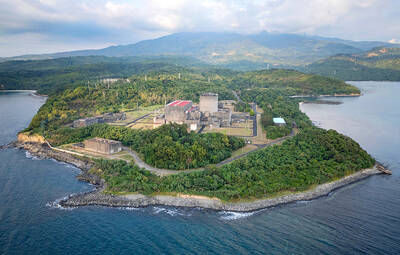
Nuclear power is getting a second look in Southeast Asia as countries prepare to meet surging energy demand as they vie for artificial intelligence-focused data centers. Several Southeast Asian nations are reviving mothballed nuclear plans and setting ambitious targets and nearly half of the region could, if they pursue those goals, have nuclear energy in the 2030s. Even countries without current plans have signaled their interest. Southeast Asia has never produced a single watt of nuclear energy, despite long-held atomic ambitions. But that may soon change as pressure mounts to reduce emissions that contribute to climate change, while meeting growing power needs. The


 RSS
RSS