


Writers are calling on parents and grandparents to buy a book by a non-celebrity this Christmas as authors such as David Walliams are set to top the festive charts.
With big names including Tom Fletcher, Jamie Oliver, Geri Horner and Paul McCartney recently releasing or announcing children’s books, the fear is that the authors and illustrators who make a living from them are going to lose out.
It is not sour grapes on the part of children’s authors, though — a survey last week by the Authors’ Licensing and Collecting Society (ALCS) said that the median earnings for a professional author are now just £7,000 (US$8,500) a year.
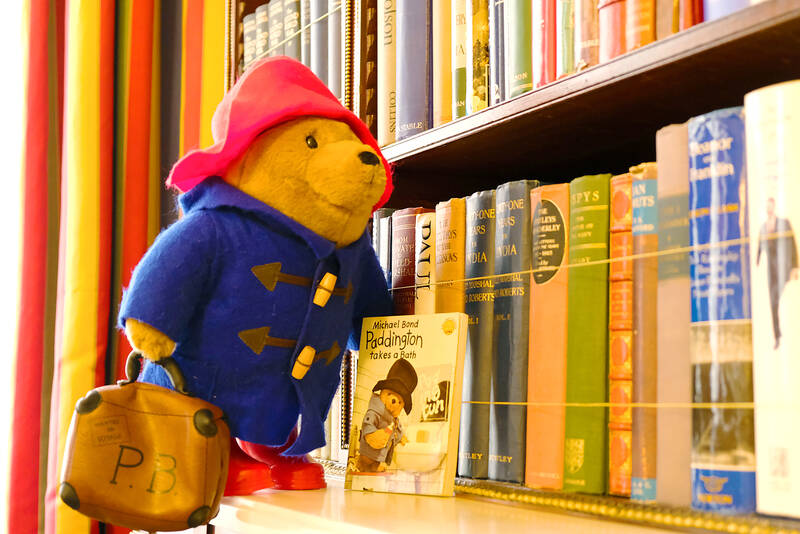
Photo: AP
Former Britain’s Got Talent presenter Walliams’s latest work, Spaceboy, probably earned far more than that on the day of release, having sold 35,000 copies in its first week.
Piers Torday, award-winning author of The Last Wild trilogy and There May Be a Castle, among others, said that it becomes an extremely unlevel playing field once celebrities decide to put pen to paper and promotional budgets are poured into marketing their books.
“The issue is with celebrities from other fields who have previously shown no interest in creative writing and see the children’s book market as a fairly pain-free way to extend their brand,” he said.
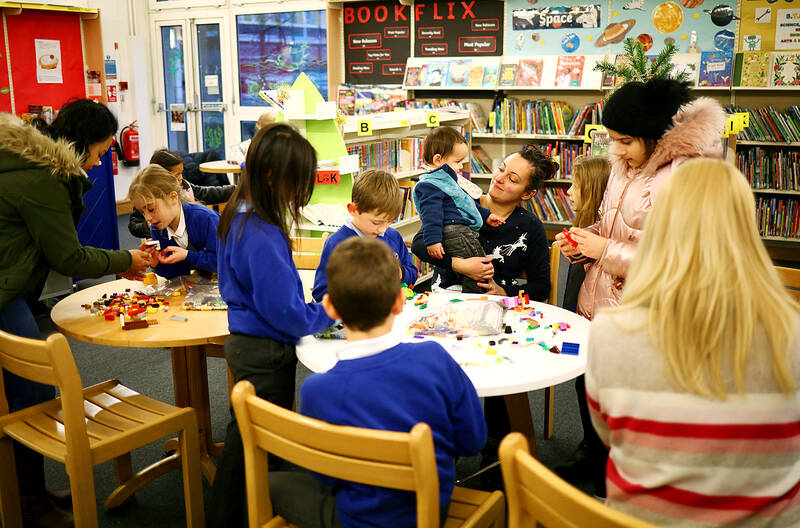
Photo: Reuters
“If harried adults don’t have time to keep up with reviews, they’ll just go into Sainsbury’s and if they’ve heard the name, they’ll just grab it.”
Claire Wilson of the RCW literary agency said: “Readers are not well-served if the first thing that they see on every shelf is mediocre writing put into a celebrity package.
“It remains the case that the offering in supermarkets and other chains is dominated by a static selection of the biggest brands and most recognizable names. I would love to see a new generation of authors brought into the public conversation and given a chance to find their readership.”
Anthony McGowan, who won the 2020 Carnegie medal for children’s books for his novel Lark, said that when buying books this Christmas, we should think of the books that have stayed with us since our own childhoods.
“Which ones have implanted themselves in your heart?” he said. “It’s unlikely to be celebrity authors. It’ll be writers who have developed their craft over years, writers who have that gift of remembering their own childhoods, of turning those memories and experience into rich, complex, powerful, moving stories and of connecting with young readers.
“It probably isn’t going to be someone who became famous by being amusing on a sofa on a TV set.”
Oliver’s book, Billy and the Giant Adventure, will not be out until next year, as will the fruits of former Spice Girl Horner’s two-book deal featuring the adventures of Rosie Frost.
“I just feel like: ‘Oh, Jamie, why do you need to do it?’” said Torday. “You’re already a successful cook and you already do really great things, but we just don’t need a children’s book from you. I mean, I’m not about to inflict my cooking on anyone.

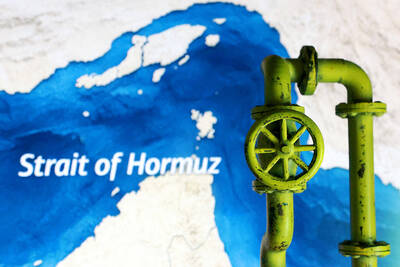
The US war on Iran has illuminated the deep interdependence of Asia on flows of oil and related items as raw materials that become the basis of modern human civilization. Australians and New Zealanders had a wake up call. The crisis also emphasizes how the Philippines is a swatch of islands linked by jet fuel. These revelations have deep implications for an invasion of Taiwan. Much of the commentary on the Taiwan scenario has looked at the disruptions to world trade, which will be in the trillions. However, the Iran war offers additional specific lessons for a Taiwan scenario. An insightful

The problem with Marx’s famous remark that history repeats itself, first as tragedy, the second time as farce, is that the first time is usually farce as well. This week Chinese Nationalist Party (KMT) Chair Cheng Li-wun (鄭麗文) made a pilgrimage to the People’s Republic of China (PRC) “to confer, converse and otherwise hob-nob” with Chinese Communist Party (CCP) officials. The visit was an instant international media hit, with major media reporting almost entirely shorn of context. “Taiwan’s main opposition leader landed in China Tuesday for a rare visit aimed at cross-strait ‘peace’”, crowed Agence-France Presse (AFP) from Shanghai. Rare!
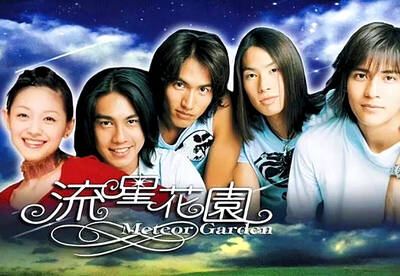
April 6 to April 13 Few expected a Japanese manga adaptation featuring four tall, long-haired heartthrobs and a plucky heroine to transform Taiwan’s television industry. But Meteor Garden (流星花園) took the nation by storm after premiering on April 12, 2001, single-handedly creating the “idol drama” (偶像劇) craze that captivated young viewers across Asia. The show was so successful that Japan produced its own remake in 2005, followed by South Korea, China and Thailand. Other channels quickly followed suit, with more than 50 such shows appearing over the following two years. Departing from the melodramatic

Sunflower movement superstar Lin Fei-fan (林飛帆) once quipped that the Democratic Progressive Party (DPP) could nominate a watermelon to run for Tainan mayor and win. Conversely, the DPP could run a living saint for mayor in Taipei and still lose. In 2022, the DPP ran with the closest thing to a living saint they could find: former Minister of Health and Welfare Chen Shih-chung (陳時中). During the pandemic, his polling was astronomically high, with the approval of his performance reaching as high as 91 percent in one TVBS poll. He was such a phenomenon that people printed out pop-up cartoon


 RSS
RSS