


Can eating insects cause diseases such as cancer?
Social media: you bet it can.
“Some insects contain chitins and toxins... [E]ating them will eventually give you respiratory disease and spinal cancer,” a person wrote on Facebook.

Photo:Tu Chien-jung, Taipei Times
Chitin is commonly found in insects, shrimp, crab and various foods.
The netizen was responding to an issue of Kang Hsuen Learning Magazine (康軒學習雜誌), a popular educational publication used in the teaching of students aged 6-18, about international food trends.
One article examined the nutritional and environmental benefits of eating bugs, and the countries that consume them. The netizen took issue with the article’s “brainwashing” Taiwan’s children into consuming the critters.
“Is Taiwan’s educational system hopeless? Children’s magazines brainwash children into eating insects to save the planet,” the netizen wrote.
But the poster was cherry-picking the facts. Tsan Mei-ling (詹美鈴), a researcher at the National Museum of Natural Science, says that chitins are found in many foods and are not harmful to humans.
Tsan added one caveat: those who are allergic to crab or shimp, may be allergic to insects, which means they probably want to avoid them.
DEMOCRACY CONFERENCE COVID-19 OUTBREAK
A rumor spread online that half of the 300 participants from 70 countries to last week’s 11th Global Assembly of the World Movement for Democracy came down with COVID-19.
In an interview with the Taiwan Fact Check Center, conference participant Wu Ming-hsuan (吳銘軒), deputy executive of the Open Culture Foundation, said that only three people were confirmed to have been infected during the three-day event.
Conference organizers said that testing protocols were in place and those confirmed participated virtually from home or from their hotel.
NINE-IN-ONE ELECTIONS
As campaigning for the nine-in-one elections on Nov. 26 reaches a fever pitch, so too has disinformation about candidates and voting.
One persistent rumor, currently making the rounds on social media, involves whether or not those Taiwanese residing overseas that have canceled their household registration can return to Taiwan and vote. To do so, the rumor states, the voter must renew their household registration and live in Taiwan for at least four months before they can vote.
The rumor seeks its legitimacy from Article 12 of the President and Vice-President Election and Recall Act (總統副總統選舉罷免法), which states: “Anyone who is or has been residing in Taiwan for at least 6 months” is entitled to vote.
When contacted for clarification, the Central Election Commission (CEC) said that the phrase “six months of continued residence” in the law refers to “six months of household registration,” not “actual residence in Taiwan.”
The CEC added that for presidential and vice-presidential elections, overseas nationals who have established a household registration in Taiwan for at least six months are eligible to apply for voting status with a Republic of China (ROC) passport, even if they are not currently registered.
For the nine-in-one elections, a person must have a household registration in the election district for at least four months in order to be eligible to vote.
GOV’T FOOTING BILL FOR TSMC PLANT IN US?
Much attention has been given over to the US$12 billion chipmaking plant Taiwan Semiconductor Manufacturing Co (TSMC, 台積電), the worlds largest contract chipmaker, plans to build in Arizona. It’s also caught the attention of the rumor mill.
Early this month, news circulated online that the government is underwriting the entire operation — from the plant’s construction, to the expenses of the families and their dependents sent to the US to set it up.
But a spokesperson for TSMC clarified to the Taiwan Fact Check Center: “The rumors are not true, as the Arizona foundry set-up costs, including staff onboarding, were paid for by TSMC.”
The center also enlisted the help of ITRI Industrial Economics and Knowledge Center researcher Ray Yang (楊瑞臨) and Dachrahn Wu (吳大任), director of the Research Center for Taiwan Economic Development industry, to look at TSMC’s financial statements. They found that the company is paying for the plant.
PRIDE TAIWAN
Some people are pretty angry that gay folks are showing pride.
“Can we still support this political party after they spent NT$30 million to invite homosexuals from all over the world to march in Taipei to harm our next generation?” a person wrote on social media
It’s not clear which “political party” the posts were referring to.
The message, being spread on social media and Line, including photos and video, referred to money spent on last month’s Taiwan LGBT Pride parade in Taipei, which attracted an estimated 120,00 participants.
The Taiwan Rainbow Civil Action Association (臺灣彩虹公民行動協會), the parade’s organizer this year, said on Nov. 7 that 80 to 90 percent of their funding — NT$7 million — comes from corporate sponsors, all of which are registered in Taiwan.
The Taipei Tourism Department is also a sponsor.
With regards to foreign participation, the association said that it has in the past received applications from groups in Japan and South Korea to participate, but didn’t receive any this year probably due to the pandemic.
However, it added, some expats who live and work in Taiwan signed up teams — the American Institute in Taiwan (AIT) and other de facto embassies participate every year, and a group of Ukrainian students were represented — but none flew into Taiwan to specifically march in the parade.
JABS HURT IMMUNE SYSTEM
A person alleging to be an orthopedic surgeon from National Taiwan University Hospital posted a video in which he says getting the jab for COVID-19 too often can compromise the immune system.
In the five-minute video, two men are seen discussing the jab when the alleged surgeon says: “If you really need to get the fourth shot, first write a suicide note.”
He added that he knows people who died or were seriously injured after getting the jab.
“There are concerns that it should be stopped,” he said, suggesting that vitamin D supplements are an effective way to combat the coronavirus.
The Taiwan Fact Check Center interviewed a number of medical professionals, who reiterated that people should get the vaccine to protect against COVID-19. Although the jab can compromise the immune system in the short term, there is no scientific evidence to show that there are long-term impacts on the immune system.
There isn’t enough empirical evidence to show that vitamin D supplementation is an effective treatment for coronavirus.
At least the “surgeon” wasn’t encouraging people to drink bleach.

By global standards, the traffic congestion that afflicts Taiwan’s urban areas isn’t horrific. But nor is it something the country can be proud of. According to TomTom, a Dutch developer of location and navigation technologies, last year Taiwan was the sixth most congested country in Asia. Of the 492 towns and cities included in its rankings last year, Taipei was the 74th most congested. Taoyuan ranked 105th, while Hsinchu County (121st), Taichung (142nd), Tainan (173rd), New Taipei City (227th), Kaohsiung (241st) and Keelung (302nd) also featured on the list. Four Japanese cities have slower traffic than Taipei. (Seoul, which has some

In our discussions of tourism in Taiwan we often criticize the government’s addiction to promoting food and shopping, while ignoring Taiwan’s underdeveloped trekking and adventure travel opportunities. This discussion, however, is decidedly land-focused. When was the last time a port entered into it? Last week I encountered journalist and travel writer Cameron Dueck, who had sailed to Taiwan in 2023-24, and was full of tales. Like everyone who visits, he and his partner Fiona Ching loved our island nation and had nothing but wonderful experiences on land. But he had little positive to say about the way Taiwan has organized its

The entire Li Zhenxiu (李貞秀) saga has been an ugly, complicated mess. Born in China’s Hunan Province, she moved to work in Shenzhen, where she met her future Taiwanese husband. Most accounts have her arriving in Taiwan and marrying somewhere between 1993 and 1999. She built a successful career in Taiwan in the tech industry before founding her own company. She also served in high-ranking positions on various environmentally-focused tech associations. She says she was inspired by the founding of the Taiwan People’s Party (TPP) in 2019 by Ko Wen-je (柯文哲), and began volunteering for the party soon after. Ko
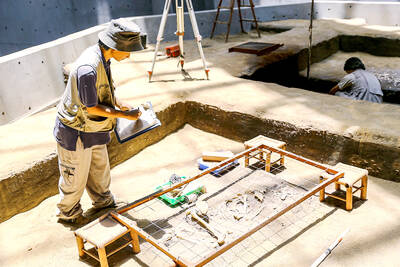
Writing of the finds at the ancient iron-working site of Shihsanhang (十 三行) in New Taipei City’s Bali District (八里), archaeologist Tsang Cheng-hwa (臧振華) of the Academia Sinica’s Institute of History and Philology observes: “One bronze bowl gilded with gold, together with copper coins and fragments of Tang and Song ceramics, were also found. These provide evidence for early contact between Taiwan aborigines and Chinese.” The Shihsanhang Web site from the Ministry of Culture says of the finds: “They were evidence that the residents of the area had a close trading relation with Chinese civilians, as the coins can be


 RSS
RSS