


Like many Indonesians in Taiwan, this exhibition’s majestic, lion or panther-like Barong is a recent transplant. Arriving in 2014 from Bali, the colorful creature was commissioned by the Indonesian Economic and Trade Office for traditional dance performances until it joined the National Taiwan Museum’s permanent collection five years later.
The Barong is an impressive showpiece on it’s own, but the museum’s new “A Centenary Dialog: When Transnational Migrants and Museum Collections Cross Paths” (百年對話:跨國移動者與藏品的相遇) exhibit goes beyond just its Southeast Asian artifacts and their countries of origin. Their connections to Taiwan via the migrants and immigrants here is a significant part of the presentation — for example, along with a historic video of the Barong dance in Bali are photos of performances in Taiwan, as well as information on how Taiwan-based Balinese artists crafted a new Barong after this one went to the museum.
The audience also hears directly from members of the cultures that produced these objects, and while the museum does interview experts, it also includes the voices of ordinary people talking about what these traditions mean to them. It doesn’t have to be something academic or profound; some simply express how the artifact reminds them of home and how happy they are to be able to see it here.
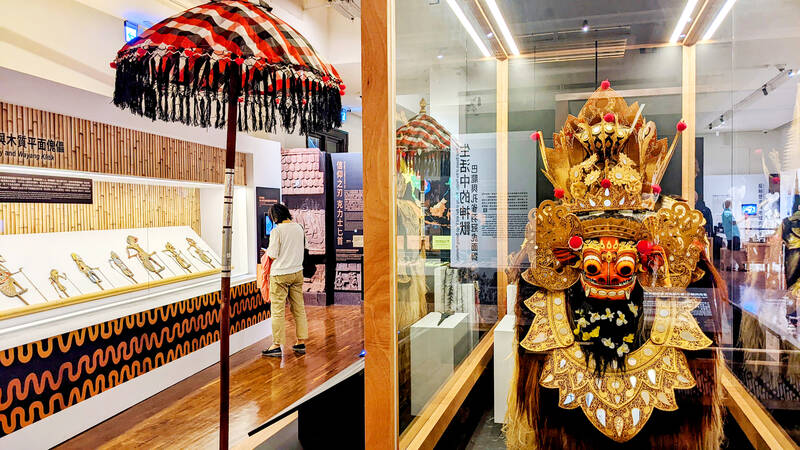
Photo: Han Cheung, Taipei Times
“It’s the most iconic form of performing arts in my home. I grew up watching the show!” a migrant worker from East Java says of the wayang klitik puppets. “I was thrilled when I saw them.”
This is a very refreshing way to exhibit cultural objects that should be employed more often, as it not just gives a voice to them, but provides meaningful, tangible context for people to connect. These are not just objects from a faraway land; visitors can find out when the next Barong performance in Taipei is and experience it themselves.
Such treatment is also crucial as it contributes to the effort by migrant advocacy groups in encouraging mutual understanding between Taiwanese and the hundreds of thousands of Southeast Asians migrants and immigrants. An entire section focuses on those who have been tirelessly helping the museum promote and explain their culture to locals, and they will be leading family-oriented workshops over the next month that include Barong dancing, dagger-making and other crafts.
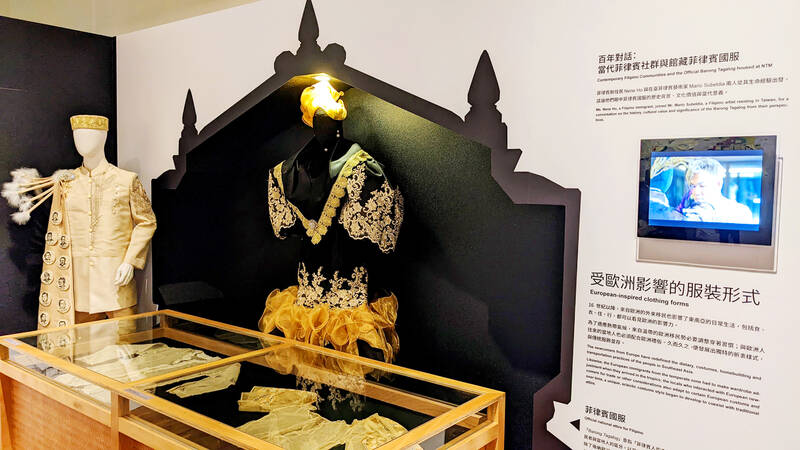
Photo: Han Cheung, Taipei Times
In addition to the Chinese and English displays, visitors can scan a QR code to read the text in Indonesian, Vietnamese and Thai.
This exhibit is a great example of “returning” displays to its people while still maintaining the authoritative knowledge of the institution. Interestingly, this inclusivity could only be accomplished today, as many objects were collected during the Japanese era when there were few Southeast Asians in Taiwan to speak about them.
Former museum director Takiya Kawakami was one of the scholars fascinated with the region, embarking on a 11-month botanical expedition between 1911 and 1912. In addition to his field research, he brought back many artifacts and penned the travelogue The Canopy of Coconut Trees, an original copy of which is displayed at the beginning of the exhibition.
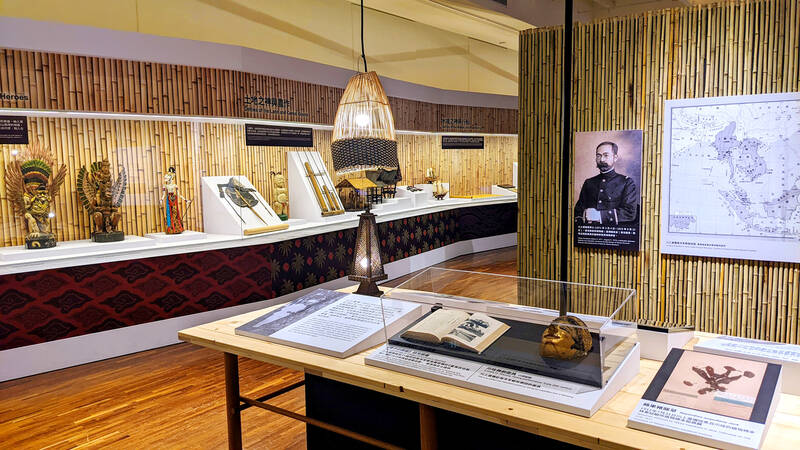
Photo: Han Cheung, Taipei Times
The religious and ritualistic sections, including masks, keris daggers, musical instruments and puppets are the highlights, while the last room sums up clothing, food, housing and other essentials.
There’s definitely an emphasis on Indonesia and to a certain extent the Philippines, and it would be nice to hear more from other groups such as the Vietnamese, who also have a significant presence in Taiwan. But overall, it’s a well-organized, easily navigable showcase that visitors should take their time browsing through.
If you have time afterward, the Monsters: An Exhibition of Aquatic Reptile Fossils (水怪-水棲爬行動物化石展), which opened in June and runs until May next year, is also quite atmospheric and fascinating.
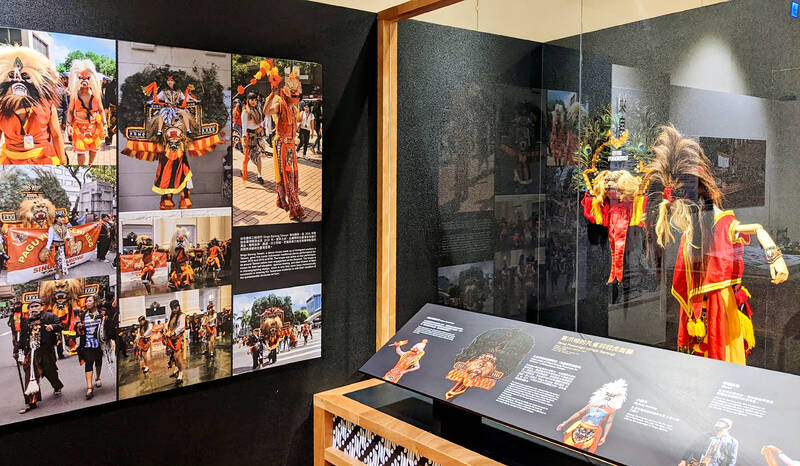
Photo: Han Cheung, Taipei Times
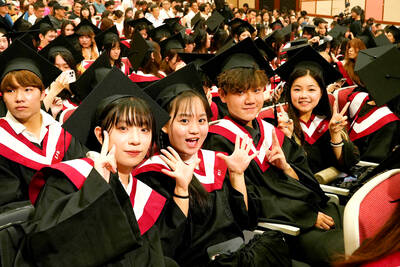
Taiwan’s English education system is being pulled apart by three opposing forces. Bilingual Nation 2030 pulls students toward English and global communication. Artificial Intelligence (AI) readiness pulls them toward digital judgment, verification and AI-mediated work. But Taiwan’s old exam culture pulls them back toward memorization, grammar drills, timed reading and correct answers. If the education system keeps using old exams to define success, it risks producing graduates who are neither genuinely bilingual nor genuinely AI-ready, but trained for tasks machines can already perform. The first force is Bilingual Nation 2030. Launched in 2018, the policy aimed to “help Taiwan’s workforce connect
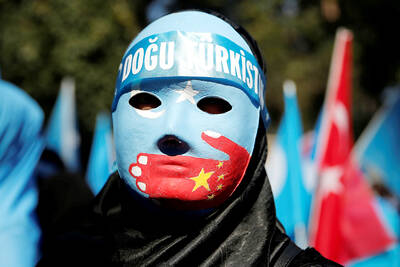
It seems every few days one bumps into one of those “real man” comments in which Taiwan is urged to “face reality” or similar, and “make a deal,” with the speaker implying that soon it will be too late. “Deal” advocates always present themselves as having a superior grip on reality, and the manly ability to make the “hard choice.” Their testosterone-laden language often echoes that of Taiwan sellout advocates. Note that such commentary always specifies a process (“make a deal, work with, make progress”), never the end state of what occupation by a violent authoritarian colonialist state will entail. In
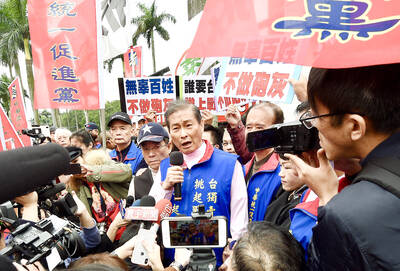
There are shadowy cabals plotting to sell out Taiwan to be annexed by China, by invasion if necessary. Fortunately, they are buffoons. In 2019, former Bamboo Union gangster and founder of the China Unification Promotion Party (CUPP), Chang An-le (張安樂, colorfully known as “White Wolf”), led a protest at the Legislative Yuan against comments made by then-premier Su Tseng-chang (蘇貞昌) that in the event of an attack by China, he would never surrender, but would protect the nation by fighting to the end, even if he only had a broom. Chang had party members bring a wooden casket that they
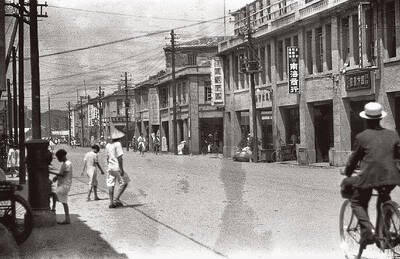
June 1 to June 7 "If all Taiwanese were as afraid of dying as you, then what would happen?” Physician Shih Chiang-nan (施江南) reportedly said this to his wife Chen Chiao-tung (陳焦桐) after she urged him to stop intervening on behalf of Taiwanese soldiers stranded overseas after serving in the Japanese Army during World War II. Shih had clashed with high-ranking officials over the issue, engaged in several heated arguments with Taiwan governor-general Chen Yi (陳儀) and allegedly shouted at general Ko Yuan-fen (柯遠芬), chief of staff of the Taiwan Garrison Command, over


 RSS
RSS