


Phones in serial killer movies are usually used by the deranged hunters to taunt the police or carefully tell victims how they’ll die. But in The Black Phone it’s the other way around, fitting for a horror-thriller that flips many of the genre’s formula.
The serial killer at the heart of Scott Derrickson’s latest film is clueless about the chunky wall-mounted rotary phone in his soundproof dungeon. He tells his victims it hasn’t worked in years. They think otherwise: They use it to communicate with each other.
The kid-centric thriller, which opens in Taiwan on July 1, is a very satisfying balancing act of a movie that has elements of supernatural, psychological suspense and horror but never falls heavily into a single camp. It also has one of the most satisfying ending of a horror-thriller in recent years.
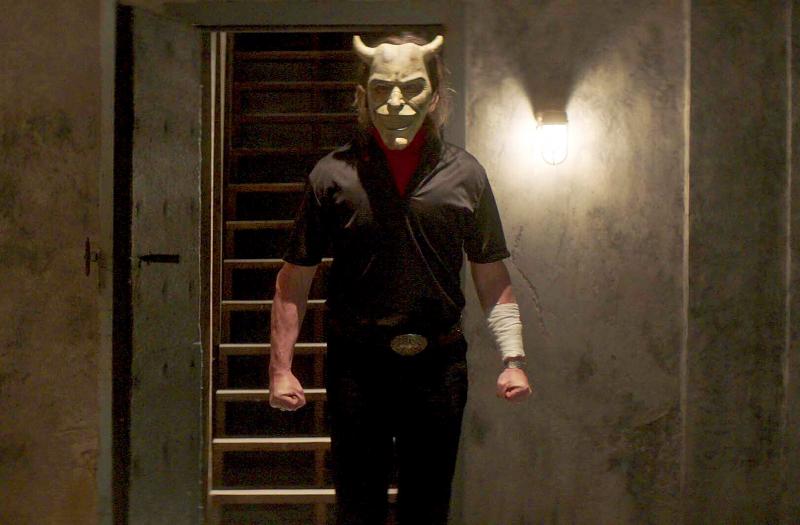
Photo: AP
The film — set in northern Denver in 1978 — follows 13-year-old Finney, played with real verve by newcomer Mason Thames. The filmmakers establish a grim mood right from the start, with wide-scale bullying, school-yard fights, bloody bruises and alcoholic and abusive parents. Add to this mix, the low-level buzz of homemade missing posters on walls.
KILLER ON THE PROWL
There’s a serial killer prowling, nicknamed The Grabber, (In a nod to John Wayne Gacy, he’s a professional magician. And in perhaps another nod to The Steve Miller Band, he drives around in a black truck emblazoned with the word Abracadabra, fitting the lyrics “I wanna reach out and grab ya.”) Five teen boys have vanished. Finney — and his spunky younger sister, a fabulous Madeleine McGraw — are old enough to understand stranger abduction but still young enough to think that saying his name out loud is unlucky.
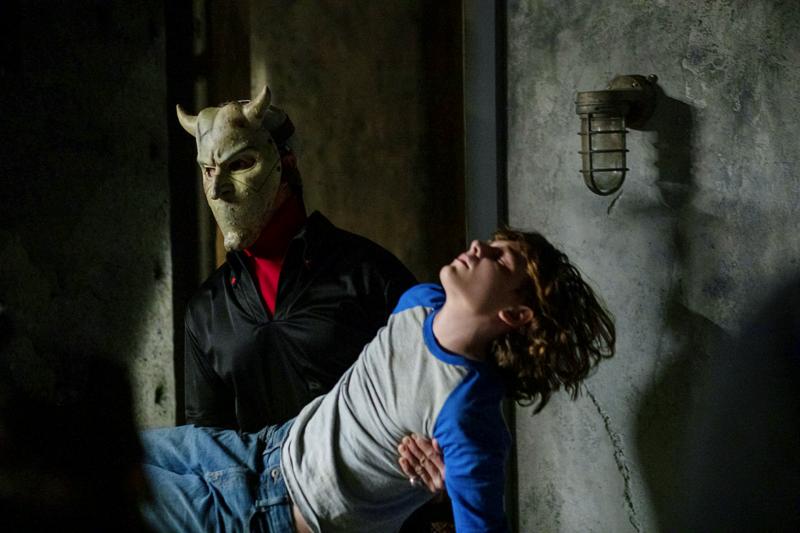
Photo: AP
Finney knows a few of the victims but gets a first-hand knowledge when The Grabber — a confusing Ethan Hawke — nabs him and locks him in his basement, a space meant to hold humans. It’s carefully curated except for that black phone the killer says is disconnected, it’s wires cut. So why does it keep ringing for Finney?
Poor Hawk is marooned as another one of those pure movie psychos, by turns gentlemanly and menacing. We’ve seen his like before, a chilling precision with enunciation and that relentless, bloodless toying with his victim. His only stand-out quality is a very good collection of creepy masks. (Halloween will be super nuts this year if this movie takes off.)
The Black Phone is in some ways a reteaming of the guys who made Sinister in 2012 — Derrickson and cowriter C Robert Cargill partnered with producer Jason Blum and Hawke for that one, too. This time, they’re leaning on horror royalty — the source material is a short story by Joe Hill, the pen name of Joe King, son of Stephen King.
The filmmakers, to my mind, lean a little too much on the supernatural to free Finney — does the phone really need to periodically beat like a heart? — but that’s me. The movie has a Stranger Things-meets-Room vibe and even namechecks a film deep in its debt: Texas Chain Saw Massacre.
‘DON’T TALK TO STRANGERS’
The film’s tagline is “Don’t Talk to Strangers” and it’s painfully wrong. While applicable to The Grabber, Finn learns that the voices on the other end of the black phone are his previous victims. They’re helping him, each call a way to outwit The Grabber and, put together, a way home safe.
“Use what we gave you,” one disembodied voice counsels.
What makes The Black Phone stand out is how it perfectly captures what growing up was like in the often raw ‘70s and an utter respect for the world of kids. Every adult is either dismissive and distant — or downright murderous. At its center is the fraternity of teen victims and the bond between sister and brother working against the twisted adult world. It will, uh, grab you.

If one asks Taiwanese why house prices are so high or why the nation is so built up or why certain policies cannot be carried out, one common answer is that “Taiwan is too small.” This is actually true, though not in the way people think. The National Property Administration (NPA), responsible for tracking and managing the government’s real estate assets, maintains statistics on how much land the government owns. As of the end of last year, land for official use constituted 293,655 hectares, for public use 1,732,513 hectares, for non-public use 216,972 hectares and for state enterprises 34 hectares, yielding

The small platform at Duoliang Train Station in Taitung County’s Taimali Township (太麻里) served villagers from 1992 to 2006, but was eventually shut down due to lack of use. Just 10 years later, the abandoned train station had become widely known as the most beautiful station in Taiwan, and visitors were so frequent that the village had to start restricting traffic. Nowadays, Duoliang Village (多良) is known as a bit of a tourist trap, with a mandatory, albeit modest, admission fee of NT$10 giving access to a crowded lane of vendors with a mediocre view of the ocean and the trains

Traditionally, indigenous people in Taiwan’s mountains practice swidden cultivation, or “slash and burn” agriculture, a practice common in human history. According to a 2016 research article in the International Journal of Environmental Sustainability, among the Atayal people, this began with a search for suitable forested slopeland. The trees are burnt for fertilizer and the land cleared of stones. The stones and wood are then piled up to make fences, while both dead and standing trees are retained on the plot. The fences are used to grow climbing crops like squash and beans. The plot itself supports farming for three years.
For many people, Bilingual Nation 2030 begins and ends in the classroom. Since the policy was launched in 2018, the debate has centered on students, teachers and the pressure placed on schools. Yet the policy was never solely about English education. The government’s official plan also calls for bilingualization in Taiwan’s government services, laws and regulations, and living environment. The goal is to make Taiwan more inclusive and accessible to international enterprises and talent and better prepared for global economic and trade conditions. After eight years, that grand vision is due for a pulse check. RULES THAT CAN BE READ For Harper Chen (陳虹宇), an adviser


 RSS
RSS