


Sex and gender have come to represent one of the hottest fronts in the modern culture wars. Now, on to this bloody battlefield, calmly dodging banned books, anti-transgender laws and political doublespeak, strolls the distinguished Dutch-American primatologist Frans de Waal, brandishing nearly half a century’s worth of field notebooks and followed, metaphorically speaking, by an astonishingly diverse collection of primates.
Given the world it enters, de Waal’s new book, Different: What Apes Can Teach Us About Gender, would arguably have failed if it didn’t stimulate debate. It seems safe from death by indifference, however, since it is dividing opinion even before it is published.
“I found the book to be as wise as it was humane,” the American primatologist Sarah Blaffer Hrdy told me, while US palaeontologist and writer Riley Black, a non-binary trans woman, is disappointed the author didn’t attempt a more radical overhaul of sex.
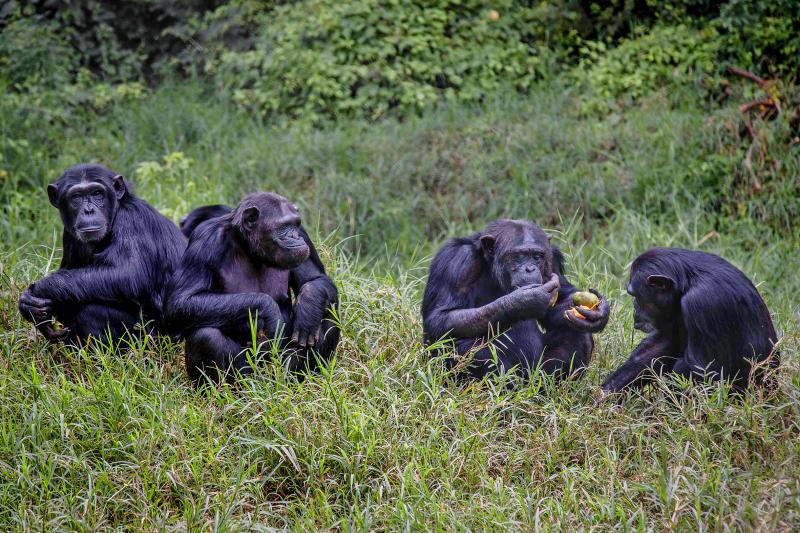
Photo: AFP
Princeton University primatologist Agustin Fuentes, meanwhile, is full of admiration for de Waal’s descriptions of ape behavior, but feels the book falls short when it comes to humans. Given the author’s public visibility and his masterful storytelling skills, Fuentes told me, this was his opportunity to present a thorough and thoughtful discussion of the latest research.
“Unfortunately,” he said, “that’s not this book.”
SOCIAL CONSTRUCT?
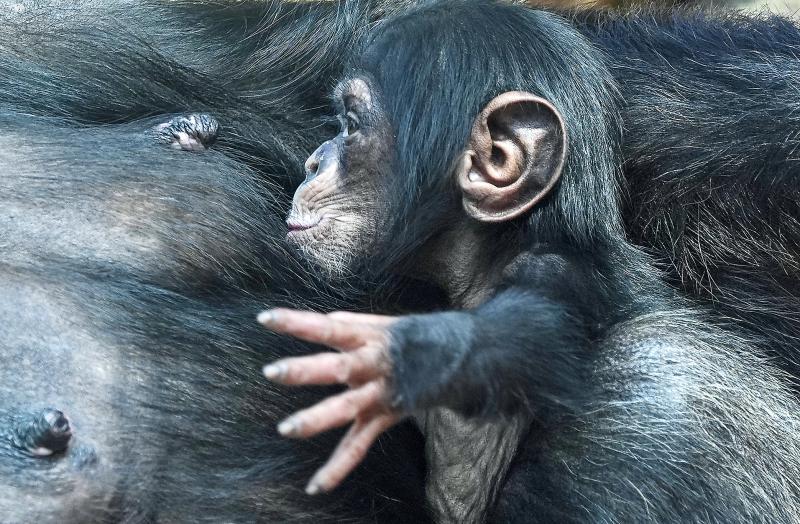
Photo: AP
What this book is is an attempt to put the biology — the sex — back into gender. For too long, de Waal thinks, gender was regarded as a purely social construct and talk of inborn sex differences was taboo.
“The fact that we have genders is related to the fact that we have sexes and sexual reproduction,” he told me, ahead of a tour to promote Different. “That’s an undeniable fact, in my opinion, even though the gender concept is obviously more flexible than the two sexes that we have.”
Sex (male/female) is approximately binary, he argues, while gender (masculine/feminine) is a spectrum. The fact that the latter grew out of the former should not stop us questioning the cultural components of gender, some of which are based on a misunderstanding of biology, nor rejecting gender-based discrimination. Different doesn’t mean better or worse.
He makes this case by reference to the non-human primates he has observed for decades, but the book is also a plea to us to look beyond chimpanzees when searching for parallels in our nearest primate relatives. We are just as close to bonobos, the “Kama Sutra apes” for whom sex is as banal as a handshake, though much more fun.
It was only by accident, de Waal reminds us, that explorers stumbled on chimps first and they became our go-to model of primate behavior (some Victorian prudishness helped). Since chimps are generally more aggressive than bonobos, this skewed emphasis gave rise to an unjustifiably bleak view of human nature, he feels, which has only begun to lighten up in the last few decades. In his unfashionable optimism about humanity, he compares himself to a frog he once spotted in an Australian lavatory bowl. Like the frog, he has clung on through periodic deluges of cynicism and despair.
Among his accumulated titles, de Waal is professor of psychology at Emory University in Atlanta, Georgia, and from the first pages of Different you know you’re in the presence of someone who feels beyond the slings and arrows of the culture wars.
“You wouldn’t write a book like that if you were 40 and trying to get tenure,” remarks Meredith Small, an anthropologist at Cornell University in Ithaca, New York, and an admirer.
He’s well-known enough to feel comfortable sharing personal reflections on growing up as one of six brothers and describing himself as a feminist who nevertheless refuses to denigrate his own gender. He’s also critical of what he sees as the contradictions of modern feminism, in particular, the idea that gender is socially constructed until it comes to gender identity and sexual orientation, which are innate and immutable.
YOUNG FIELD
Primatology is a relatively young field that was founded by men but came to be dominated by women, which means it is acutely aware that who is looking is as important as what they see. This cisgender, straight, 73-year-old white man is no exception. He describes how the field broadened its horizons thanks to the feminization that has happened over his career.
“When the women came, we got more interested in female-female and mother-offspring relationships,” he told me. “Female choice became an important issue.”
His entrancing descriptions of apes illustrate this. There’s Princess Mimi, the “bonobo with staff” who grew up pampered in a human home and was mystified by the retinue of males with obvious erections she acquired on meeting her own kind; the gender-nonconforming chimp Donna and the gay capuchin monkey Lonnie, both of whom were fully integrated into their respective colonies; Mama, the wise kingmaker among chimps; and the rhesus macaque love triangle of Orange, Dandy and Mr Spickles.
Through these characters de Waal brings to life the complexity of sex and social behavior in other apes. He recounts, for example, how Nikkie, a young and possibly overpromoted alpha-male chimp, was chased up a tree by a bunch of disgruntled underlings who wouldn’t let him come down.
“After about a quarter of an hour, Mama slowly climbed into the tree. She touched Nikkie and kissed him. Then she climbed down while he followed close at heel. Now that Mama was bringing him with her, nobody resisted any more. Nikkie, obviously still nervous, made up with his adversaries. No other chimp in the group, male or female, could have brought about such a smooth closing.”
Mr Spickles was the alpha male of a large macaque troop; Orange was the alpha female. The males all looked up to Mr Spickles, the females to Orange. But Mr Spickles enjoyed his privileged status largely thanks to Orange, his staunchest political ally.
When mating season came around, Orange would pair up with Dandy, a handsome male almost half Mr Spickles’s age. If Mr Spickles tried to chase Dandy away, Orange would simply seek her younger mate out again. But if Dandy was tempted to flaunt his youth and vigor in front of Mr Spickles, Orange would loyally take up position next to the aging alpha.
“Orange carefully balanced two preferences,” de Waal writes. “One concerned political leadership and the other sexual desire. She never confused the two.”
EVOLUTIONARY FITNESS
Both males and females strive — non-consciously — to maximize their evolutionary fitness, but because they differ biologically their methods for achieving this goal differ too. Protecting offspring from male infanticide is a common female preoccupation, de Waal says, which is why one rule holds across species: “The typical primate society is at heart a female kinship network run by older matriarchs.”
Beyond that, however, there are as many models of relations between the sexes as there are species.
Males and females are both hierarchical, but these hierarchies are based on more than just physical prowess or fighting ability. Prestige, which is less visible, counts too. Hierarchies are always at least partly coercive, but prestige always has a component of altruism and community-mindedness to it, as Mama and Orange showed. In most primates, the alpha female ranks below the alpha male. He has strength but she has choice. (Bonobos, uniquely, have reversed this order: females invest everything in the sisterhood, which collectively dominates the group.)
As a result, the female has been underrated, an argument the British zoologist Lucy Cooke also made recently, in her acclaimed book Bitch. But de Waal thinks we’ve gone wrong at a deeper level. He challenges the idea that non-humans are “natural” while humans are “cultural,” arguing that nature and nurture are inextricably entwined in both. Apes may have gender as well as sex — there are hints of cultural variation in the way the sexes behave in non-human primates, though he says it hasn’t been studied enough yet — but you can’t take the sex out of human gender.
In this domain as in so many others, de Waal says, we’re more similar to other primates than we think. (Years ago, he coined a term for those who warned against anthropomorphizing other primates: “anthropodenialists.”) Yet humans do seem to be unique in one way. We are apparently the only ape that attaches labels to sexual or gender diversity and prejudices to the labels. In other primates, he says, “I don’t find the kind of intolerance we have in human societies.”
BLOWBACK
He expects blowback from two broad camps — the feminists whom he overtly criticizes in the book and those conservatives who claim that men are men and women are women and never the twain shall meet, wrongly asserting that science supports their position. But he also has critics closer to home.
Black says he fails to ask the most fundamental question: what is biological sex?
“Is it chromosomes or hormones or gametes, or some combination thereof, or is it a concept we need to go back and start over?” she asks. Until we’ve answered that question, she feels it’s unreasonable to assume that sex is essentially binary, even if de Waal does allow for some blurring and acknowledges non-binary and transgender people.
Fuentes wonders why he overlooks a large body of research on human sex and gender — work by the American neuroscientist Lise Eliot, for example, showing that male and female brains aren’t that different, or British psychologist Cordelia Fine’s probing of the complex feedback loops that exist between sex and gender.
To read these and other researchers, Fuentes says, is to understand that the non-human-natural/human-cultural division is a straw person argument. Moreover, in the introduction to Different, de Waal explains that he will not discuss areas of human behavior for which there are no animal parallels, such as economic disparities, household labor and dress.
“But you can’t discuss gender without these!” Fuentes says.
These controversies will undoubtedly dominate discussion of the book once it comes out, so now seems a good moment to flag up some of de Waal’s quieter but still thought-provoking observations, such as: “Most beauty in nature exists thanks to female taste.” Or: “We have no evidence that any species other than our own knows that sex leads to progeny.”
And whether or not you agree with him, Different is worth reading for its anecdotes alone. The description of two grizzled male chimps who were normally sworn enemies, arms slung around each other’s shoulders, forming a barrage between a newborn and a young alpha male with possibly infanticidal intent, is one of many that will be hard to forget.

For many people, Bilingual Nation 2030 begins and ends in the classroom. Since the policy was launched in 2018, the debate has centered on students, teachers and the pressure placed on schools. Yet the policy was never solely about English education. The government’s official plan also calls for bilingualization in Taiwan’s government services, laws and regulations, and living environment. The goal is to make Taiwan more inclusive and accessible to international enterprises and talent and better prepared for global economic and trade conditions. After eight years, that grand vision is due for a pulse check. RULES THAT CAN BE READ For Harper Chen (陳虹宇), an adviser
Traditionally, indigenous people in Taiwan’s mountains practice swidden cultivation, or “slash and burn” agriculture, a practice common in human history. According to a 2016 research article in the International Journal of Environmental Sustainability, among the Atayal people, this began with a search for suitable forested slopeland. The trees are burnt for fertilizer and the land cleared of stones. The stones and wood are then piled up to make fences, while both dead and standing trees are retained on the plot. The fences are used to grow climbing crops like squash and beans. The plot itself supports farming for three years.

The breakwater stretches out to sea from the sprawling Kaohsiung port in southern Taiwan. Normally, it’s crowded with massive tankers ferrying liquefied natural gas from Qatar to be stored in the bulbous white tanks that dot the shoreline. These are not normal times, though, and not a single shipment from Qatar has docked at the Yongan terminal since early March after the Strait of Hormuz was shuttered. The suspension has provided a realistic preview of a potential Chinese blockade, a move that would throttle an economy anchored by the world’s most advanced and power-hungry semiconductor industry. It is a stark reminder of

May 4 to May 10 It was once said that if you hadn’t performed at the Sapphire Grand Cabaret (藍寶石大歌廳), you couldn’t truly be considered a star. Taking the stage at the legendary Kaohsiung club was more than just a concert. Performers were expected to entertain in every sense, wearing outlandish or revealing costumes and staying quick on their feet as sharp-tongued, over-the-top hosts asked questions and delivered jokes that would be seen as vulgar, even offensive, by today’s standards. Opening in May 1967 during a period of strict political and social control, Sapphire offered a rare outlet for audiences in


 RSS
RSS