


Unlike his surrealist contemporaries, Rene Magritte tended to keep Freud at a distance from his work — though few artists offer as much scope for armchair analysis. Speaking in 1961, he observed that “psychology doesn’t interest me. It claims to reveal the flow of our thoughts and emotions. Its efforts are contrary to what I know; it seeks to explain a mystery. There is only one mystery: the world.”
One conclusion in reading Alex Danchev’s recreation of Magritte’s formative years, in this diligent and insightful biography (almost complete at the time of Danchev’s death in 2016), is that he was in denial about being in denial. In their village, 30 miles west of Brussels, at the turn of the century, the Magritte family was notorious for its chaos. The artist’s father, a tailor, was also a gambler and drunk who sometimes sold pornography to make ends meet. His mother was severely depressive (“neuraesthenic” was the contemporary term) and apparently had to be locked in the family home overnight for her own safety. The three sons — Magritte was the oldest — were known locally as “Cherokees;” there were widespread rumors of them mistreating animals, even starving a donkey to death in their backyard.
This village chatter was compounded when eventually, one night when Magritte was 13, his mother did slip out of the house and drowned herself in the nearby River Sambre. Her body was discovered by bargemen some days later. Magritte subsequently refused to discuss the tragedy even with his childhood sweetheart and lifelong partner, Georgette Berger, though it surfaces in more than one of his paintings; in The Musings of the Solitary Walker (1926), for example, a ghoulish and naked female figure floats in the air behind a characteristic faceless bowler-hatted figure who is turned away from the viewer, staring at the bridge near where his mother’s body was found.
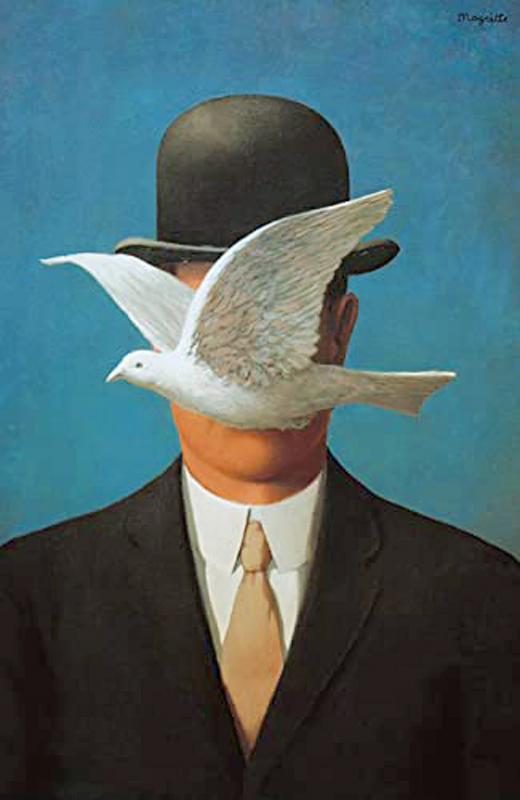
“He did not speak about things that touched him deeply,” Berger said. “He painted them away.”
In place of nightmares, it seems, in Danchev’s telling, that Magritte found a way to exist in a world of objects, somewhat dissociated from extremes of emotion. He was a compulsive voyeur, sometimes seen at the keyhole of bathrooms in friend’s houses in which he stayed. Looking back on his own childhood, he frequently claimed to have been haunted by two singular images that he was ever after trying to explain. One was a locked chest that was apparently next to his cot as an infant (the longing to know what was inside never left him, he insisted). The other was a hot air balloon that he claimed had once crashed into the roof of his childhood home before it was dismantled and carried away, deflated (Danchev can find no record of any such accident).
Magritte, typically, refused any symbolic reading of those images when they appeared in his early paintings, insisting that along with his pipes and apples and nudes they were an effort to “restore to objects their value as objects.”
The drama of his painting came to lie in the way these objects refused to exist in mimetic exterior space, but in worlds of the artist’s imagination.
Magritte did his best to tether himself to Earth in his relationship with Berger, whom he first met at the local fair in 1913, when she was 12 and he 14; a juvenile crush that was interrupted when Germany invaded Belgium a year later but never forgotten. The pair were eventually reunited six years later in Brussels and thereafter hardly apart.
Danchev suggests that the steadiness of Magritte’s marriage was a viable substitute for the alpha male antics of the avant garde. Among the Paris surrealists, with their penchant for clubbiness and manifestos, the painter was at once a hero and an outsider. Salvador Dalí noted with approval the philosophical subversion of Magritte’s Ceci n’est pas une pipe in January 1929 (though there were no buyers for the painting for 25 years) and by the end of the year Magritte had been invited to contribute his latest thinking on words and images to the group’s house journal, La Revolution Surrealiste.
At a party the night before publication, however, Andre Breton loudly insisted that Berger remove a cross — “something we abhor” — that she wore on a necklace. She refused and husband and wife silently left the party, beginning a rift between Magritte and his peers that was never properly resolved.
The second world war separated Rene and Georgette once more — this time only for three months — and it was not until the 1950s that the painter was able, for the first time, to stop worrying about finding a market and an audience for his pictures. Having settled in the US (conjured in Paul Simon’s nicely dispassionate song Rene and Georgette Magritte With Their Dog After the War), Magritte was adopted as a master by a generation of New York-based artists that included Jasper Johns, Roy Lichtenstein and Andy Warhol.
Danchev proved an indefatigable researcher, and Sarah Whitfield does full justice to his labors in completing this final chapter of Magritte’s life. Here as elsewhere, however, the artist seems to resist coming to full corporeal life on the page. Still, you can’t help feeling that the persistent sense of Rene being there and not being there might have been exactly as he would have wished it.

For many people, Bilingual Nation 2030 begins and ends in the classroom. Since the policy was launched in 2018, the debate has centered on students, teachers and the pressure placed on schools. Yet the policy was never solely about English education. The government’s official plan also calls for bilingualization in Taiwan’s government services, laws and regulations, and living environment. The goal is to make Taiwan more inclusive and accessible to international enterprises and talent and better prepared for global economic and trade conditions. After eight years, that grand vision is due for a pulse check. RULES THAT CAN BE READ For Harper Chen (陳虹宇), an adviser
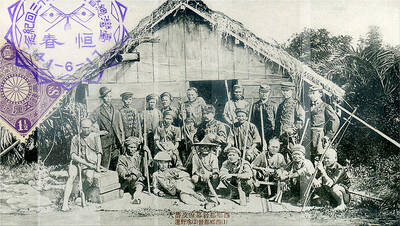
Traditionally, indigenous people in Taiwan’s mountains practice swidden cultivation, or “slash and burn” agriculture, a practice common in human history. According to a 2016 research article in the International Journal of Environmental Sustainability, among the Atayal people, this began with a search for suitable forested slopeland. The trees are burnt for fertilizer and the land cleared of stones. The stones and wood are then piled up to make fences, while both dead and standing trees are retained on the plot. The fences are used to grow climbing crops like squash and beans. The plot itself supports farming for three years.

The breakwater stretches out to sea from the sprawling Kaohsiung port in southern Taiwan. Normally, it’s crowded with massive tankers ferrying liquefied natural gas from Qatar to be stored in the bulbous white tanks that dot the shoreline. These are not normal times, though, and not a single shipment from Qatar has docked at the Yongan terminal since early March after the Strait of Hormuz was shuttered. The suspension has provided a realistic preview of a potential Chinese blockade, a move that would throttle an economy anchored by the world’s most advanced and power-hungry semiconductor industry. It is a stark reminder of

May 4 to May 10 It was once said that if you hadn’t performed at the Sapphire Grand Cabaret (藍寶石大歌廳), you couldn’t truly be considered a star. Taking the stage at the legendary Kaohsiung club was more than just a concert. Performers were expected to entertain in every sense, wearing outlandish or revealing costumes and staying quick on their feet as sharp-tongued, over-the-top hosts asked questions and delivered jokes that would be seen as vulgar, even offensive, by today’s standards. Opening in May 1967 during a period of strict political and social control, Sapphire offered a rare outlet for audiences in


 RSS
RSS