


How will this age be remembered? After the stone age, the bronze age, the steam age and the information age, what material or innovation will most define the current era? According to a new exhibition at the Design Museum, the most ubiquitous hallmark of the Anthropocene is not a gamechanging material, nor the mastery of technology. It’s trash.
“We are arguably living in the waste age,” says Justin McGuirk, the London museum’s chief curator, who has spent the last three years rifling through rubbish with co-curator Gemma Curtin to put together this timely show. “The production of waste is absolutely central to our way of life, a fundamental part of how the global economy operates. We wanted to show how design is deeply complicit in the waste problem — and also best placed to address it.”
Opening on the eve of the Cop26 climate summit, Waste Age is a powerful wake-up call, not so much to consumers, but to the manufacturers, retailers and, most crucially, government regulators. It is not intended to be a slap around the face for buying that takeaway coffee on your way to the museum, or forgetting your cotton tote bag yet again, but an eye-opening look at the sheer scale of the issue, and the people working on ingenious solutions.
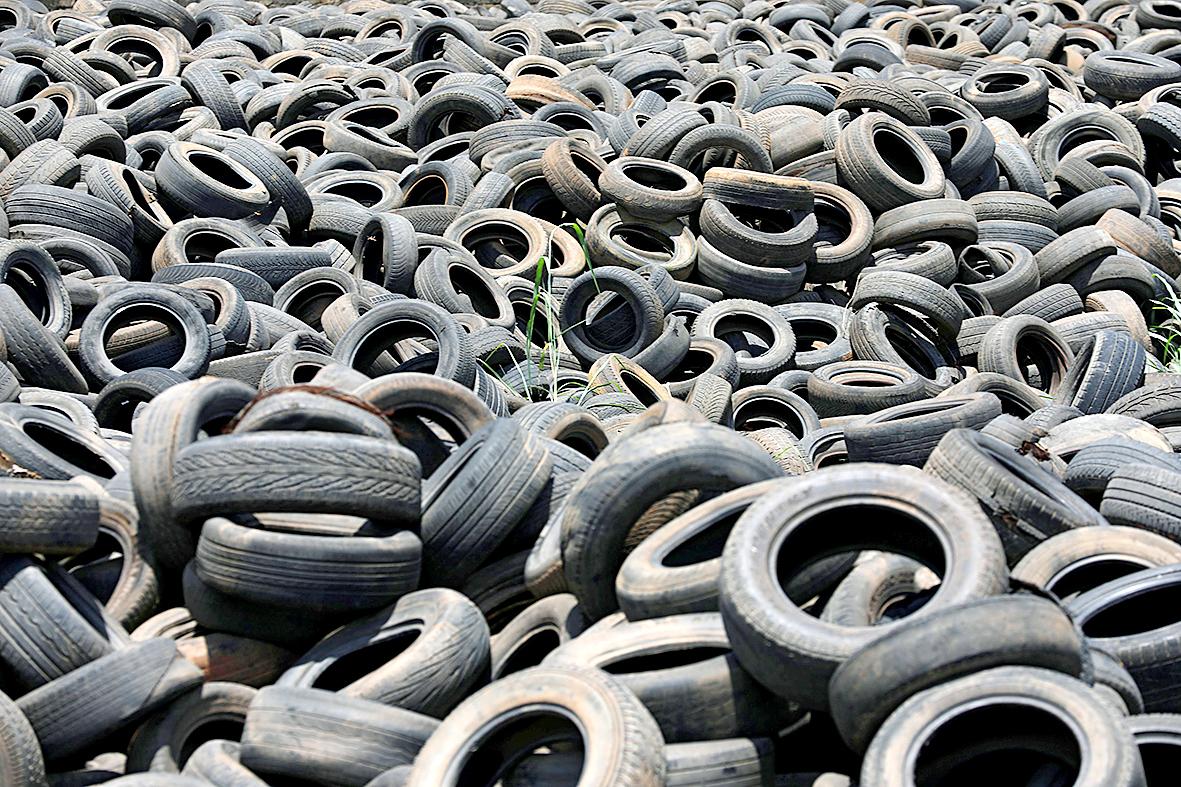
Photo: Reuters
The exhibition begins with a useful reminder that we didn’t get here by accident. Humans are not inherently wasteful creatures. Throwaway culture was something we had to learn — indeed, it was a lifestyle choice, marketed from the mid-20th century onwards as a decadent release, following the austerity of wartime. It was the intentional opposite of “make do and mend.”
One advert from the 1960s extolls the wonders of the new-fangled polystyrene cup: “New and very in! The party ‘glass’ you just enjoy … and throw away.”
It hangs next to a plastic carrier bag from the 1980s, printed with descriptions of its many advantages over paper. Little did we know that, four decades later, the world would be consuming more than a million plastic bags a minute.
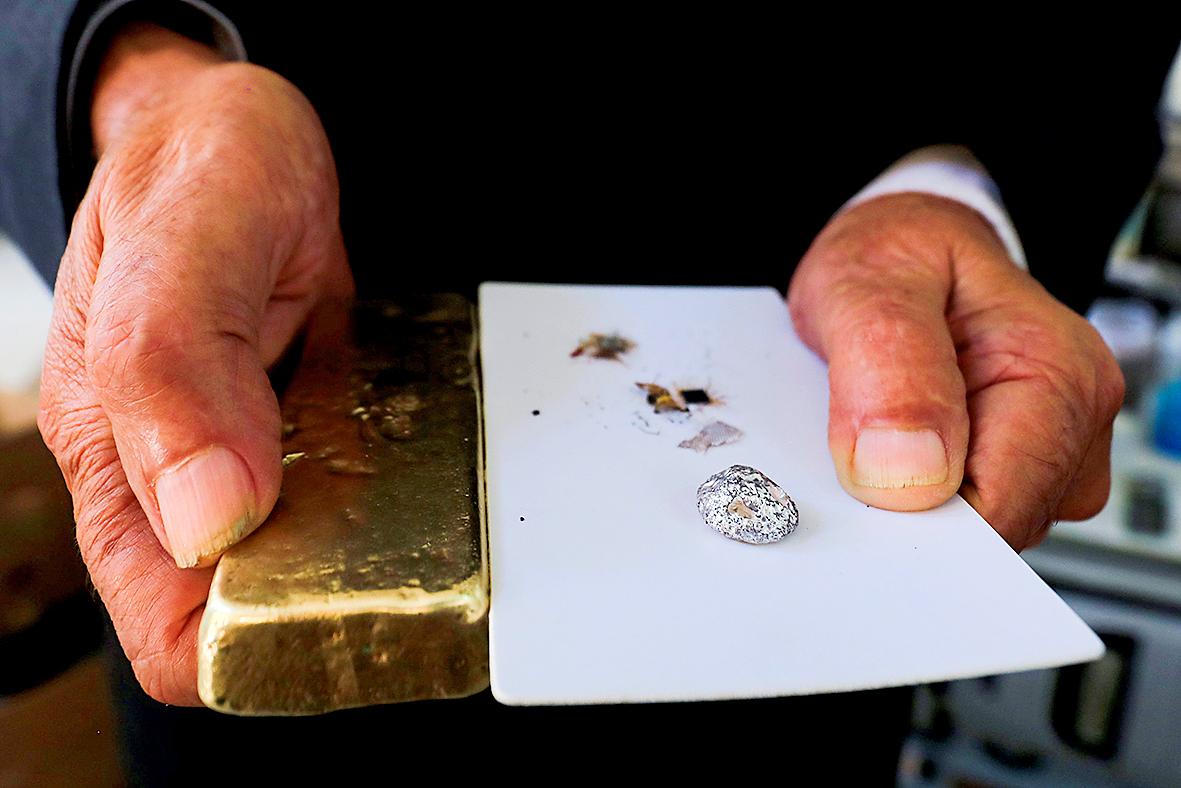
Photo: Reuters
Generating waste, the curators argue, has long been a primary engine of the economy. The history of the lightbulb is an illuminating case in point. In the 1920s, bulbs were so long-lasting that they were deemed commercially unviable. General Electric, Philips and others formed the Phoebus cartel in 1924 to standardize the life expectancy of lightbulbs at 1,000 hours — down from the previous 2,500 hours. And so the culture of planned obsolescence was born. Almost a century later, similar practices continue: last year Apple agreed to pay up to US$500 million, after it was accused of deliberately slowing down older phone models to encourage consumers to buy the latest handsets.
A striking installation by Ibrahim Mahama brings home the reality of where such defunct electronics end up. He has erected a giant wall of old TV monitors that play clips from Agbogbloshie in Ghana, for many years the world’s largest e-waste dump, where informal workers burn electrical cables to harvest the copper wire and other precious metals. Mahama has commissioned them to cast the salvaged metal in the form of TV screen surrounds, which frame footage showing this toxic process. The scenes are desperate, but the message is clear: waste is precious.
About 7 percent of the world’s gold supplies are trapped inside existing electronic devices, meaning that, according to some estimates, by 2080 the largest metal reserves will not be underground but in circulation as existing products. What’s more, one tonne of extracted gold ore yields 3g of gold, whereas recycling one tonne of mobile phones yields 300g. So waste dumps and landfill sites are the new resource-rich mines.
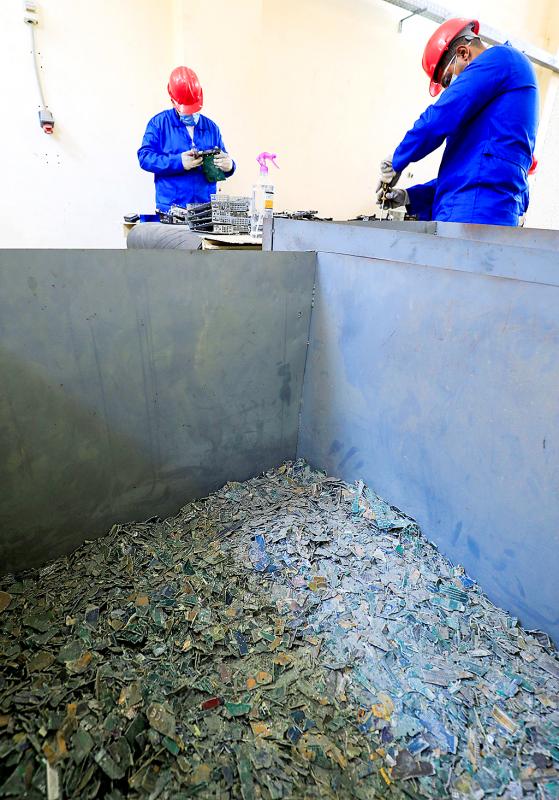
Photo: Reuters
“In many ways ‘waste’ is a category error,” says McGuirk. “It’s often perfectly good material that’s simply undervalued.”
The exhibition includes designers who are already working on what a future of “above-ground mining” might look like, exploring how objects and buildings can be dismantled and their parts reused. There is the work of pioneering Belgian group Rotor, a team of architects who set up a demolition company to carefully remove materials and components from buildings slated for the wrecking ball.
Their Brussels warehouse brims with everything from marble slabs to vintage lamps, the spoils of what they call “forestry in the city.” It is shown alongside the refurbishment projects of French architects Lacaton & Vassal, for whom demolition is “a waste of energy, a waste of material, a waste of history [and] an act of violence.”
At a time when global construction waste is set to double to 2.2 billion tonnes a year by 2025, their joint calls to re-use what we already have couldn’t be more urgent.
In the consumer goods sphere, the re-use cause is championed by the likes of iFixit, an online global repair platform that publishes free repair guides and sells spare parts and tools, like a screwdriver to disassemble the iPhone. It has been lobbying governments for repairability legislation since 2003, with some success. France is the first country in Europe to implement a Repairability Index, adopted in January, which requires manufacturers to provide clear information on the repairability of smartphones, laptops, washing machines, televisions and lawnmowers, and award their products scores out of 10. The iPhone 11 may include some recycled rare earth elements, but it got a repairability score of 4.5 out of 10.
The final section of the exhibition moves beyond fixing and recycling to imagine a “post-waste” world, where materials are grown rather than extracted. Design exhibition regulars might be familiar with the wonders of hempcrete or mycelium insulation, but this show includes a dazzling range of innovations, from water-soluble electronic circuit boards made of natural fibers, to “sea stone,” a concrete-like material made from crushed seashells. Also featured are Sony’s packaging made from bamboo and sugarcane (embossed rather than printed, to save ink waste), Notpla’s seaweed-based sachets for liquids and condiments, a polystyrene substitute made from sunflowers, and a new kind of leather made from coconut water — alongside things made from algae, corn husks and organic pulps of all kinds.
Such biodegradable solutions come with their own pitfalls: how many times have you thrown a plastic container in the recycling bin, before realizing it was actually compostable Vegware? And should it go in the compost bin or landfill? Behavior and expectations will have to adjust to meet the brave new bio-future.
“Our aesthetic sensibilities may have to adapt,” McGuirk writes in the exhibition catalog. “After nearly a century of appreciating the hard-smooth-shiny perfection of plastics, we may begin to embrace irregularity, imperfection, decay and decomposition.”
Your future organo-laptop might not overheat, slow down, or need its battery constantly replaced. But it might start to go moldy instead.

Taiwan’s overtaking of South Korea in GDP per capita is not a temporary anomaly, but the result of deeper structural problems in the South Korean economy says Chang Young-chul, the former CEO of Korea Asset Management Corp. Chang says that while it reflects Taiwan’s own gains, it also highlights weakening growth momentum in South Korea. As design and foundry capabilities become more important in the AI era, Seoul risks losing competitiveness if it relies too heavily on memory chips. IMF forecasts showing Taiwan widening its lead over South Korea have fueled debate in Seoul over memory chip dependence, industrial policy and

“China wants to unify with Taiwan at the lowest possible cost, and it currently believes that unification will become easier and less costly as time passes,” wrote Amanda Hsiao (蕭嫣然) and Bonnie Glaser in Foreign Affairs (“Why China Waits”) this month, describing how the People’s Republic of China (PRC) is playing the long game in its quest to seize Taiwan. This has been a favorite claim of many writers over the years, easy to argue because it is so trite. Very obviously, if the PRC isn’t attacking Taiwan, it is waiting. But for what? Hsiao and Glaser’s main point is trivial,

May 18 to May 24 Gathered on Yangtou Mountain (羊頭山) on Dec. 5, 1972, Taiwan’s hiking enthusiasts formally declared the formation of the “100 Peaks Club” (百岳俱樂部) and unveiled the final list of mountains. Famed mountaineer Lin Wen-an (林文安) led this effort for the Chinese Alpine Association (中華山岳協會). Working with other experienced climbers, he chose 100 peaks above 10,000 feet (3,048m) that featured triangulation points and varied in difficulty and character. The list sparked an alpine hiking craze, inspiring many to take up mountaineering and competing to “conquer” the summits. A common misconception is that the 100 Peaks represent Taiwan’s 100 tallest

And so, in the wake of US President Donald Trump’s trip to the People’s Republic of China (PRC), all the experts on the Strait of Hormuz suddenly became experts on US-China-Taiwan relations. The Internet has certainly expanded human knowledge. Lots of these sudden experts made noise this week about Trump’s words after the meeting with PRC dictator Xi Jin-ping (習近平). Trump is going to sell out Taiwan! Longtime Taiwan commentator J. Michael Cole summed the situation up neatly in the Guardian: “We need to keep in mind that he has a tendency to say many things — sometimes contradicting himself within


 RSS
RSS