


Holding a V-shaped branch point down, David Sagouspe examines the cracked soil of a California farm. Under the blazing sun, he takes a breath and sets off, mechanically turning the branch five times towards the sky and five times towards the ground.
He stops, marks the spot with a pink flag and nods.
“People would pay a lot of money for that strata right there,” he says, referring to underground water.
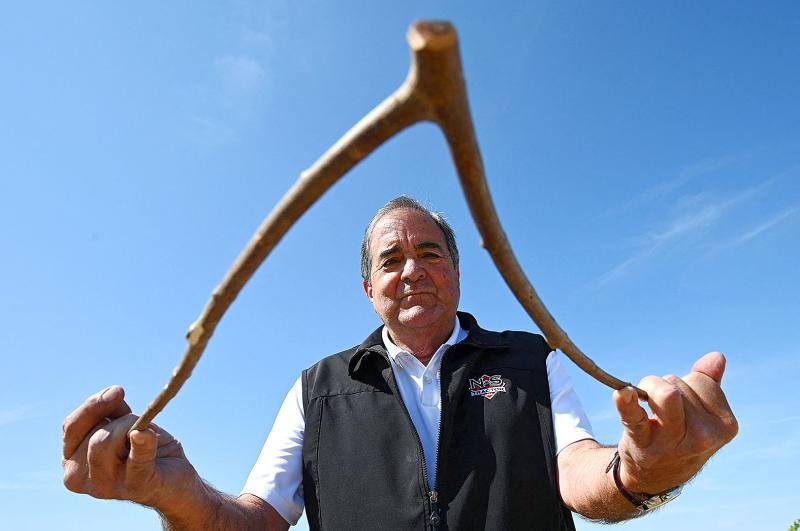
Photo: AFP
For more than 40 years, Sagouspe has worked as a dowser, also known as a “water witch,” offering to help the largest farmers in central California find groundwater. Proudly claiming to live in “America’s orchard” but desperate in the face of increasingly extreme droughts, farmers are turning to him more and more.
In order to find water in a region that severely lacks it, Sagouspe can’t use just any piece of wood. “Some people use willow, but it is too fast-reacting for me,” he says, as if it were obvious.
His tool of choice is a piece of olive wood, wrapped with black tape around the bottom, that he keeps on the dashboard of his white pickup truck.
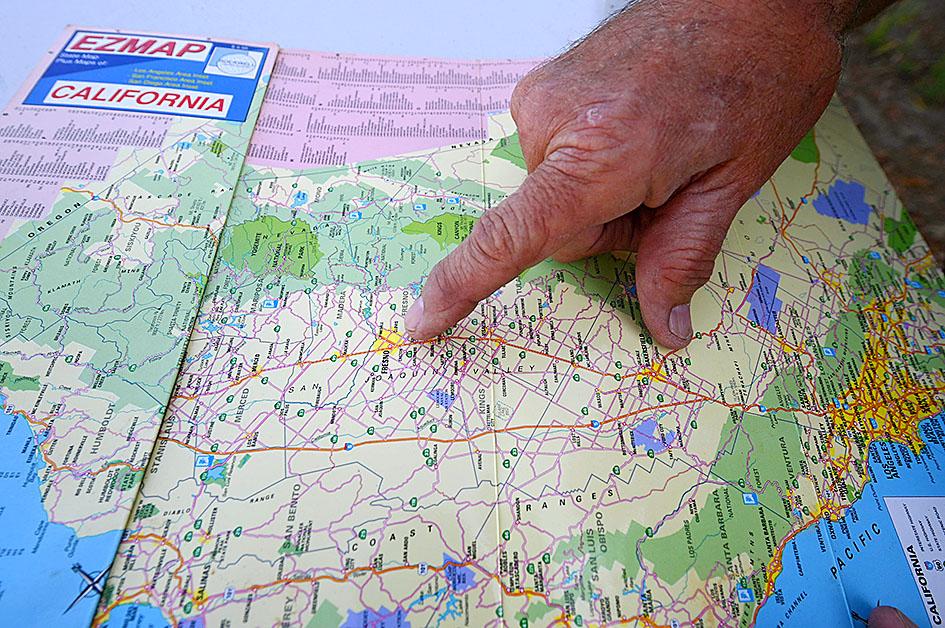
Photo: AFP
“The stick, it becomes almost bonded to me,” he says. “When I witch from my truck, it starts tingling in my hands when I know there’s going to be water.”
A ‘RENEGADE’
Sagouspe swears he doesn’t use any tools, maps or geological surveys in his work.
“I’m a renegade,” the 70-year-old says mischievously.
Instead, he bases his work on very precise knowledge of the region and the neighboring mountain range that irrigates the valley with water — when there is any. His father, who transferred this “energy” to him, also worked as a dowser in the area.
Sagouspe offers to “pass that energy down” to AFP, but without much success.
For each supposed water source that he marks with his little pink flags, Sagouspe makes US$1,000.
During the severe drought in 2014, “I paid for my daughter’s wedding, I had so many people calling me,” he says. This year, with orchards parched, animals dehydrated and farmers panicked, he also stands to make record revenues.
Farmers who hire the dowser have no guarantee of actually finding water at the spots he marks. They then have to pay tens, even hundreds of thousands of dollars to build wells and extract water — or come home empty-handed.
But they take that risk because specialized companies cost more, without necessarily being more precise, says Bikram Hundal, a farmer who in the past dug an expensive well nearly 300 meters deep without finding even a drop of water.
‘SUCCESSFUL’
During his first meeting with the dowser, Hundal — whose company packages nine million kilograms of almonds per year — said he didn’t take Sagouspe seriously.
“Are we doing a probe, are we using a satellite?” Hundal, standing in the middle of his almond field, recalls asking. “He said, ‘No, I can feel the electromagnetic currents of the water.’”
“I was like, ‘This is BS,’” says Hundal, who has an engineering background.
But then...
“I’ve used him five times, and he’s been successful five times,” says Hundal.
‘CALL ME’
Experts bristle at such examples, arguing that if you dig deep enough, you can find a certain amount of water almost anywhere.
But it won’t necessarily be of high quality, and digging it up can endanger already fragile water tables.
“The dowser commonly implies that the spot indicated by the rod is the only one where water could be found, but this is not necessarily true,” warns the US Geological Survey.
Sagouspe insists that the wand doesn’t lie. “Sure, you’re going to have your skeptics,” he says, shrugging.
“Until you have a ranch that is completely dry,” he adds, smiling. “Then, call me.”

The Portuguese never established a presence on Taiwan, but they must have traded with the indigenous people because later traders reported that the locals referred to parts of deer using Portuguese words. What goods might the Portuguese have offered their indigenous trade partners? Among them must have been slaves, for the Portuguese dealt slaves across Asia. Though we often speak of “Portuguese” ships, imagining them as picturesque vessels manned by pointy-bearded Iberians, in Asia Portuguese shipping between local destinations was crewed by Asian seamen, with a handful of white or Eurasian officers. “Even the great carracks of 1,000-2,000 tons which plied
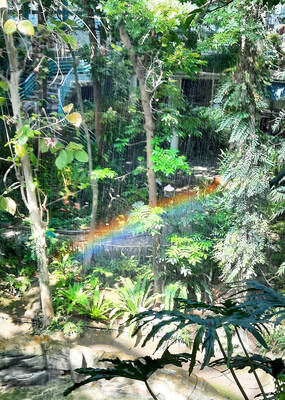
It’s only half the size of its more famous counterpart in Taipei, but the Botanical Garden of the National Museum of Nature Science (NMNS, 國立自然科學博物館植物園) is surely one of urban Taiwan’s most inviting green spaces. Covering 4.5 hectares immediately northeast of the government-run museum in Taichung’s North District (北區), the garden features more than 700 plant species, many of which are labeled in Chinese but not in English. Since its establishment in 1999, the site’s managers have done their best to replicate a number of native ecosystems, dividing the site into eight areas. The name of the Coral Atoll Zone might

On Monday morning, in quick succession, the Chinese Communist Party (CCP) and the Chinese Nationalist Party (KMT) released statements announcing “that the Central Committee of the Communist Party of China and General Secretary Xi Jinping (習近平) have invited KMT Chairwoman Cheng Li-wun (鄭麗文) to lead a delegation on a visit to the mainland” as the KMT’s press release worded it. The KMT’s press release added “Chairwoman Cheng expressed her gratitude for the invitation and has gladly accepted it.” Beijing’s official Xinhua news release described Song Tao (宋濤), head of the Taiwan Work Office of the CCP Central Committee, as
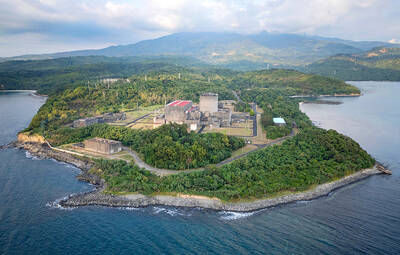
Nuclear power is getting a second look in Southeast Asia as countries prepare to meet surging energy demand as they vie for artificial intelligence-focused data centers. Several Southeast Asian nations are reviving mothballed nuclear plans and setting ambitious targets and nearly half of the region could, if they pursue those goals, have nuclear energy in the 2030s. Even countries without current plans have signaled their interest. Southeast Asia has never produced a single watt of nuclear energy, despite long-held atomic ambitions. But that may soon change as pressure mounts to reduce emissions that contribute to climate change, while meeting growing power needs. The


 RSS
RSS