


Yuichiro welled up as he collected a food parcel at a Tokyo outreach event offering help to the growing number of Japanese pushed into poverty by the coronavirus pandemic.
“There is no work. Absolutely none,” said the 46-year-old, until recently a construction worker, while clutching a small plastic bag of essentials on a cold winter street in the capital.
“This doesn’t get reported much in the media, but many people are sleeping at train stations and in cardboard boxes. Some are dying of hunger.”
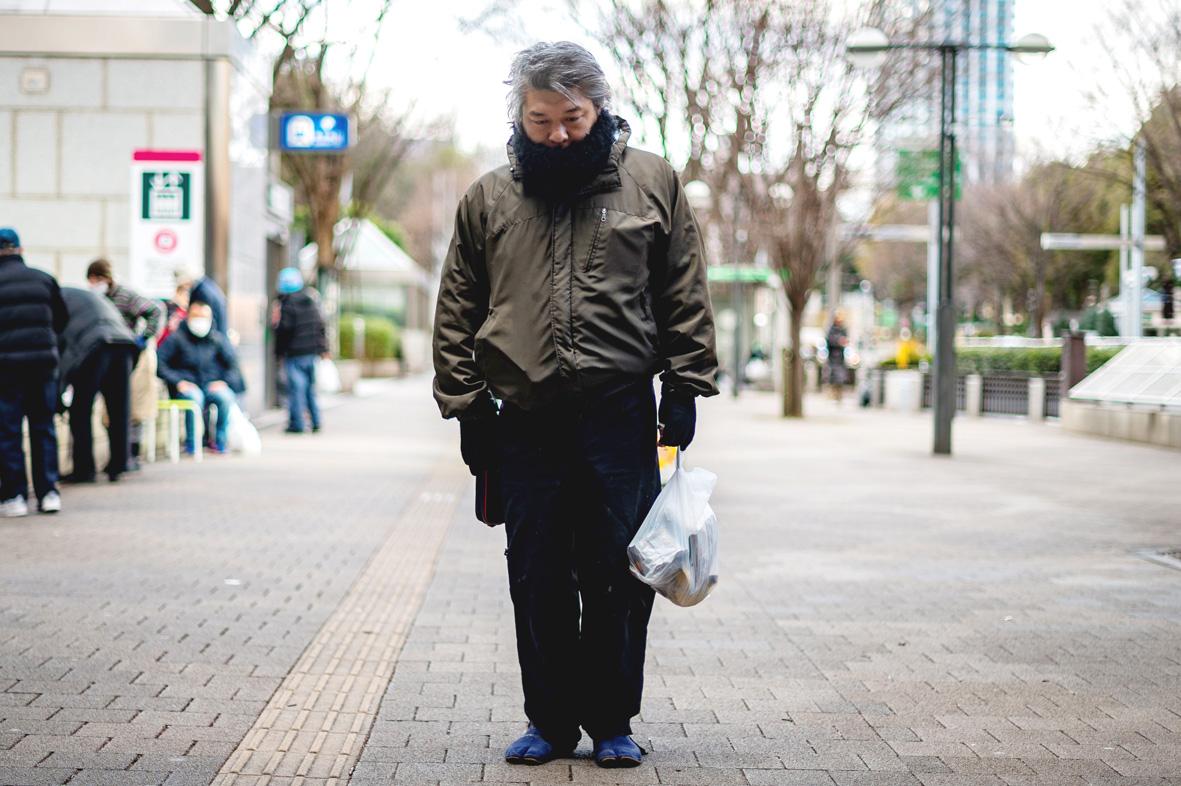
Photo: AFP
The world’s third-largest economy has seen a relatively small coronavirus outbreak so far, with around 4,500 deaths and largely without the drastic lockdowns seen in other countries.
With an unemployment rate below three percent and a reputation for a strong social safety net, Japan also appears well placed to weather the pandemic’s economic fallout.
But campaigners say the most vulnerable have still been hit hard, with statistics masking the high rate of underemployment and poorly paid temporary work.
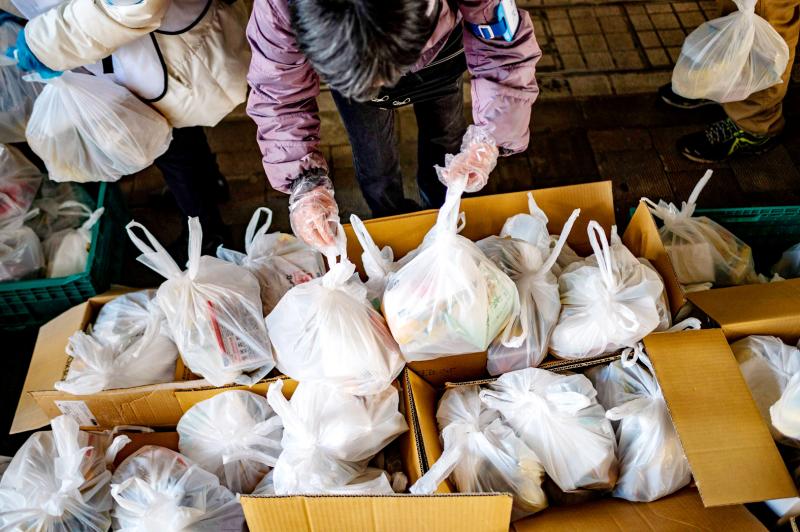
Photo: AFP
“The pandemic, rising joblessness and falling wages have directly hit the working poor, people who were barely getting by before,” said Ren Ohnishi, who heads the Moyai Support Center for Independent Living, an anti-poverty group.
Around 40 percent of workers are in vulnerable “non-regular” jobs with lower wages and contracts that can be terminated easily.
Many also struggle to access welfare.
Yuichiro, who did not give his last name, said he was sent from one government office to another before being told assistance was only for those with children.
“But there are lots of adults who aren’t able to eat,” he said.
‘THE ROPE JUST SNAPPED’
More than 10 million people in Japan live on less than US$19,000 a year, while one in six lives in “relative poverty” on incomes less than half the national median.
Economists say that half a million Japanese lost their jobs in the past six months, and campaigners say the ripple effects are spreading across the population.
“I know for certain the middle class is collapsing,” said Kenji Seino, who heads the non-profit relief group Tenohasi.
Around 250 people were lined up in Tokyo’s bustling Ikebukuro district to receive food, clothes, sleeping bags and medical help from Tenohasi’s volunteer team, who also give free advice on job-hunting and government services.
“People who were already struggling were confronted with the coronavirus. They were on a tightrope and the rope just snapped,” he added.
Experts warn the economic pain may be contributing to a rise in the suicide rate seen towards the end of last year.
A one percent point rise in Japan’s unemployment rate translates into roughly 3,000 additional suicides a year, according to Taro Saito of the NLI Research Institute.
Women in particular are facing economic hardship because many work on temporary contracts in retail, restaurants and hotels — all industries hit hard by the pandemic.
Experts say women often hesitate to seek help or to join men in queues for food, but even so, they are now seeing more women and mothers with small children at outreach events.
Seino said less than 20 percent of the people he helps are women, but he believes “many more” have not come forward.
“Some women feel that their children won’t be able to walk with their heads high if they are on welfare,” he added.
‘A VERY JAPANESE SYSTEM’
While statistics show rising applications for public assistance, Ohnishi of the Moyai Support Centre said the shame and stigma of being a welfare recipient made many reluctant to seek help.
“The system itself has rules that assistance from family members must be the priority. So families receive notices saying things like ‘your son is applying for welfare,’” he said.
“It’s a very Japanese system. Everyone has the legal rights to use it. But society does not necessarily tolerate that.”
Campaigners admit the scale of poverty in Japan is dwarfed by that in many nations — even among other developed countries.
But that means little for individual Japanese struggling for food and shelter.
One man receiving help in Ikebukuro said his monthly income from construction had fallen to less than US$200 and he only had enough cash left for one more rental payment.
“I don’t want to go onto the streets. It’s too cold,” he said, declining to give his name.
“I don’t know exactly what I will do now.”
If one asks Taiwanese why house prices are so high or why the nation is so built up or why certain policies cannot be carried out, one common answer is that “Taiwan is too small.” This is actually true, though not in the way people think. The National Property Administration (NPA), responsible for tracking and managing the government’s real estate assets, maintains statistics on how much land the government owns. As of the end of last year, land for official use constituted 293,655 hectares, for public use 1,732,513 hectares, for non-public use 216,972 hectares and for state enterprises 34 hectares, yielding

The March/April volume of Foreign Affairs, long a purveyor of pro-China pablum, offered up another irksome Beijing-speak on the issues and solutions for the problems vexing the People’s Republic of China (PRC) and the US: “America and China at the Edge of Ruin: A Last Chance to Step Back From the Brink” rang the provocative title, by David M. Lampton and Wang Jisi (王緝思). If one ever wants to describe what went wrong with US-PRC relations, the career of Wang Jisi is a good place to start. Wang has extensive experience in the US and the West. He was a visiting

One of the challenges with the sheer availability of food in today’s world is that lots of us end up spending many of our waking hours eating. Whether it’s full meals, snacks or desserts, scientists have found that it’s not uncommon for us to be mindlessly grazing at some point during all of our 16 or so waking hours. The problem? As soon as this food hits the bloodstream in the form of glucose, it initiates the release of the hormone insulin. This in turn activates a switch present in every one of our cells, which is responsible for driving cell
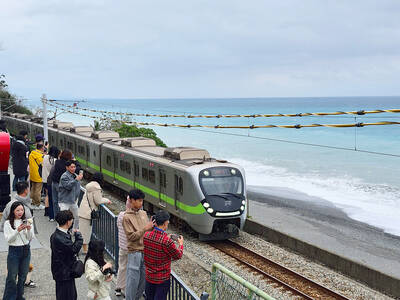
The small platform at Duoliang Train Station in Taitung County’s Taimali Township (太麻里) served villagers from 1992 to 2006, but was eventually shut down due to lack of use. Just 10 years later, the abandoned train station had become widely known as the most beautiful station in Taiwan, and visitors were so frequent that the village had to start restricting traffic. Nowadays, Duoliang Village (多良) is known as a bit of a tourist trap, with a mandatory, albeit modest, admission fee of NT$10 giving access to a crowded lane of vendors with a mediocre view of the ocean and the trains


 RSS
RSS