


Time passes slowly for the characters and audiences of Samuel Beckett’s 1953 theater of the absurd classic Waiting for Godot, and yet the play itself has proven timeless, with an ability to be performed in a wide variety of locales and languages.
Yet despite the theme and dialogue’s ability to transcend language and culture, the two-act play — and considered by many critics to be the most significant English-language play of the 20th century — has rarely been seen in Taiwan, either in English or Mandarin, since the first production in 1965.
In the past two decades there have been just a handful of shows: Stan Lai (賴聲川) directed a version at the National Theater in 2001 for his Performance Workshop (表演工作坊), while the Contemporary Legend Theatre (當代傳奇劇場) did a Beijing opera-ish version at the Metropolitan Hall in 2005.
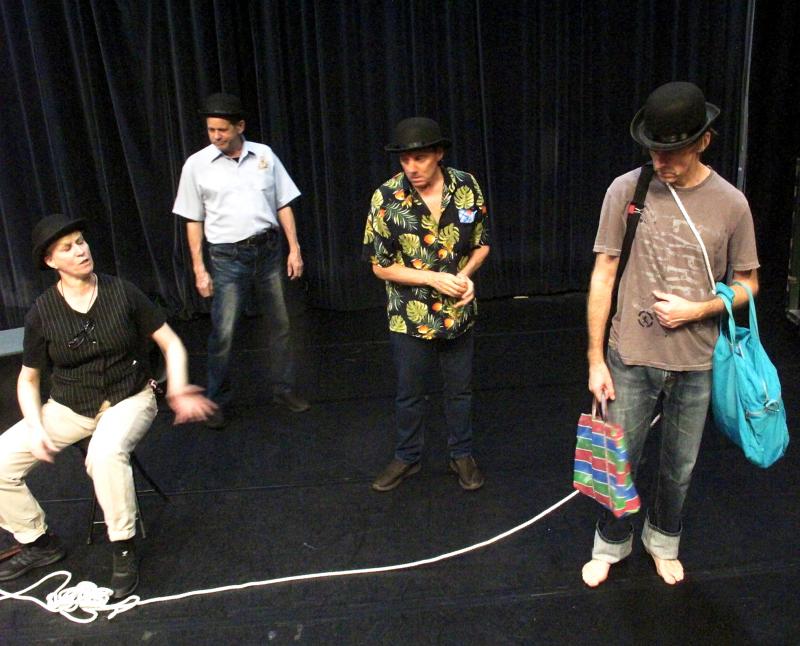
Photo: courtesy of Phoenix Theatre
Deutsches Theater Berlin brought their production to that same hall in 2017 as part of the Taipei Arts Festival, while Coism (明日和合製作所) used the title and the idea of waiting for something to happen for their five-minute shows as part of this year’s Nuit Blanche Taipei last month.
However, the Phoenix Theatre, which was launched in 1999 and was a stalwart of local English-language productions for many years, chose the play to mark its return to the Taipei stage after a hiatus of more than a decade.
The play, which will be performed this weekend at Soochow University, has been directed by Catherine Diamond, a professor of literature and theater at university, as well as an author, flamenco dancer and director of the Phoenix Theatre and the Kinnari Ecological Theatre Project.

Photo: courtesy of Phoenix Theatre
She said that the Phoenix team thought that Waiting for Godot was an appropriate choice for this COVID-19 stricken year.
It is an “apt text to perform while human societies are in stasis, waiting for the pandemic to end and to see what the post-virus future looks like. What do we all do while waiting? We wait because we assume that this will end and is not the new normal…yet,” she wrote in the production notes.
However, it is not just COVID-19 that propelled the team. They also wanted to explore another crisis facing the world crisis, global warming and an overheated Earth.
Beckett set his play in a post-World War II northern Europe wasteland, when the institutional structures of so many countries had been devastated, but Diamond said Phoenix has transposed the action to the hot and humid climes of the global south.
Waiting for Godot is about two men, Estragon (Gogo) and Vladimir (Didi), who are waiting for a friend, Godot. They swap tales as they wait, and sleep, dream or engage with an occasional passer-by.
It can be seen as an allegory about life and death — or boredom — and while sometimes it seems endlessly bleak, there are threads of humor laced throughout.
Most of the five-member cast of Waiting for Godot are veterans of earlier Phoenix productions or those by other small troupes such as Outcast Theatre, the Taipei Alien Dramatic Society or the Butterfly Effect Theatre Company: Maurice Harrington, Paul Jackson, Sara Tarbox, Peter Balfy and Aiden Lin.
Diamond said the Phoenix production has given the play “a Taiwanese twist,” but because Beckett, when asked to describe his characters, “reputedly said: ‘The only thing I’m sure of is that they’re wearing bowlers,’ we have preserved their hats.’”
One twist that the team is divulging ahead of time is that all the actors change roles from Act I to Act II.
The play will be performed in English, with Mandarin subtitles.
There are several buses that run by Soochow University from the Shihlin MRT Station Exit 1: Nos. 557, 255, 304, 30, 18 and 620.

Jason Han says that the e-arrival card spat between South Korea and Taiwan shows that Seoul is signaling adherence to its “one-China” policy, while Taiwan’s response reflects a reciprocal approach. “Attempts to alter the diplomatic status quo often lead to tit-for-tat responses,” the analyst on international affairs tells the Taipei Times, adding that Taiwan may become more cautious in its dealings with South Korea going forward. Taipei has called on Seoul to correct its electronic entry system, which currently lists Taiwan as “China (Taiwan),” warning that reciprocal measures may follow if the wording is not changed before March 31. As of yesterday,

The Portuguese never established a presence on Taiwan, but they must have traded with the indigenous people because later traders reported that the locals referred to parts of deer using Portuguese words. What goods might the Portuguese have offered their indigenous trade partners? Among them must have been slaves, for the Portuguese dealt slaves across Asia. Though we often speak of “Portuguese” ships, imagining them as picturesque vessels manned by pointy-bearded Iberians, in Asia Portuguese shipping between local destinations was crewed by Asian seamen, with a handful of white or Eurasian officers. “Even the great carracks of 1,000-2,000 tons which plied
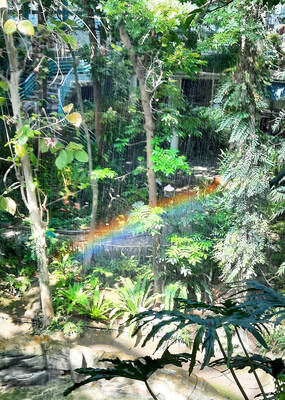
It’s only half the size of its more famous counterpart in Taipei, but the Botanical Garden of the National Museum of Nature Science (NMNS, 國立自然科學博物館植物園) is surely one of urban Taiwan’s most inviting green spaces. Covering 4.5 hectares immediately northeast of the government-run museum in Taichung’s North District (北區), the garden features more than 700 plant species, many of which are labeled in Chinese but not in English. Since its establishment in 1999, the site’s managers have done their best to replicate a number of native ecosystems, dividing the site into eight areas. The name of the Coral Atoll Zone might
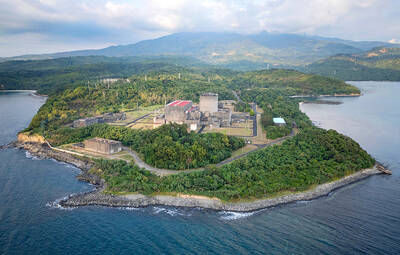
Nuclear power is getting a second look in Southeast Asia as countries prepare to meet surging energy demand as they vie for artificial intelligence-focused data centers. Several Southeast Asian nations are reviving mothballed nuclear plans and setting ambitious targets and nearly half of the region could, if they pursue those goals, have nuclear energy in the 2030s. Even countries without current plans have signaled their interest. Southeast Asia has never produced a single watt of nuclear energy, despite long-held atomic ambitions. But that may soon change as pressure mounts to reduce emissions that contribute to climate change, while meeting growing power needs. The


 RSS
RSS