


Taiwan Through Foreign Eyes is a collection of 18 short stories by 14 authors. Most of the writers are foreign, though some have Taiwanese ancestry. The book’s subtitle, though, needs closer examination.
We’re told by the editor, Christopher Logan, that Stories from the Miracle Days refers to the 1990s, a decade that he considers had an allure that’s missing today. But the only reference I could find here was in a story about the last evening in Taiwan of someone who isn’t sure he really wants to leave. He meets someone he hasn’t seen for 15 years who says they last met in the mid-1980s.
In addition, nothing about these stories seems to me particularly old-fashioned. It may be true that a dangki, or spirit medium, is today harder to find than in a story about someone who consults one about a stolen gold ring, but for the most part Taiwan appears much as it is today. The only big difference, perhaps, is that Christopher Logan no longer lives here but in the US state of Oregon, where his publishing company, Deep World Publishing, is based.
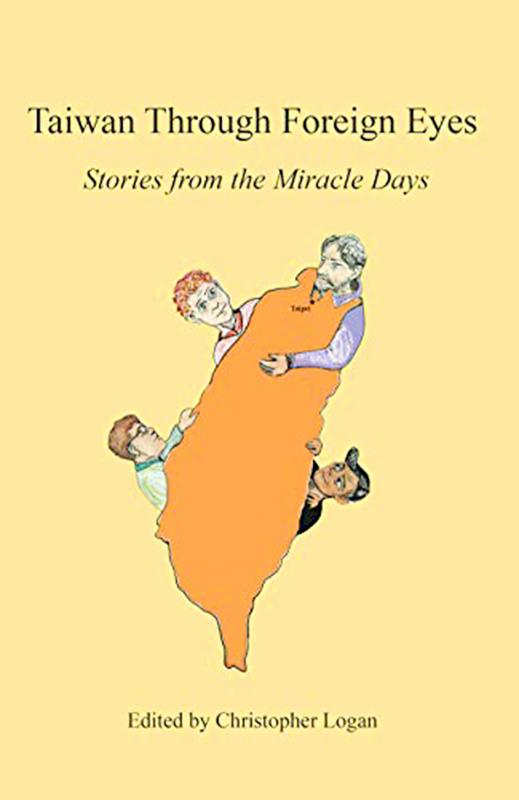
The reality seems to be rather different. Logan says in his Introduction that these stories were meant to be published after his book Culture Taipei! but that this was delayed until 2003. Either way, Taiwan Through Foreign Eyes clearly comes from the same period, but has had to wait 20 years to see the light of day. Logan tells us, for instance, that two of his authors wrote their tales when they were still schoolboys at the Taipei American School, but that they went on to Harvard and Pomona.
This volume, in other words, has all the appearance of a collection of stories given a belated unity, and possibly charm, by being set in the “miracle days” of the 1990s, whereas in reality they could just as well have been written yesterday and set in modern Taiwan.
This is not to say that the tales don’t have their particular magic anyway. Many are very good, and the volume as a whole makes for some very interesting reading.
Almost all the stories are set in Taipei. Exceptions are one about a retired soldier living in the mountains who goes looking for a lost dog in a raging typhoon, and one set near Changhua, where a Dutchman sets about cleaning an ancestral shrine in his Taiwanese wife’s home village.
Many recognizable Taipei landmarks are evoked, from City Hall and the Grand Hyatt to Wanhua (萬華) and Beitou (北投) districts and Taoyuan.
One memorable tale concerns a young girl from Tamsui who goes to visit her mother’s estranged husband in East Taipei without being prepared for the very different kind of life he’s now living. Another contains a murder, albeit in Canada, of a man thought to be responsible (by having deserted her) for the suicide of the killer’s sister back in Taiwan.
Many of the protagonists are language teachers working in Taipei cram schools. One makes off for Yangmingshan on his motorbike after work where he finds a measure of relaxation, while another feels he has to make love with a different woman every week in order to overcome his insomnia.
The Taipei Times reviewed Christopher Logan’s Culture Taipei! on Nov. 30, 2003 and praised its exceptional range, including as it did, for example, the Han Tang Pear Garden Dancers, with their use of ancient nan guan music.
Logan includes three of his own stories in this new book, and they’re all very good, and very different. One concerns a man and a woman who come to Taiwan from the US to interview a reclusive artist who specializes in female nudes and eventually asks if he can paint the female journalist. The next has a 130-year-old female ghost waiting for the spirit of her lover. He never comes, but instead, following an earthquake, contacts her younger sister. And third is the story of an old teacher of Peking Opera who is in danger of losing his prize pupil to television.
Other memorable tales include one about a man with a New York girlfriend who, while lying beside her, remembers a Japanese girl he had an affair with in the neighborhood of the Taroko Gorge. Another is the first one in which a drug-runner is questioned at a police roadblock, and another (already mentioned) where a language teacher struggles between the claims of the early-morning ticket for Hong Kong in his pocket and a deep-seated desire not to leave Taipei.
In other stories, insomnia is mis-diagnosed as insanity, and a teacher’s Taiwanese girlfriend urges him not to own up to throwing a brick through a neighbor’s window (because he’d left his three-wheeled motorbike parked in an alley without any lights) because it would lead to him losing face.
If an occasional story seems inconsequential, such as one about a walk from Wanhua District to Ximen, it’s because it lacks a dramatic element. Somerset Maugham’s stories, some of the most commercially successful ever written, all have brilliant plots — consider for instance Red and Mr Know-All. The same cannot always be said of Maupassant and Chekhov, other masters of the genre, but generally it can.
But this is an attractive story collection. I didn’t detect any typos, and the level of stylishness was consistently high. Lastly, whether the tales are set in the 1990s or the present day didn’t appear, whatever the editor said, to matter one iota.
Recently the Chinese Nationalist Party (KMT) and its Mini-Me partner in the legislature, the Taiwan People’s Party (TPP), have been arguing that construction of chip fabs in the US by Taiwan Semiconductor Manufacturing Co (TSMC, 台積電) is little more than stripping Taiwan of its assets. For example, KMT Legislative Caucus First Deputy Secretary-General Lin Pei-hsiang (林沛祥) in January said that “This is not ‘reciprocal cooperation’ ... but a substantial hollowing out of our country.” Similarly, former TPP Chair Ko Wen-je (柯文哲) contended it constitutes “selling Taiwan out to the United States.” The two pro-China parties are proposing a bill that

Institutions signalling a fresh beginning and new spirit often adopt new slogans, symbols and marketing materials, and the Chinese Nationalist Party (KMT) is no exception. Cheng Li-wun (鄭麗文), soon after taking office as KMT chair, released a new slogan that plays on the party’s acronym: “Kind Mindfulness Team.” The party recently released a graphic prominently featuring the red, white and blue of the flag with a Chinese slogan “establishing peace, blessings and fortune marching forth” (締造和平,幸福前行). One part of the graphic also features two hands in blue and white grasping olive branches in a stylized shape of Taiwan. Bonus points for
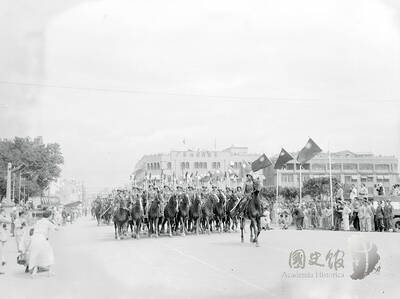
March 9 to March 15 “This land produced no horses,” Qing Dynasty envoy Yu Yung-ho (郁永河) observed when he visited Taiwan in 1697. He didn’t mean that there were no horses at all; it was just difficult to transport them across the sea and raise them in the hot and humid climate. “Although 10,000 soldiers were stationed here, the camps had fewer than 1,000 horses,” Yu added. Starting from the Dutch in the 1600s, each foreign regime brought horses to Taiwan. But they remained rare animals, typically only owned by the government or
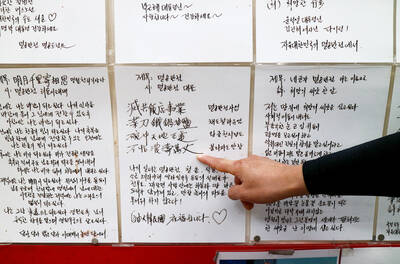
“M yeolgong jajangmyeon (anti-communism zhajiangmian, 滅共炸醬麵), let’s all shout together — myeolgong!” a chef at a Chinese restaurant in Dongtan, located about 35km south of Seoul, South Korea, calls out before serving a bowl of Korean-style zhajiangmian —black bean noodles. Diners repeat the phrase before tucking in. This political-themed restaurant, named Myeolgong Banjeom (滅共飯館, “anti-communism restaurant”), is operated by a single person and does not take reservations; therefore long queues form regularly outside, and most customers appear sympathetic to its political theme. Photos of conservative public figures hang on the walls, alongside political slogans and poems written in Chinese characters; South


 RSS
RSS