


The nine-day Matsu pilgrimage from Gongtian Temple (拱天宮) in Miaoli County’s Baishatun (白沙屯) saw more than 55,000 followers walking in the summer heat as the pandemic raged. While pilgrims followed government regulations and wore masks to guard against the virus, Matsu, one of Taiwan’s most popular deities and the patron saint of fishermen, provided her own kind of protection.
“It would be against Matsu’s benevolent nature if the temple management insisted on having the pilgrimage without considering the public concern of the pandemic,” said Hung Jian-hua (洪建華), of Gongtian Temple.
Some rituals practiced during the pilgrimage, such as pilgrims crawling under Matsu’s palanquin and worshipers exchanging flowers with Matsu, were discouraged this year. Participants were not allowed to enter the Gongtian Temple in the small hours of July 5, the day when Matsu’s palanquin departed from Baishatun, in order to maintain social distancing.
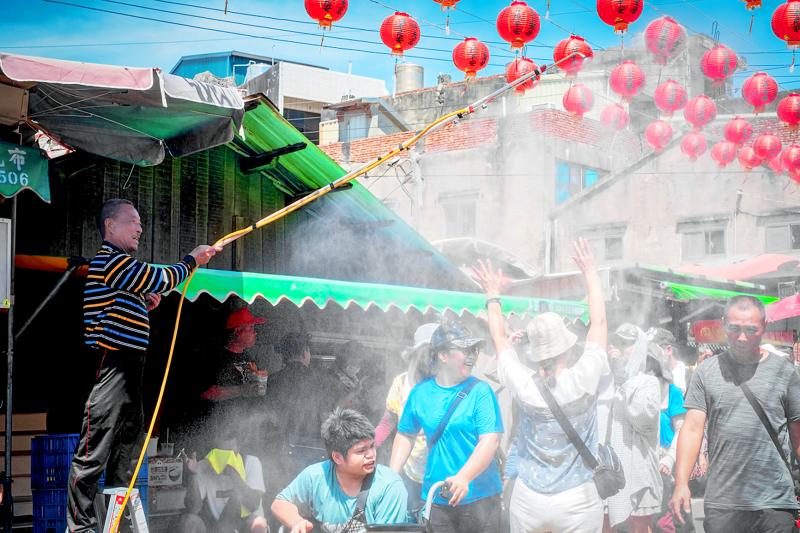
Photo: Paul Cooper, Taipei Times
The temple urged participants to wear masks, sanitize their hands and maintain social distancing. But this was more like background music than a serious instruction.
Those who wore masks did so more as an ornament: it did not completely cover the nose and mouth. When pilgrims rushed into the temple to get closer to Matsu, social distancing was thrown out of the window.
The Baishatun pilgrimage, held for more than 200 years, is one of the largest annual religious processions in Taiwan. Every year people flood into this small fishing town to join the 200km pilgrimage, which took pilgrims to Chaotian Temple (朝天宮) in Beigang (北港), Yunlin County, and back.
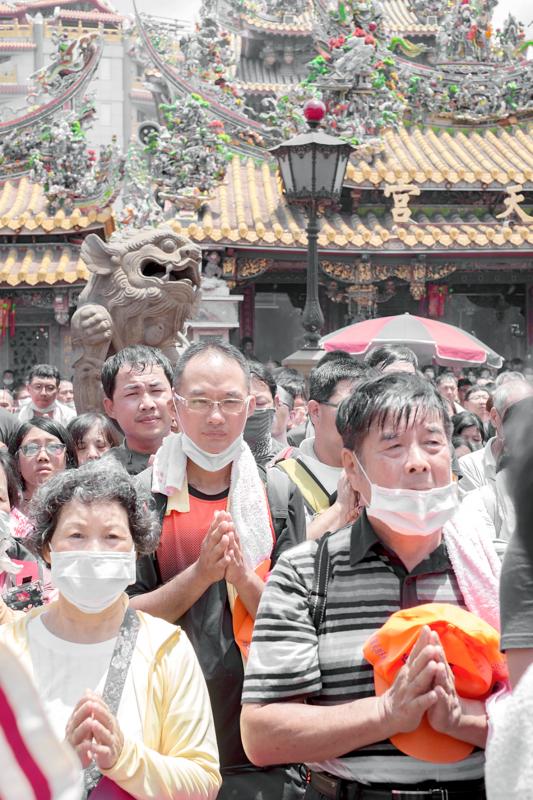
Photo: Paul Cooper, Taipei Times
Due to the pandemic, the temple pushed the pilgrimage back four months. It ended on Monday.
MATSU’S HOSPITALITY
Hospitable crowds were waiting on the pilgrimage route, giving out free food, beverages, pain relief patches and talismans — all, of course, gifts from Matsu.
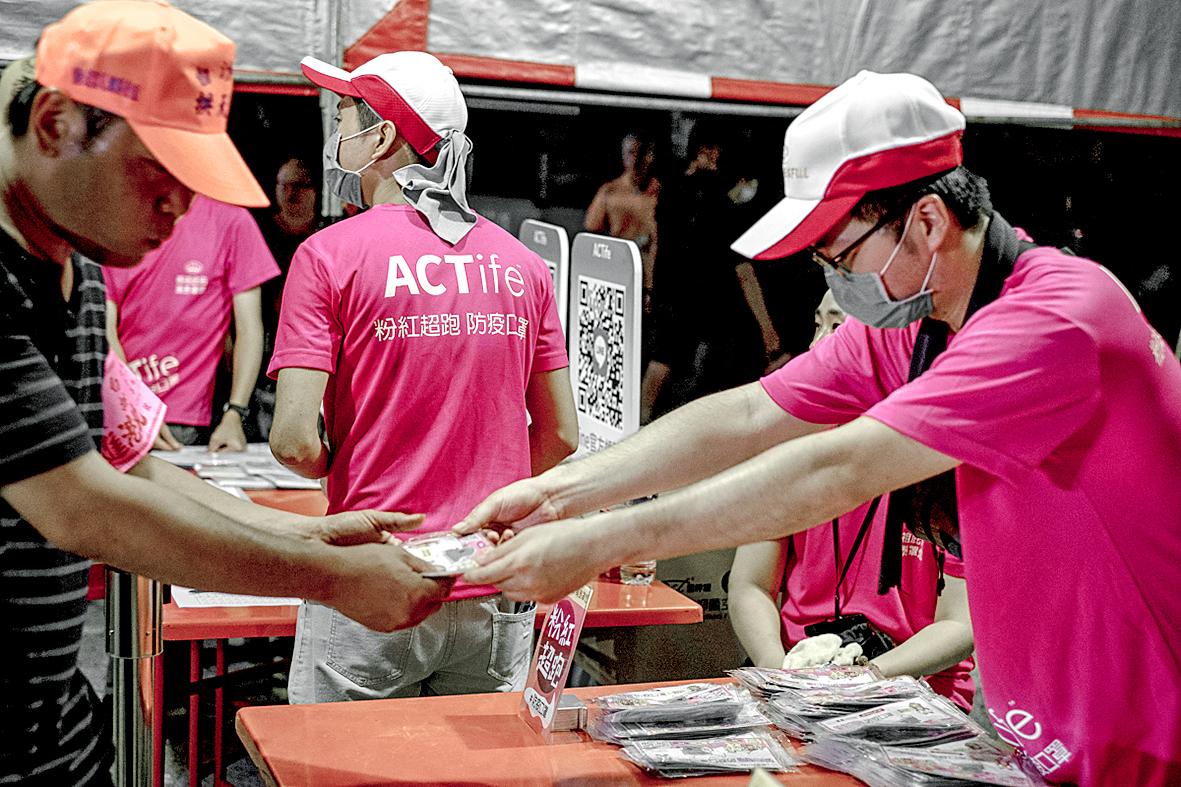
Photo: Paul Cooper, Taipei Times
A woman surnamed Tseng (曾), 38, who has been providing food and drinks for the pilgrimage with her father since she was 18, prepared more than 100 boxes of croissants for this year’s pilgrimage. People helping her distribute the bread were required to wear masks, sanitize their hands and have their temperatures measured.
“We make sure our procedure is in line with government policy,” Tseng said.
Apart from the pandemic, the summer heat was also a big concern, Hung said. In order to avoid the summer heat, the pilgrimage paused at 10:30am letting the pilgrims rest then started walking again at 5pm.

Photo: Paul Cooper, Taipei Times
For believers, Matsu eased their anxiety by protecting them from the virus.
And she had some help. In April, the temple held a chuwen (除瘟, “purifying”) ceremony to combat the pandemic. It was the first time in 200 years that the temple had conducted the ceremony.
“Matsu brings us together. She is the chief director and we are her assistants. We are a team with the same goal,” Hung says, calling the effort “team Matsu.”
Chang Ming-lei (張銘烈), chairman of Wonderful Hi-Tech Corporation (萬泰科技集團) and a follower of this year’s pilgrimage, also joined “team Matsu.”
Chang said he distributed 300,000 masks to participants throughout the pilgrimage. The masks were products of Wonderful Hi-Tech Corporation, a company making electronic wire and cable in Taiwan that expanded its business this year to producing masks.
“I want people to join the event without worrying about the pandemic,” Chang said He added that the mask idea “is just a small contribution we can make for Matsu.”
BIG TURNOUT
Even with the pandemic, Hung says 55,000 worshipers registered for the pilgrimage this year — 5,000 more than last year.
“More and more people are getting interested in the history of Taiwan and its folk religion. Also, some people sign up for their family so that their names would be written on a mention to Matsu and read out by the Chaotian Temple priests when the pilgrimage arrives at Beigang. They might not take part in the physical event, but they are with us, too.”
Chen Ting-li (陳廷莉), 21, gave another reason why this year’s procession is able to attract more people.
“I am able to join the pilgrimage because this year it takes place during summer vacation. Otherwise, I won’t be able to come all the way here from Hualien,” Chen said.
Vivian Chang (張如欣), 26, thinks that people have been cooped up for too long.
“Since the government is now allowing temples to have large-scale religious events, people are taking this opportunity to go outdoors,” Chang said, adding that she believes that the government has done well in containing the spread of the virus.
And maybe, somewhere, Matsu is smiling to herself on a job well done, too.

Google unveiled an artificial intelligence tool Wednesday that its scientists said would help unravel the mysteries of the human genome — and could one day lead to new treatments for diseases. The deep learning model AlphaGenome was hailed by outside researchers as a “breakthrough” that would let scientists study and even simulate the roots of difficult-to-treat genetic diseases. While the first complete map of the human genome in 2003 “gave us the book of life, reading it remained a challenge,” Pushmeet Kohli, vice president of research at Google DeepMind, told journalists. “We have the text,” he said, which is a sequence of
On a harsh winter afternoon last month, 2,000 protesters marched and chanted slogans such as “CCP out” and “Korea for Koreans” in Seoul’s popular Gangnam District. Participants — mostly students — wore caps printed with the Chinese characters for “exterminate communism” (滅共) and held banners reading “Heaven will destroy the Chinese Communist Party” (天滅中共). During the march, Park Jun-young, the leader of the protest organizer “Free University,” a conservative youth movement, who was on a hunger strike, collapsed after delivering a speech in sub-zero temperatures and was later hospitalized. Several protesters shaved their heads at the end of the demonstration. A
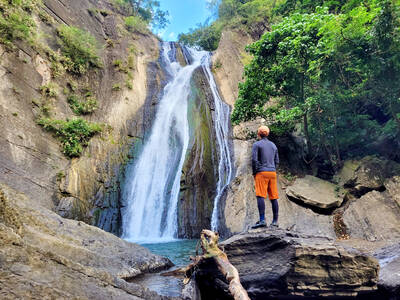
Every now and then, even hardcore hikers like to sleep in, leave the heavy gear at home and just enjoy a relaxed half-day stroll in the mountains: no cold, no steep uphills, no pressure to walk a certain distance in a day. In the winter, the mild climate and lower elevations of the forests in Taiwan’s far south offer a number of easy escapes like this. A prime example is the river above Mudan Reservoir (牡丹水庫): with shallow water, gentle current, abundant wildlife and a complete lack of tourists, this walk is accessible to nearly everyone but still feels quite remote.

In August of 1949 American journalist Darrell Berrigan toured occupied Formosa and on Aug. 13 published “Should We Grab Formosa?” in the Saturday Evening Post. Berrigan, cataloguing the numerous horrors of corruption and looting the occupying Republic of China (ROC) was inflicting on the locals, advocated outright annexation of Taiwan by the US. He contended the islanders would welcome that. Berrigan also observed that the islanders were planning another revolt, and wrote of their “island nationalism.” The US position on Taiwan was well known there, and islanders, he said, had told him of US official statements that Taiwan had not


 RSS
RSS