


In the spring of 1870, Lin Wen-ming (林文明), local strongman and scion of the powerful Lin family of Wufeng (霧峰林家), strode into the Changhua County magistrate’s court surrounded by a dozen of his bodyguards, and was never seen alive again.
Aged 36 and in the prime of his life, Lin expected to walk out of court with impunity, untouched by some 47 land and property disputes that had been filed against his family. Instead, he was ambushed and cut down by order of the magistrate Ling Ting-kuo (凌定國), who had long harbored a grudge against the Lin family.
His decapitated head was displayed on the city wall.
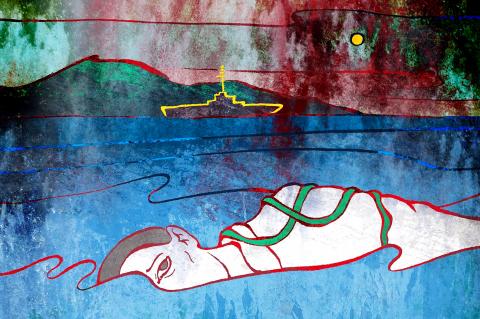
Photo courtesy of Office of Historical Suspense Investigation and Research
In death, Lin was immortalized. The shocking use of a judicial killing to settle a personal vendetta was the talk of the nation even among his contemporaries. Lin’s untimely demise, woven into the tale of his family’s fortunes, became part of a wider social history “of the settling of a new land, of the jostling of many newcomers in an ill-governed frontier region, of the patterns of local power and class differentiation that emerged,” Johanna Meskill writes in A Chinese Pioneer Family: The Lins of Wufeng, Taiwan, 1729–1895.
Last year, Lin’s killing was retold for a modern audience in a Public Television Service (PTS) docudrama special, based on a story and research developed by the creatives at the Office of Historical Suspense Investigation and Research (重大歷史懸疑案件調查辦公室, OHSIR).
Defying its name and logo — designed to resemble an imperial bureau — OHSIR, a project run by local content agency Power of Content, is turning murders of a bygone era into the stuff of viral social media posts, historical drama and literary non-fiction. In the process, it turns basic human curiosity and obsession with mortality into difficult questions about what it means to be Taiwanese.
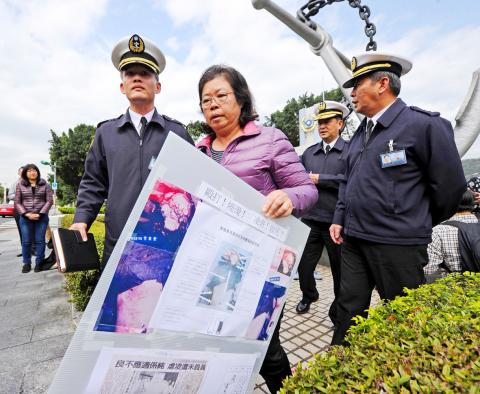
Photo: CNA
‘COLLECTIVE AMNESIA’
I first became acquainted with Taiwan’s deadly past on a walking tour of Taipei. For one afternoon in the seventh lunar month, a guide from OHSIR breathed suspense, terror and humanity into unremarkable buildings and streets — the sites of spine-chilling deaths that took place in and around Zhongshan District (中山), an area already popularly associated with all sorts of vices.
On the edge of Qingguang Market (晴光市場), we looked out on the street where a butcher made a humble living at her beef stall until that day in 1972 when her children found her stabbed to death at home in an armed robbery. At a wastewater drain under an overpass, I swatted flies away and listened to the discovery, in 1950, of a woman’s body at the number 13 water gate along the Tamsui River’s course farther east. Outside Jinxin Building (錦新大樓), which holds the dishonor of being “Taipei’s number one haunted house,” I learned how 23 tenants had perished in fires and a murder-suicide in the mere 44 years since its construction.
I was not alone in my morbid curiosity; the tour was fully booked a month in advance. Some 250 people have participated in OHSIR’s tours since the project started two years ago. There are more than 20,000 followers on OHSIR’s Facebook page, where Wang and other writers post lyrical, detailed accounts of true crime linked from their Web site (ohsir.tw).
On online forum Mystery (mysterystring.com), almost 2,000 fans get a deeper fix by discussing theories of unsolved — or unsatisfactorily solved — crimes.
True crime commands our attention because it carries “sociological meaning,” says Wang Pin-han (王品涵), deputy editor-in-chief of Power of Content.
For those with the stomach for it, gazing into the depths of deviance and depravity is a way of getting at the heart of what it means to be human. To Wang, the nation’s past experiences, including its crimes, are all part of Taiwan’s unique identity and consciousness.
Some of the most public deaths in Taiwanese history were politically-motivated murders of the White Terror era, including that of dissidents Henry Liu (劉宜良), Chen Wen-chen (陳文成) and the mother and daughters of Lin I-hsiung (林義雄) in the 1980s.
While these victims remain household names, Wang says that most people of her generation and younger — below the age of 40 — have no more than a superficial understanding of what Taiwan’s independence and democracy advocates experienced.
“As Taiwanese, one very big problem that we have is collective amnesia,” Wang says. “By interpreting and excavating these real-life cases anew, we want to let everyone remember again.”
That social significance is found not just in high-profile political assassinations, but also in the murders of ordinary people committed by ordinary people.
In 1995, Taiwan was rocked by a torrid love affair that resulted in two deaths, masterminded by the nation’s own “Black Widow.” A body found on a mountain in northern Taipei led the police to a 27-year-old woman named Pan Ming-hsiu (潘明秀), who was found guilty of murdering her boyfriend, Hsu Chih-chung (徐志忠), with the help of her new lover. Police investigations revealed that three years earlier, Hsu himself had helped Pan to kill her own husband, whom she had reported as missing.
Pan and her dead husband both suffered from polio, and the petite, baby-faced woman relied on crutches to move around. The public lapped up the sensational case, made all the more riveting because of the incongruence between Pan’s vulnerable appearance and her cold-hearted acts of murder. But Pan’s testimony that she sought to end the lives of her husband and boyfriend because they physically abused her also offered a glimpse at another side to the story.
“[The case] demonstrated how in a transitioning society, one in which the patriarchy was gradually starting to loosen but faced very strong resistance still, [Pan] was unable to break free of the oppression upon her,” Wang says.
Then in 1996, politician and women’s rights activist Peng Wan-ru (彭婉如) was found dead in Kaohsiung, three days after disappearing into a taxi at the end of a Democratic Progressive Party (DPP) event. Wang says that the presence of women at the center of two high-profile murder cases catalyzed a nationwide reflection about the status of women’s rights in Taiwan at the time.
THE TRUTH IS OUT THERE
Death and murder might be a curious choice of material for a content agency, but Joe Weng (翁健鐘), project manager at Power of Content, tells me that from a business point-of-view, such stories have a unique selling point.
“Suspense and mystery have the most cross-cultural potential,” Weng says, even more so than love stories. “Our feeling is that this is a language the whole world can understand — a crime or murder has taken place, and justice must be realized.”
Recognizing the potential for cultural production and export, the Ministry of Culture has already awarded grants to OHSIR under its scheme for developing the audiovisual industry. Weng says that the pursuit of transitional justice under President Tsai Ing-wen’s (蔡英文) administration also dovetails with OHSIR’s work. That’s resulted in a subsidy for OHSIR to develop an online encyclopedia of murders.
But OHSIR’s brand of private investigation into crime also taps into an underlying vein of distrust held by many citizens toward Taiwan’s authorities and judicial system. Weng says that this distrust is especially evident in the case of deaths in the military, often arising from incidents of bullying or abuse. He cites the death of navy conscript Huang Kuo-chang (黃國章) in 1995, the circumstances of which remain unexplained despite Taiwan’s navy commander issuing a public apology to Huang’s mother, Chen Pi-e (陳碧娥), in 2018. Chen’s search for the truth about her son’s death led her to establish the Association for the Promotion of Human Rights in the Military (軍中人權促進會).
“This is actually a huge problem that Taiwanese have about the judiciary, which is that they lack trustworthiness. We do not believe in the judiciary. On some level, we feel that many judicial decisions are contrary to our expectations or perceptions, and they are unable to bring forth strong enough evidence to convince us that these decisions are sound,” Wang says.
As a commercial endeavor, OHSIR stops short of activism. But it has formed partnerships with advocacy groups like the Taiwan Innocence Project (台灣冤獄平反協會, TIP), which seeks to exonerate the wrongly convicted. OHSIR taps on TIP’s intimate understanding of the judicial process and legal documents, as well as its first-hand interaction with convicted criminals, to run workshops on researching and writing about true crime.
For now, OHSIR intends to continue researching, writing, teaching and illuminating these dark spots in Taiwan’s collective memory, in hopes of holding a mirror up to society.
“The question is whether we have the ability to accurately know what it is that makes us who we are,” Wang says.

If one asks Taiwanese why house prices are so high or why the nation is so built up or why certain policies cannot be carried out, one common answer is that “Taiwan is too small.” This is actually true, though not in the way people think. The National Property Administration (NPA), responsible for tracking and managing the government’s real estate assets, maintains statistics on how much land the government owns. As of the end of last year, land for official use constituted 293,655 hectares, for public use 1,732,513 hectares, for non-public use 216,972 hectares and for state enterprises 34 hectares, yielding

The small platform at Duoliang Train Station in Taitung County’s Taimali Township (太麻里) served villagers from 1992 to 2006, but was eventually shut down due to lack of use. Just 10 years later, the abandoned train station had become widely known as the most beautiful station in Taiwan, and visitors were so frequent that the village had to start restricting traffic. Nowadays, Duoliang Village (多良) is known as a bit of a tourist trap, with a mandatory, albeit modest, admission fee of NT$10 giving access to a crowded lane of vendors with a mediocre view of the ocean and the trains

The March/April volume of Foreign Affairs, long a purveyor of pro-China pablum, offered up another irksome Beijing-speak on the issues and solutions for the problems vexing the People’s Republic of China (PRC) and the US: “America and China at the Edge of Ruin: A Last Chance to Step Back From the Brink” rang the provocative title, by David M. Lampton and Wang Jisi (王緝思). If one ever wants to describe what went wrong with US-PRC relations, the career of Wang Jisi is a good place to start. Wang has extensive experience in the US and the West. He was a visiting

One of the challenges with the sheer availability of food in today’s world is that lots of us end up spending many of our waking hours eating. Whether it’s full meals, snacks or desserts, scientists have found that it’s not uncommon for us to be mindlessly grazing at some point during all of our 16 or so waking hours. The problem? As soon as this food hits the bloodstream in the form of glucose, it initiates the release of the hormone insulin. This in turn activates a switch present in every one of our cells, which is responsible for driving cell


 RSS
RSS