


Last week, I went to Jioujiou Peaks Nature Reserve (九 九峰自然保留區) in Nantou County’s Caotun Township (草屯鎮). At least, I think I did. I can’t be sure, because I haven’t been able to find a sufficiently detailed map of the reserve, and during the morning I spent in the area, I didn’t see any unambigious boundary markers.
Not knowing precisely where the reserve begins wouldn’t matter so much, but for the warning I saw on a bilingual signboard. Those who enter without authorization may be fined between NT$30,000 and NT$150,000, while those who “damage or alter natural conditions” or collect specimens face an additional fine of NT$200,000 to NT$1 million.
So even if I was positive I’d been inside, I’d be wise not to admit to the fact in a newspaper article. Or perhaps it wouldn’t matter in the slightest. I’ve browsed several Chinese-language blog posts about this corner of Nantou, and none mentions getting a permit.
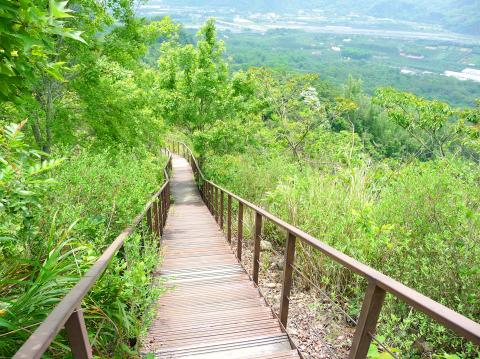
Photo: Steven Crook
I approached the area from the southwest by bicycle. Avoiding the busier roads in the center of Caotun, I joined Highway 14 where it points directly at the distinctively steep hills of Jioujiou Peaks. The Chinese toponym implies there are 99 peaks; there are certainly more pinnacles than I could count.
Highway 14 crosses the Wu River (烏溪), runs parallel with Freeway 6 for just under 2km on its northbank, then crosses back over to the southbank. Just east of Shuangdong Police Station (雙冬派出所), I found the turnoff to Shihjhuo Bridge (石灼橋). Crossing the river once again, I followed the signs for the Caotun Bike Trail Jioujiou Peaks Branch (草屯自行車道九九峰支線) and made my way north up a rough, steep and narrow road called Jhongsin Lane (中心巷).
There was a dry-as-dust creekbed to my left. To my right, some of the land was used to grow fruit. I stopped to examine a pile of sawdust-like matter dumped beside the road. When I spotted a few mushrooms mixed in with it, I realized that it was spent substrate from a mushroom farm, a concoction that usually includes rice bran, and which some farmers use to improve soil texture.
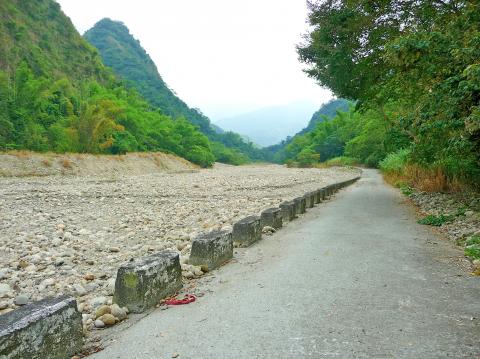
Photo: Steven Crook
Some 1.6km beyond Shihjhuo Bridge, I came to the signboard and another bridge. By crossing the bridge, was I entering the nature reserve? A sign said the biking route ended here, but there was no gate or barrier. I kept going on a concrete track that stayed very close to the creek, slowing often to avoid small rocks, distracted by the sheer number and variety of butterflies.
I felt immersed in nature. I couldn’t see another soul, and I couldn’t hear a single motor vehicle. But the garbage made me think I hadn’t yet reached the nature reserve — or, if I had, that it isn’t well maintained or policed. Later, when I was leaving, I took with me more than a dozen plastic bottles, plus several coffee cans.
After another 1.7km, the road began to climb away from the creek. I parked my bike and proceeded on foot. In darker corners of the forest, I found a variety of ferns and several fine specimens of Elephant Ear. According to a Forestry Bureau Web page, the canopy here includes longan and lychee trees, Trema orientalis (a relative of the hemp sometimes called the Indian charcoal-tree), Taiwan copperleaf (Acalypha angatensis) and bamboo.
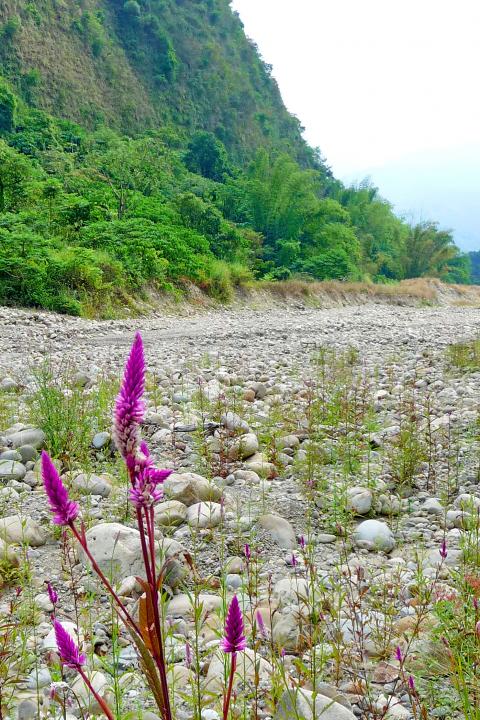
Photo: Steven Crook
AFTER DARK
If you were to explore the reserve at night, you might spot a Taiwan ferret badger (Melogale moschata subaurantiaca). Some years back, researchers were surprised to find here the goat-like Taiwan Serow (Capricornis swinhoei), which usually lives at higher altitudes and further from humanity. I didn’t see any Formosan rock macaques (Macaca cyclopis), but I heard them crashing through the canopy, and I saw their feces on the road.
I hiked as far as I could, which was less than a kilometer. Freewheeling back toward civilization, I stopped again at the signboard to see what else I could glean from it. In some respects, it’s very informative. The 921 Earthquake, which ravaged central Taiwan just over 20 years ago, shook loose layers of compacted gravel. When they slid, they dislodged topsoil and foliage. Overnight (the quake struck at 1:47am) the once-verdant Jioujiou Peaks became mostly bald.
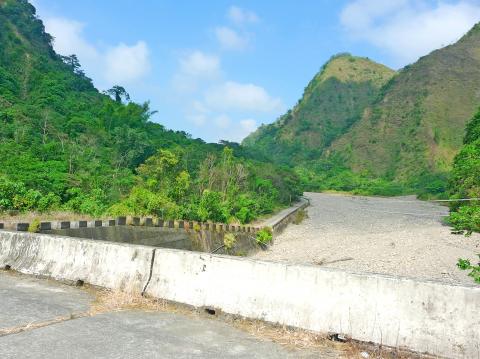
Photo: Steven Crook
Recognizing the distinctiveness of the landscape, and realizing that the environment wouldn’t recover unless it were protected, less than a year after the disaster the Council of Agriculture created this reserve. The highest point is 780m above sea level, the lowest is at 200m, and the entire reserve covers 1,198 hectares.
The authorities also created an official hiking trail, which I visited before the summer. This 1.93-km-long path begins near Pinglin Elementary School (平林國小), around 3km to the west of Shihjhuo Bridge as the crow flies; look for signs reading “99 Peaks Forest Trail” (九 九峰森林步道).
The 99 Peaks Forest Trail climbs from 280m above sea level to an elevation of 485m. I spent about two hours doing a full circuit, which gave me plenty of time to enjoy views toward the nature reserve and also over central Caotun. There’s a good amount of shade along the way, and enough steps to give your legs a proper work-out.
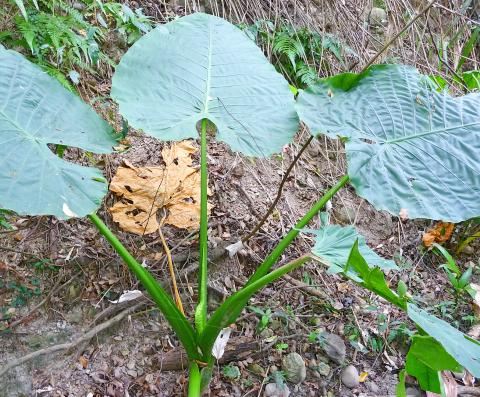
Photo: Steven Crook
Located between the trailhead and Highway 14, Yu-Hsiu Museum of Art (毓繡美術館) is sometimes worth a look. Even if the art isn’t your thing, you’ll appreciate the air-conditioning and clean bathrooms. For details of current and upcoming exhibitions, visit www.yu-hsiu.org.
Steven Crook has been writing about travel, culture, and business in Taiwan since 1996. He is the co-author of A Culinary History of Taipei: Beyond Pork and Ponlai, and author of Taiwan: The Bradt Travel Guide, the third edition of which has just been published.
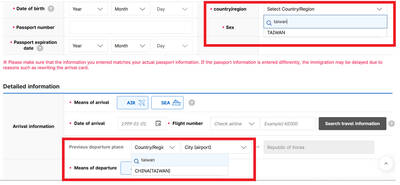
Jason Han says that the e-arrival card spat between South Korea and Taiwan shows that Seoul is signaling adherence to its “one-China” policy, while Taiwan’s response reflects a reciprocal approach. “Attempts to alter the diplomatic status quo often lead to tit-for-tat responses,” the analyst on international affairs tells the Taipei Times, adding that Taiwan may become more cautious in its dealings with South Korea going forward. Taipei has called on Seoul to correct its electronic entry system, which currently lists Taiwan as “China (Taiwan),” warning that reciprocal measures may follow if the wording is not changed before March 31. As of yesterday,

The Portuguese never established a presence on Taiwan, but they must have traded with the indigenous people because later traders reported that the locals referred to parts of deer using Portuguese words. What goods might the Portuguese have offered their indigenous trade partners? Among them must have been slaves, for the Portuguese dealt slaves across Asia. Though we often speak of “Portuguese” ships, imagining them as picturesque vessels manned by pointy-bearded Iberians, in Asia Portuguese shipping between local destinations was crewed by Asian seamen, with a handful of white or Eurasian officers. “Even the great carracks of 1,000-2,000 tons which plied
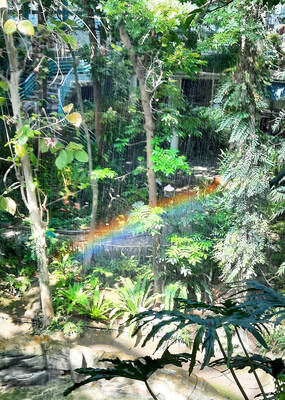
It’s only half the size of its more famous counterpart in Taipei, but the Botanical Garden of the National Museum of Nature Science (NMNS, 國立自然科學博物館植物園) is surely one of urban Taiwan’s most inviting green spaces. Covering 4.5 hectares immediately northeast of the government-run museum in Taichung’s North District (北區), the garden features more than 700 plant species, many of which are labeled in Chinese but not in English. Since its establishment in 1999, the site’s managers have done their best to replicate a number of native ecosystems, dividing the site into eight areas. The name of the Coral Atoll Zone might
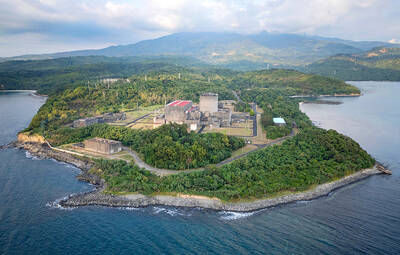
Nuclear power is getting a second look in Southeast Asia as countries prepare to meet surging energy demand as they vie for artificial intelligence-focused data centers. Several Southeast Asian nations are reviving mothballed nuclear plans and setting ambitious targets and nearly half of the region could, if they pursue those goals, have nuclear energy in the 2030s. Even countries without current plans have signaled their interest. Southeast Asia has never produced a single watt of nuclear energy, despite long-held atomic ambitions. But that may soon change as pressure mounts to reduce emissions that contribute to climate change, while meeting growing power needs. The


 RSS
RSS