


Vietnam may be one of the world’s fastest-growing economies, yet it’s still in the dark ages when it comes to joining the global trend toward cashless transactions. To understand why, look no further than to consumers like Tran Van Nhan, who recently bought his two-bedroom home in Hanoi with gold and a sack of cash.
“We paid almost half in gold bars and the rest in cash,” Nhan, a 47-year-old shopkeeper, said of his new US$138,000 condo. “We did that because we and the flat’s owner didn’t want to do a bank transfer. We are so used to buying things with cash and gold.”
Prime Minister Nguyen Xuan Phuc is trying to drag his citizens into the modern era of digital payments, reduce the amount of US dollars in circulation in the country and establish the dominance of the nation’s domestic currency, the Vietnamese dong. That also means introducing Vietnamese households to credit cards, bank transfers and digital payments rather than carrying around piles of cash and bullion for purchases.
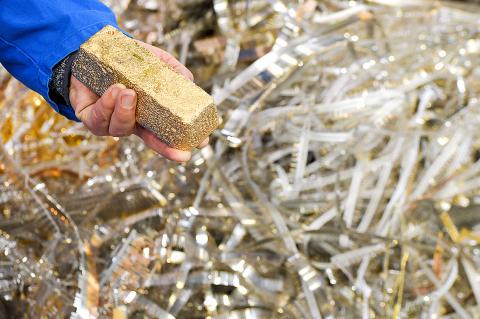
Photo: AFP
Behind the push is growing frustration among Vietnamese officialdom about the cost of printing banknotes and the need for more transparent payment records in order to crack down on tax evasion and money laundering, a growing problem as the US$237-billion economy continues to expand dramatically.
Officials have their work cut out for them: Just 31 percent of Vietnamese adults have bank accounts and more than 95 percent of payments are made with cash and gold, according to the government.
“It’s embedded in the culture,” said Hanoi-based economist Nguyen Tri Hieu, senior adviser to National Citizen Bank. “It’s holding Vietnam back. The government recognizes that to integrate Vietnam into the world economy, its cash-based economy has to change.”
The government has made modernizing the nation’s payments a top priority. The prime minister is directing banks to reduce cash transactions to less than 10 percent by the end of next year. E-commerce is being promoted at malls and supermarkets in major cities and the government wants at least 70 percent of Vietnamese aged 15 and older to have bank accounts.
An exasperated Phuc also ordered the central bank this year to convince more Vietnamese to use digital payment systems, such as QR codes. A new regulation in January mandated providers of public services — from hospitals to schools — to stop accepting cash by December.
South Korea, though, offers a cautionary tale of what can happen if a society pivots too quickly to mass adoption of credit cards. A credit binge in the early 2000s led to massive household debt. About one in 13 of South Korea’s 48 million people in 2004 were three months or more behind on debt payments, with two-thirds of them credit-card defaulters.
PAYMENTS REVOLUTION?
Unlike in China, home to the world’s biggest mobile payments market, most of Vietnam’s 97 million citizens rely on paper currency — and precious metals — to buy everything from groceries to automobiles. Shop owners make numerous trips to banks during the week, hauling sacks of Vietnam dong like Santas on motorbikes.
Vietnam would appear poised for a payment revolution. Its young population is tech savvy, with 70 percent using smartphones and having easy access to digital payment systems offered by local startups. Mercedes-Benz sedans tussle with Honda motorbikes on narrow streets in Hanoi and Ho Chi Minh City. Building cranes fill urban skies as luxury towers and high-rise office buildings rise up from congested streets. It has a fast-growing middle class sending children abroad for school in an economy with newly minted millionaires and billionaires.
Amazon.com, Alibaba and other global e-commerce companies have set up operations in Vietnam, where revenue from e-commerce swelled to US$8 billion last year, doubling from three years ago as about a third of the population shops online, according the trade ministry. Yet, most digital purchases are paid with cash.
Many Vietnamese, who remember double-digit inflation at its peak of 28.3 percent in August 2008, still like to keep their savings in greenbacks and gold stored in home safes. Vietnamese hold an estimated 400 tons of gold, economist Hieu said. “People are still hoarding gold,” he said. “I have friends with gold at home.”
Meanwhile, just 4.1 percent of Vietnamese own credit cards, according to Standard Chartered Plc. “About 80 percent of my clients pay cash and I also feel more comfortable taking cash than credit card payments,” said Nguyen Thu Huong, 44, who operates a clothes shop in Ho Chi Minh City’s central financial district. Her credit card reader was covered in dust. “The government has been trying to get people to use more credit cards, but frankly I think it’s still a long way to go before a lot of people use them.”
Vietnam’s inability to pivot to a modern payment system is holding the economy back. It’s virtually impossible for many small and medium-sized enterprises to get loans because financial institutions frequently have no way to verify revenue, Hieu said.
“They have cash books they show to the tax authority but there is no way for a bank to confirm if they are accurate,” he said.
ECONOMIC REFORMS
The predicament reflects how the culture began its transformation to a capitalist society just a few decades ago with the doi moi reforms launched by the politburo that opened the Communist country to a market-oriented economy. The nation’s rapid growth — the government expects gross domestic product to expand at least 6.8 percent this year — is outpacing its ability to modernize the economy.
Authorities have yet to put in place the regulatory framework needed for wide use of mobile payments or the establishment of agents that can represent banks in rural areas that lack banking services, said Alwaleed Alatabani, the World Bank’s head finance specialist in Vietnam.
“It’s not easy to change,” said Tran Thi Le, a 35-year-old Ho Chi Minh City secretary who keeps gold and foreign currencies in a home safe. “Keeping money in gold or strong foreign currencies, like US dollars or euros, is a long-standing habit for most Vietnamese people.”
Indeed, Hanoi shop owner Nhan and his wife set aside money to buy gold bars.
“I want to save gold so that we can use it in the future for our retirement,” he said. “We feel safer with gold.”
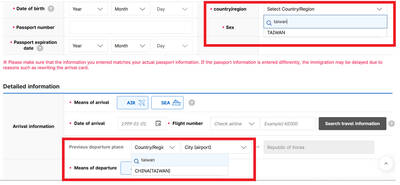
Jason Han says that the e-arrival card spat between South Korea and Taiwan shows that Seoul is signaling adherence to its “one-China” policy, while Taiwan’s response reflects a reciprocal approach. “Attempts to alter the diplomatic status quo often lead to tit-for-tat responses,” the analyst on international affairs tells the Taipei Times, adding that Taiwan may become more cautious in its dealings with South Korea going forward. Taipei has called on Seoul to correct its electronic entry system, which currently lists Taiwan as “China (Taiwan),” warning that reciprocal measures may follow if the wording is not changed before March 31. As of yesterday,

The Portuguese never established a presence on Taiwan, but they must have traded with the indigenous people because later traders reported that the locals referred to parts of deer using Portuguese words. What goods might the Portuguese have offered their indigenous trade partners? Among them must have been slaves, for the Portuguese dealt slaves across Asia. Though we often speak of “Portuguese” ships, imagining them as picturesque vessels manned by pointy-bearded Iberians, in Asia Portuguese shipping between local destinations was crewed by Asian seamen, with a handful of white or Eurasian officers. “Even the great carracks of 1,000-2,000 tons which plied

It’s only half the size of its more famous counterpart in Taipei, but the Botanical Garden of the National Museum of Nature Science (NMNS, 國立自然科學博物館植物園) is surely one of urban Taiwan’s most inviting green spaces. Covering 4.5 hectares immediately northeast of the government-run museum in Taichung’s North District (北區), the garden features more than 700 plant species, many of which are labeled in Chinese but not in English. Since its establishment in 1999, the site’s managers have done their best to replicate a number of native ecosystems, dividing the site into eight areas. The name of the Coral Atoll Zone might
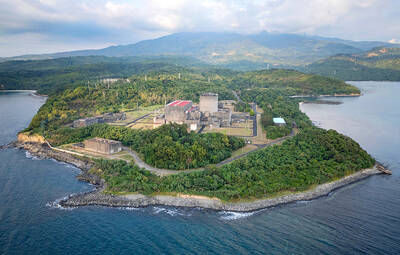
Nuclear power is getting a second look in Southeast Asia as countries prepare to meet surging energy demand as they vie for artificial intelligence-focused data centers. Several Southeast Asian nations are reviving mothballed nuclear plans and setting ambitious targets and nearly half of the region could, if they pursue those goals, have nuclear energy in the 2030s. Even countries without current plans have signaled their interest. Southeast Asia has never produced a single watt of nuclear energy, despite long-held atomic ambitions. But that may soon change as pressure mounts to reduce emissions that contribute to climate change, while meeting growing power needs. The


 RSS
RSS