


Tales from the shadowy edges of modern Chinese society aim to turn heads at the Cannes film festival, showing the growing scope and sophistication of the world’s second-largest movie market.
The crime thriller The Wild Goose Lake, directed by Diao Yinan- (刁亦男), is going head-to-head with the likes of Quentin Tarantino’s highly anticipated Once Upon a Time in Hollywood for the festival’s top prize, the Palme D’Or.
Similar gritty themes are expected to be explored in director Zu Fen’s (祖峰) Summer of Changsha, which is competing in the more edgy Un Certain Regard section.
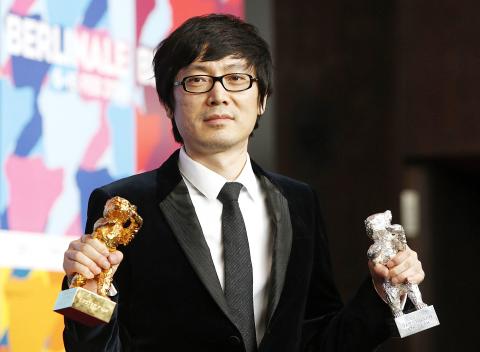
Photo: AFP
Both films are part of a growing “mainland noir” film movement that is expanding the boundaries of a Chinese film industry strictly controlled by government censorship over topics such as violence, corruption and sex.
Shot and situated far from the gleaming lights of modern China’s metropolises, these films feature haunted anti-heroes dwelling on the edges of society.
The box office success of 2017’s critically lauded Looming Storm — about one man’s hunt for a serial killer stalking a small town — showed that previously taboo subjects are increasingly tolerated by China’s National Film Administration.

Photo: AFP
Diao’s last crime thriller Black Coal, Thin Ice picked up the Golden Bear top prize at the Berlin Film Festival in 2014 with its gripping tale of a wronged policemen looking for redemption.
It was also a global box office ground-breaker for low-budget Chinese films, collecting around US$17 million after successful domestic and limited international runs.
“These are exciting times,” said Alexandre Mallet-Guy, producer of The Wild Goose Lake. “Our film is noir, with a very complex plot and it is very stylish.”
CRIME AND CORRUPTION
Diao is currently locked away in an editing suite in Beijing working on a final cut of his new production, made with the support of companies in both China and France.
“It’s even more stylish than Black Coal Thin Ice,” said its Paris-based producer Mallet-Guy. “He is very influenced by noir. Most of the films from China that go international are genre films, actioners and those with big budgets. But hopefully we are seeing a new generation and a new style of film.”
Over the past two decades the Chinese film market has gone from being very humble beginnings to one that produces around 600 movies a year with box office receipts now topping US$8.5 billion — second only to the North American market’s US$11.4 billion.
Chinese audiences have previously flocked to a string of locally produced blockbusters such as the bombastic military themed Wolf Warrior 2 (2017), which became China’s biggest-grossing locally made film with takings of an estimated US$870 million.
But tastes appear to be changing.
Last year saw the surprise phenomenal success of Wen Muye’s (文牧野) Dying to Survive, which focused on the illicit trade for cancer drugs, and made an estimated US$450 million for its investors.
At the same time, China’s arthouse scene has been hotting up.
International festival heavyweight Marco Muller was among the first to introduce Chinese cinema to the world through his work with the Venice and Rotterdam festivals. Since 2017 the Italian has hooked up with leading Chinese director Jia Zhangke (賈樟柯) to put together the annual Pingyao Crouching Tiger Hidden Dragon International Film Festival.
Jia’s last film Ash is Purest White, which featured his long-time partner Zhao Tao (趙濤), was in competition at Cannes last year, and also played with themes of crime and corruption.
ZHANG FILM PULLED
“Those are the films that sell well internationally,” said Muller. “They are edgy, dark and exciting. They still have to be approved by the various departments of government but it seems that more and more filmmakers are looking into noir.”
Like American “film noir,” which first emerged in the 1920s and enjoyed its heyday in the 1940s and 1950s when movies’ moral fiber was strictly controlled by the notorious Production Code, its Chinese variant centers on stories around crime set mostly in the shadowy fringes of society.
China recently introduced regulations that require filmmakers to be handed a “dragon seal” of approval before films are permitted to screen at festivals. But the production team behind The Wild Goose Lake say they have been given the all clear. Less is known about Zu’s production, although the film has reportedly been officially passed to screen.
However, Chinese officials are capable of last-minute interventions — and fame is no protection.
Zhang Yimou (張藝謀), the maker of Raise the Red Lantern, and one of the country best known auteurs, had to pull his latest movie, One Second, from Berlin in February on government orders on the eve of the festival.
Another Chinese movie Better Days that had been scheduled for a screening, did not get shown because it failed to get the go-ahead in time from Beijing’s censors.
May 11 to May 17 Traversing the southern slopes of the Yushan Range in 1931, Japanese naturalist Tadao Kano knew he was approaching the last swath of Taiwan still beyond colonial control. The “vast, unknown territory,” protected by the “fierce” Bunun headman Dahu Ali, was “filled with an utterly endless jungle that choked the mountains and valleys,” Kano wrote. He noted how the group had “refused to submit to the measures of our authorities and entrenched themselves deep in these mountains … living a free existence spent chasing deer in the morning and seeking serow in the evening,” even describing them as

As a different column was being written, the big news dropped that Chinese Nationalist Party (KMT) caucus whip Fu Kun-chi (傅?萁) announced that negotiations within his caucus, with legislative speaker Han Kuo-yu (韓國瑜) of the KMT, party Chair Cheng Li-wun (鄭麗文), Taichung Mayor Lu Shiow-yen (盧秀燕) and Taiwan People’s Party (TPP) Chair Huang Kuo-chang (黃國昌) had produced a compromise special military budget proposal. On Thursday morning, prior to meeting with Cheng over a lunch of beef noodles, Lu reiterated her support for a budget of NT$800 or NT$900 billion — but refused to comment after the meeting. Right after Fu’s

Yesterday, the Democratic Progressive Party (DPP) nominated legislator Puma Shen (沈伯洋) as their Taipei mayoral candidate, the Chinese Nationalist Party (KMT) put their stamp of approval on Wei Ping-cheng (魏平政) as their candidate for Changhua County commissioner and former legislator Tsai Pi-ru (蔡壁如) of the Taiwan People’s Party (TPP) has begun the process to also run in Changhua, though she has not yet been formally nominated. All three news items are bizarre. The DPP has struggled with settling on a Taipei nominee. The only candidate who declared interest was Enoch Wu (吳怡農), but the party seemed determined to nominate anyone
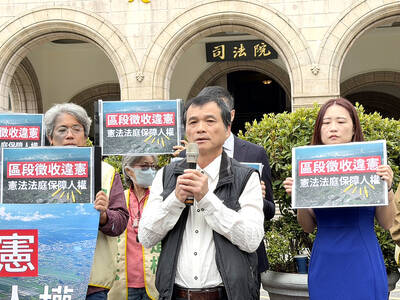
What government project has expropriated the most land in Taiwan? According to local media reports, it is the Taoyuan Aerotropolis, eating 2,500 hectares of land in its first phase, with more to come. Forty thousand people are expected to be displaced by the project. Naturally that enormous land grab is generating powerful pushback. Last week Chen Chien-ho (陳健和), a local resident of Jhuwei Borough (竹圍) in Taoyuan City’s Dayuan District (大園) filed a petition for constitutional review of the project after losing his case at the Taipei Administrative Court. The Administrative Court found in favor of nine other local landowners, but


 RSS
RSS