


After traveling the world for more than two decades seeking to improve access to bathrooms, “Mr Toilet” Jack Sim has now plunged into the cinematic world with a film about his unusual campaign.
Armed with humor — and sometimes a plunger — the World Toilet Organization’s founder is the subject of a film, Mr. Toilet: The World’s #2 Man, which premiered over the weekend, as health campaigners warn billions are still at risk of disease due to toilet shortages.
“Toilet is my religion and we create a belief system that everybody subscribes to,” the 62-year-old Singaporean said.
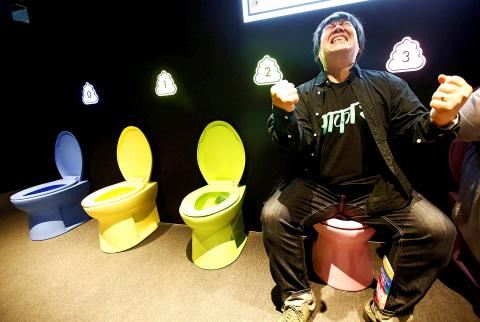
Photo: Reuters/Kim Kyung-hoon
“We have to make toilets sexy. If governments understand how much money they are already spending (on public healthcare) without having toilets, there is no reason for them not to build toilets,” he added.
Sim’s work has stretched from Asia to Africa and was the inspiration behind the UN’s 2013 declaration of a “World Toilet Day,” in a push to break taboos around toilets.
The UN day is marked on Nov. 19 each year — the same date Sim set up his group in 2001 to lobby governments around the world to change their policies and make sanitation accessible for all.
The Singapore-headquartered group builds toilets in places like China and trains local entrepreneurs in India as well as Cambodia to develop affordable latrines in remote villages.
From India to China and Africa, 60 percent of the world’s population — or 4.5 billion people — either have no toilet at home or one that does not safely manage human waste, the UN said.
Some 900 million people still practice open defecation, risking disease, and causing tens of thousands of diarrhea-related deaths and cases of chronic malnutrition each year, according to the group.
The UN warned last year that the world is not on track to end open defecation and ensure access to safe toilets for all by 2030, as pledged by countries.
Sim said he hopes his new film will help turn the tide.
CULTURAL TRANSFORMATION
Shot in four countries over five years, the 86-minute film was screened at the Hot Docs Canadian International Documentary Festival in Toronto on Saturday.
“The intention of the film is to use both humor and a heartfelt story to draw attention to a subject people normally wouldn’t care about,” said Los Angeles-based director Lily Zepeda.
“Many people are unaware of how disproportionately a lack of sanitation affects women and girls around the world,” she added.
Women and girls are at risk of sexual attack when they go out in the fields to relieve themselves, while adolescent girls are often forced to miss classes when they are on their periods if there are no proper toilets, UK-based charity WaterAid said.
The World Bank in 2017 warned countries they needed to quadruple spending to US$150 billion a year to deliver universal safe water and sanitation.
Sim’s effort is not the first time a film has been made about toilets.
In India, a Bollywood movie, Toilet: A Love Story, was released in 2017 as an attempt to bring the issue into the mainstream.
The lack of access to sanitation remains a major problem in the South Asian giant and Prime Minister Narendra Modi’s government has been pushing a campaign to build 100 million toilets, although the drive has not covered large parts of the country.
“Our pace of work is definitely much slower than the need,” said Deepmala Mahla, the Asia director for humanitarian agency CARE International, which campaigns on sanitation issues.
“We can only be on the right track fully when we don’t look at the (toilet) issue in isolation. Our sanitation work needs to be more responsive to the need of women and girls,” she said.
Sim struck a more optimistic note.
As the world’s two most populous nations, China and India, step up efforts to improve access to toilets, he believes the world will achieve the 2030 UN target on ending open defecation but he warned building bathrooms alone is not enough.
The key, he said, is to turn the poop culture into “pop culture.”
“The cultural transformation must come in because we can build the toilet, but if people don’t use it there is no use,” he said.
“We have to turn toilets into a fashion, a social status.”
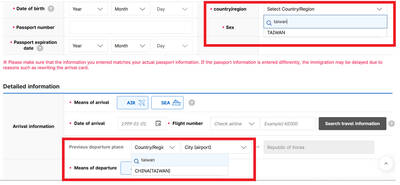
Jason Han says that the e-arrival card spat between South Korea and Taiwan shows that Seoul is signaling adherence to its “one-China” policy, while Taiwan’s response reflects a reciprocal approach. “Attempts to alter the diplomatic status quo often lead to tit-for-tat responses,” the analyst on international affairs tells the Taipei Times, adding that Taiwan may become more cautious in its dealings with South Korea going forward. Taipei has called on Seoul to correct its electronic entry system, which currently lists Taiwan as “China (Taiwan),” warning that reciprocal measures may follow if the wording is not changed before March 31. As of yesterday,

The Portuguese never established a presence on Taiwan, but they must have traded with the indigenous people because later traders reported that the locals referred to parts of deer using Portuguese words. What goods might the Portuguese have offered their indigenous trade partners? Among them must have been slaves, for the Portuguese dealt slaves across Asia. Though we often speak of “Portuguese” ships, imagining them as picturesque vessels manned by pointy-bearded Iberians, in Asia Portuguese shipping between local destinations was crewed by Asian seamen, with a handful of white or Eurasian officers. “Even the great carracks of 1,000-2,000 tons which plied

It’s only half the size of its more famous counterpart in Taipei, but the Botanical Garden of the National Museum of Nature Science (NMNS, 國立自然科學博物館植物園) is surely one of urban Taiwan’s most inviting green spaces. Covering 4.5 hectares immediately northeast of the government-run museum in Taichung’s North District (北區), the garden features more than 700 plant species, many of which are labeled in Chinese but not in English. Since its establishment in 1999, the site’s managers have done their best to replicate a number of native ecosystems, dividing the site into eight areas. The name of the Coral Atoll Zone might
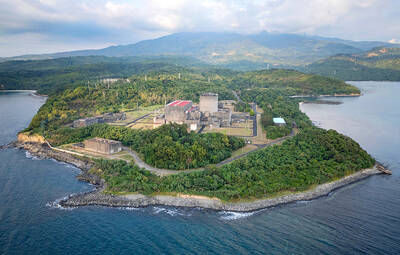
Nuclear power is getting a second look in Southeast Asia as countries prepare to meet surging energy demand as they vie for artificial intelligence-focused data centers. Several Southeast Asian nations are reviving mothballed nuclear plans and setting ambitious targets and nearly half of the region could, if they pursue those goals, have nuclear energy in the 2030s. Even countries without current plans have signaled their interest. Southeast Asia has never produced a single watt of nuclear energy, despite long-held atomic ambitions. But that may soon change as pressure mounts to reduce emissions that contribute to climate change, while meeting growing power needs. The


 RSS
RSS