


Five hundred years after the death of Leonardo da Vinci, a silk mill incorporating one of his designs is still shuttling some of the finest threads in the world across its looms.
Tucked away in the historic San Frediano neighborhood in Florence, L’Antico Setificio Fiorentino was founded in 1786 and is one of the oldest silk workshops in Europe.
Its looms date back to the 17th, 18th and 19th centuries, but the jewel at its heart is a machine to unwind the reels of threads, designed by Renaissance genius Da Vinci, who died in 1519.
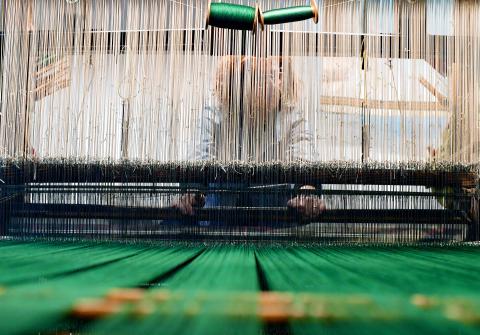
Photo: AFP
“It is a warping machine made in the late 17th century according to the maestro’s original design, and we still make passementerie (tassels, cords, trimmings) today” using it, silk worker Beatrice Fazzini said.
The polymath’s device is used to prepare the threads before they are placed on the loom, following a technique that has been closely guarded down the centuries.
Golden chenille, damask and taffeta with floral or geometric motifs are among the fabrics made here and sold for between 200 euros (US$226) and 1,500 euros (US$1,700) per meter.
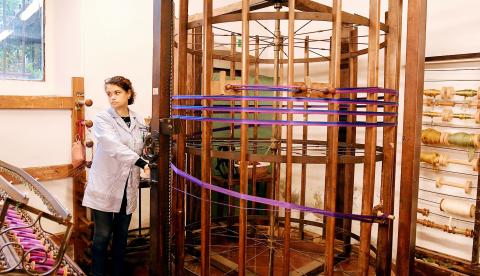
Photo: AFP
The workshop, which since 2010 has belonged to the family of Italian fashion designer Stefano Ricci, manufactures fabrics, lace and ribbons in styles and colors favored by the historic House of Medici, an Italian banking family and political dynasty. It was during the Medici’s rise to power that silk manufacturing enjoyed a boom along the banks of the Arno River.
MUSTARD YELLOW, PETROL BLUE
Fabrics produced by L’Antico Setificio Fiorentino can be found in places of grandeur both home and abroad, from Italy’s palaces and the famous Uffizi Galleries in Florence, to the royal residence in Denmark and the Kremlin in Russia.
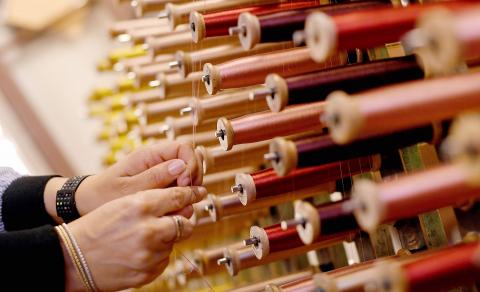
Photo: AFP
Pope Francis and opera singers Maria Callas and Andrea Bocelli have also worn garments created on its aged looms. “It’s a museum that is also a factory,” said Briza Datti, interior designer and head of the commercial sector.
The hand looms move to the weaver’s rhythm and bear “the imprint of the family to which they belonged in the past,” she says.
The designs and fabrics produced down the ages are preserved in the workshop’s historical archives, which can be visited by school children or tourists.
The 15 or so artisans that spend their days teasing threads say it is a privilege to produce precious fabrics in silk, linen and cotton once used by kings and emperors.
“I’m lucky to work here, surrounded by centuries-old looms, but it doesn’t feel like a museum, just a special environment,” says Simona Polimeni, who trained at the school of weaving and restoration in the Tuscan capital. “Each fabric must be woven by the same person. The rhythm must always be the same, or you risk imperfections,” the 26-year old says, as she crosses the warp and weft threads in an echo of age-old gestures.
No fewer than eight hours of work are needed to produce two metres of this fabric, worthy of the court of 15th century Italian statesman Lorenzo the Magnificent himself.
On one of the looms, 50-year old Silvana expertly shuttles shimmering colours, from mustard yellow to fuchsia and petrol blue.
The Brazilian, who came to Italy 30 years ago to work in the world-renowned textile industry in Tuscany, said she is proud to have such “a very creative job, in such an area of excellence.”
If one asks Taiwanese why house prices are so high or why the nation is so built up or why certain policies cannot be carried out, one common answer is that “Taiwan is too small.” This is actually true, though not in the way people think. The National Property Administration (NPA), responsible for tracking and managing the government’s real estate assets, maintains statistics on how much land the government owns. As of the end of last year, land for official use constituted 293,655 hectares, for public use 1,732,513 hectares, for non-public use 216,972 hectares and for state enterprises 34 hectares, yielding

The small platform at Duoliang Train Station in Taitung County’s Taimali Township (太麻里) served villagers from 1992 to 2006, but was eventually shut down due to lack of use. Just 10 years later, the abandoned train station had become widely known as the most beautiful station in Taiwan, and visitors were so frequent that the village had to start restricting traffic. Nowadays, Duoliang Village (多良) is known as a bit of a tourist trap, with a mandatory, albeit modest, admission fee of NT$10 giving access to a crowded lane of vendors with a mediocre view of the ocean and the trains

For many people, Bilingual Nation 2030 begins and ends in the classroom. Since the policy was launched in 2018, the debate has centered on students, teachers and the pressure placed on schools. Yet the policy was never solely about English education. The government’s official plan also calls for bilingualization in Taiwan’s government services, laws and regulations, and living environment. The goal is to make Taiwan more inclusive and accessible to international enterprises and talent and better prepared for global economic and trade conditions. After eight years, that grand vision is due for a pulse check. RULES THAT CAN BE READ For Harper Chen (陳虹宇), an adviser

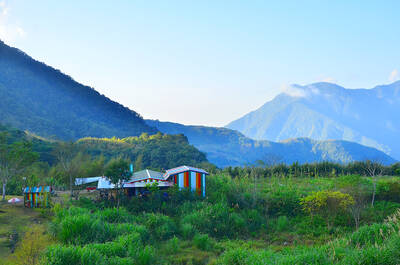
Traditionally, indigenous people in Taiwan’s mountains practice swidden cultivation, or “slash and burn” agriculture, a practice common in human history. According to a 2016 research article in the International Journal of Environmental Sustainability, among the Atayal people, this began with a search for suitable forested slopeland. The trees are burnt for fertilizer and the land cleared of stones. The stones and wood are then piled up to make fences, while both dead and standing trees are retained on the plot. The fences are used to grow climbing crops like squash and beans. The plot itself supports farming for three years.


 RSS
RSS